
Heavy headphones are not automatically better headphones. Extra mass can come from large driver assemblies, metal hardware, wood earcups, thick pads, or reinforced headbands, but sound quality still depends on the complete acoustic design. The real question is whether the added weight works for your listening setup and remains comfortable for the length of time you actually wear it.
Quick answer: There is no universal industry cutoff that makes a headphone “heavy.” For this guide, roughly 400 g and above is a practical comparison range for full-size over-ear models, not an official standard.
Heavy models make the most sense for stationary listening when you can prioritize driver design, build, and fit over portability. Test comfort carefully, and judge amplifier needs from impedance, sensitivity, and manufacturer guidance—not from weight alone.
Why some headphones are heavy
Headphone weight comes from the sum of the driver system, earcup structure, headband, yokes, pads, connectors, and any electronics or batteries. Two headphones can weigh the same for completely different reasons.
- Planar magnetic assemblies: large diaphragms and magnet arrays can add mass, although planar designs vary widely in weight and efficiency.
- Metal and wood parts: aluminum, steel, magnesium, or hardwood may be used for structure, appearance, or enclosure design. Material choice alone does not prove better sound or longer life.
- Large earcups and thick pads: deep pads and large circumaural cups add material while changing fit, seal, and comfort.
- Suspension systems: straps and wide headbands can add a little weight while distributing the total load across a larger area.

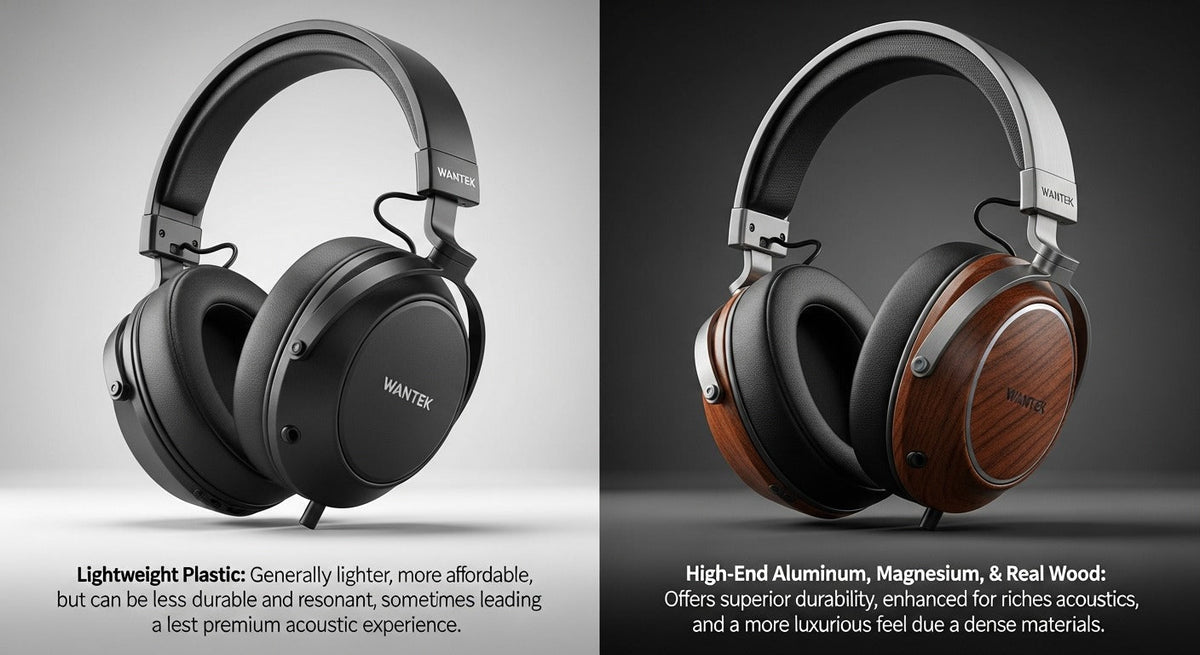
The image above is illustrative. Plastic, metal, magnesium, or wood can all be used successfully; material names by themselves do not establish durability or acoustic performance.
Pros and cons of heavy headphones

This cutaway is a conceptual illustration, not a diagram of a specific commercial model. Actual internal construction varies by headphone.
Potential advantages
- More design freedom for large assemblies: manufacturers can use substantial magnet structures, reinforced frames, large cups, or dense materials when the design calls for them.
- Stable desktop use: a substantial full-size headphone may feel secure when used at a desk, mixing position, or dedicated listening chair.
- Comfort can still be excellent: a wide headband, suspension strap, suitable clamp, and well-shaped pads can distribute a high total weight effectively.
Potential disadvantages
- Long-session comfort becomes more sensitive to fit: crown pressure, jaw pressure, pad heat, and poor weight distribution can become noticeable sooner as total mass rises.
- Portability usually gets worse: heavy full-size headphones and their cases take more room and are less convenient for commuting, walking, or frequent packing.
- Head movement can matter more: a high-mass earcup can shift or create leverage if the headband fit is loose.
- Weight does not guarantee value: paying for premium materials or complex construction does not automatically produce the sound signature, comfort, or durability you prefer.
Five heavy headphones worth comparing
The models below are not ranked. They are useful reference points because their manufacturers publish current weight and driver specifications, making the trade-offs easier to compare.
| Model | Approx. Weight | Driver Type | Key Characteristics & Target User |
|---|---|---|---|
| Audeze LCD-X | 612 g | Planar magnetic | Open-back studio and desktop model. Audeze lists 20-ohm impedance, 103 dB/1mW sensitivity, and a suspension headband for weight distribution. |
| Focal Utopia | 490 g | 40 mm pure-beryllium dynamic | Open-back flagship for stationary high-end listening. Focal lists 80-ohm impedance and a 490 g total weight. |
| HIFIMAN HE1000 Stealth | 458 g | Planar magnetic | Open-back planar model for home or desktop listening. HIFIMAN lists 32-ohm impedance, 93 dB sensitivity, and a published weight of 458 g. |
| ZMF Atrium Closed | 490 g ± 30 g | Biocellulose dynamic | Closed-back model for listeners who want a full-size high-end design with less acoustic leakage than an open-back headphone. ZMF lists 300-ohm impedance. |
| Meze Audio Elite Tungsten | 433 g | Rinaro Isodynamic Hybrid Array | Open-back planar model with pressure-distribution wings. Meze lists 32-ohm impedance and 101 dB SPL/mW sensitivity. |
Do heavier headphones sound better?
No. Weight is a physical property, not a sound-quality metric. A heavy chassis can support a particular driver or mechanical design, but frequency response, distortion, damping, enclosure behavior, pad geometry, fit, and tuning determine much more of what you hear.
The reverse is also true: reducing mass does not automatically improve comfort or sound. A lighter model with concentrated headband pressure or excessive clamp can be less comfortable than a heavier model with better distribution.
Do heavy headphones need a headphone amp?
Not because they are heavy. Amplifier requirements are model-specific. For example, Audeze lists the 612 g LCD-X at 20 ohms and 103 dB/1mW and describes it as efficient enough for many headphone outputs, while ZMF lists the Atrium Closed at 300 ohms. Those electrical specifications—not gram weight—are the relevant starting point.
Before buying an amplifier, check the manufacturer’s impedance, sensitivity, recommended power, connector requirements, and the output capability of your source device.
How to test comfort before buying
A short try-on can miss problems that appear later. If possible, test the headphone for a normal listening session and pay attention to where the load is carried.
- Check crown pressure. The headband should spread weight rather than concentrate it on one small point.
- Check clamp and jaw pressure. The earcups should stay stable without creating uncomfortable side pressure.
- Check pad dimensions. Your ears should fit inside the opening without rubbing the driver cover or pad edge.
- Move your head. Look up, down, and side to side to see whether the earcups shift or pull.
- Test with glasses if you wear them. Frames can change pressure and the earpad seal.
- Match the design to the room. Open-back headphones leak sound and admit outside noise; closed-back designs isolate more, but may feel warmer.
If weight is only one part of your decision, use our headphone buying framework to compare form factor, sound, comfort, connection, and noise control together.
Who should consider heavy headphones?
Heavy over-ear headphones are easiest to justify when most listening happens at a desk, studio, or dedicated chair and you are willing to trade portability for a particular acoustic or mechanical design. They can also make sense when a preferred model simply happens to be heavy and fits you well.
They are less convenient when you commute daily, exercise, pack light, wear headphones through an entire workday, or already know that crown or neck fatigue limits your listening time. In those cases, a lighter design may be the more practical choice even if the heavier model is technically impressive.
Frequently Asked Questions
What weight is considered heavy for headphones?
There is no official industry cutoff. For this guide, about 400 g and above is a useful comparison range for full-size over-ear headphones, but fit and weight distribution matter more than a single number.
Are heavy headphones always better sounding?
No. Weight may reflect driver architecture or materials, but it does not predict tuning, distortion, imaging, bass quality, or overall preference. Compare acoustic performance separately from chassis weight.
Can heavy headphones work for gaming?
Yes, especially for stationary play, but comfort matters during long sessions. Also check microphone needs, cable length, console compatibility, imaging, and whether the open- or closed-back design suits your room.
Do heavy headphones require a special amplifier?
No. Amplifier requirements depend on impedance, sensitivity, recommended power, and source output. Some very heavy headphones are relatively easy to drive, while lighter high-impedance models may benefit from dedicated amplification.
How should I compare comfort between two heavy headphones?
Wear each for a normal session and compare crown pressure, clamp, pad heat, ear clearance, stability, and glasses interference. Total grams matter, but the distribution of that weight often changes the experience.

