
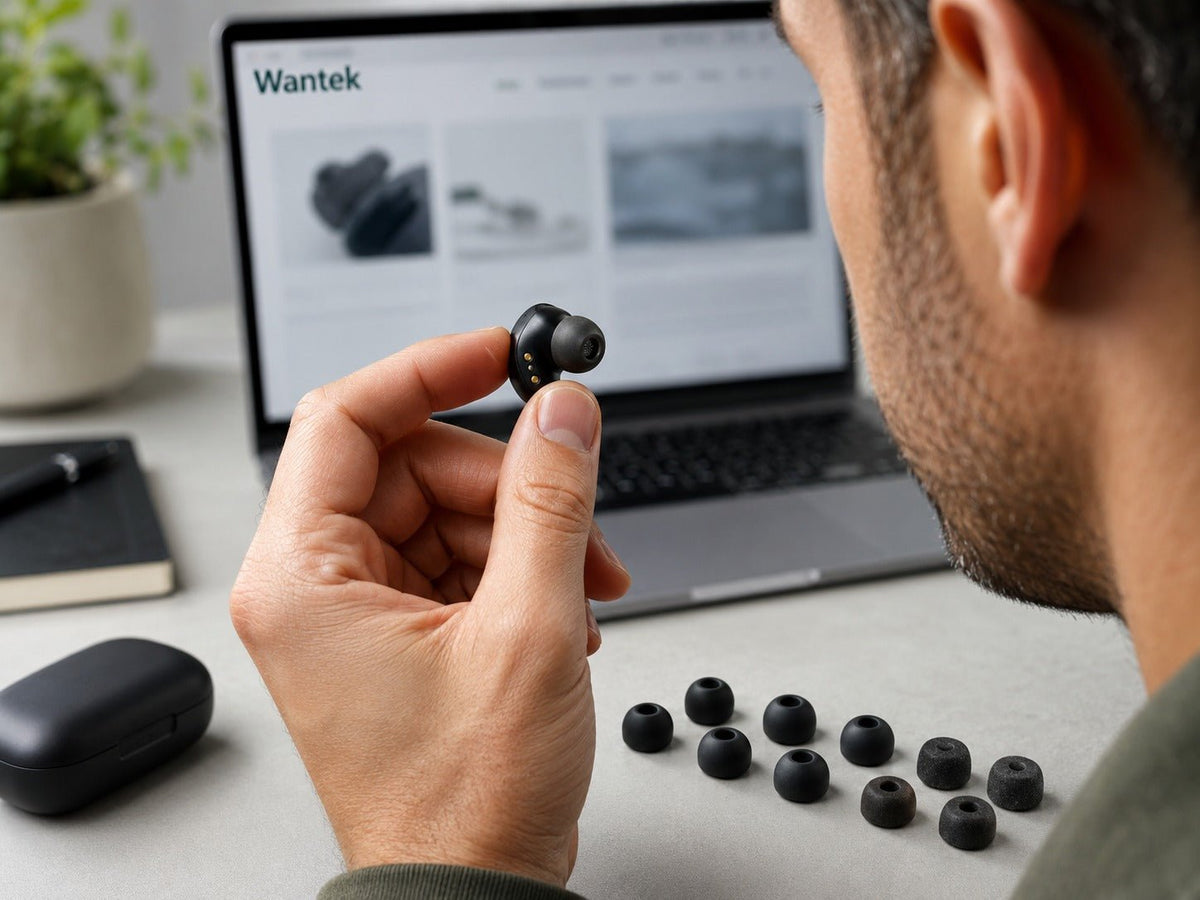
Choosing hypoallergenic earbuds for sensitive ears is less about trusting a label and more about understanding what actually touches your skin. Exposed metal, adhesives, ear-tip materials, trapped moisture, friction, pressure, and cleaning products can all matter. A practical buying process starts by identifying the likely trigger, checking manufacturer material disclosures, and choosing a fit you can adjust.
Quick answer: No earbud is guaranteed to be allergy-free for everyone. If you have sensitive ears, prioritize clear material information, replaceable contact parts, multiple fit options, and cleaning instructions that match the exact product. If in-ear pressure or moisture is the main problem, an open-ear design may be a better form factor to evaluate.
Why Earbuds Can Irritate Sensitive Ears
Itching, redness, swelling, scaling, or soreness after earbud use can have more than one cause. Allergic contact dermatitis is a delayed immune reaction to a specific substance, while irritant contact dermatitis can result from friction, moisture, pressure, or repeated exposure to irritating residues. Similar symptoms can also occur when several factors overlap.
The useful question is not simply “Are these earbuds hypoallergenic?” It is “What materials contact my skin, how long do they stay there, and what changes when I switch the fit, tip, cleaning method, or wearing style?”
Common Materials and Triggers to Check
Nickel and Other Metals
Nickel is a well-established contact allergen. For earbuds, the practical concern is whether a nickel-containing metal is present at a skin-contact surface and whether wear, sweat, or corrosion can increase exposure. Cobalt and chromium can also cause contact allergy in sensitized people, so broad labels such as “stainless steel” or “surgical steel” are not enough to prove a particular earbud is suitable for a specific allergy.
Acrylates, Methacrylates, and Adhesives
Acrylates and methacrylates are used in many adhesive and polymer systems. Some people develop contact allergy to specific compounds in these families. Apple’s current wearable-material guidance, for example, states that AirPods and related products contain trace acrylates and methacrylates from adhesives and that their stainless-steel acoustic mesh contains some nickel. That type of product-specific disclosure is more useful than a generic “skin-friendly” claim.
Rubber Additives and Rosin
Thiurams, carbamates, mercapto compounds, and related rubber chemicals are recognized contact allergens. Rosin or colophony derivatives can also trigger allergic contact dermatitis in susceptible users. Their presence should not be assumed in a particular ear tip or adhesive without product-specific evidence.

What “Hypoallergenic” Does — and Does Not — Tell You
“Hypoallergenic” should be treated as a screening term, not a guarantee. The U.S. Food and Drug Administration says there are no federal standards or definitions governing the term “hypoallergenic” for cosmetics. That rule is about cosmetics, not earbuds, but the buyer lesson transfers: the word itself is weaker evidence than a clear material disclosure or product-specific test.
Material transparency matters more than a reassuring label. Look for the exact skin-contact materials, coatings, adhesives, and replaceable parts rather than assuming a product is safe because it is marketed for sensitive skin.
Titanium and Stainless Steel
Certain titanium alloys and tightly controlled stainless steels are widely used in medical applications, but that does not make every titanium- or steel-containing consumer product allergy-proof. Surface finish, coatings, composition, wear, corrosion, and actual skin contact still matter.
Silicone
Silicone ear tips are common because they are flexible, washable in many designs, and available in multiple sizes. A “medical-grade” claim is meaningful only when the maker identifies the formulation or supporting evaluation. ISO 10993-1:2025 describes biological-safety evaluation for medical devices within a risk-management process; it is not a universal certification that makes a consumer earbud or silicone formulation non-allergenic.
Memory Foam and Other Elastomers
Polyurethane memory foam can improve conformity and seal, but formulations differ and cleaning instructions are material-specific. Thermoplastic elastomers and specialty silicones also vary in additives and surface chemistry. For sensitive ears, the material family name alone is rarely enough information.

Earbuds to Evaluate for Sensitive Ears
There is no universal “safest” earbud for every allergy. A more useful comparison asks what the manufacturer actually discloses, which parts touch the skin, whether those parts are replaceable, and how much fit flexibility the design provides.
| Model | What the maker discloses | Why it may matter | Important limitation |
|---|---|---|---|
| Apple AirPods Pro family | Apple lists plastic housing, silicone or silicone-foam tips, stainless-steel acoustic mesh, some nickel in the mesh, and trace acrylates/methacrylates from adhesives. | Unusually detailed skin-contact disclosure helps users with known sensitivities evaluate specific materials. | Material transparency does not make the product nickel-free or acrylate-free. |
| Jabra Elite 10 Gen 2 | Jabra lists four sizes of EarGels and publishes the model’s fit, IP rating, and product specifications. | Multiple tip sizes can help reduce pressure and seal problems when fit is the main irritation trigger. | Fit flexibility is not proof of hypoallergenicity. |
| Bose QuietComfort Ultra Earbuds | Bose provides three eartip sizes and three stability-band sizes that can be mixed and matched. | Separate tip and stability-band sizing gives more ways to change pressure distribution. | A comfortable fit does not rule out sensitivity to a contact material. |
| Sony WF-1000XM5 | Sony supplies Noise Isolation Earbud Tips and publishes model-specific fit and cleaning guidance. | Fit can be adjusted by tip size, and Sony warns that its polyurethane-foam tips require specific handling. | Foam should not automatically be described as hypoallergenic. |
| Shure AONIC 215 Gen 2 | Shure includes replaceable Soft Flex sleeves and foam sleeves in multiple sizes. | Replaceable contact parts make it easier to experiment with fit and sleeve type. | Replaceability is useful, but it does not guarantee compatibility with a specific allergy. |
Comparison principle: ANC performance, battery life, water resistance, and sound quality may matter to your purchase, but none of those features independently proves lower allergy risk.
How to Reduce Irritation From Fit, Moisture, and Cleaning
1. Start With the Correct Size
The tip should create the intended seal without painful pressure. Left and right ears do not always need the same size. If irritation appears exactly where the tip or housing presses, changing size or shape may matter more than changing brands.
2. Avoid Continuous Pressure
Even a relatively inert material can become uncomfortable when it rubs or presses the same area for hours. Persistent tenderness is a fit problem worth addressing, not something to “break in.” Periodic removal also reduces continuous heat and moisture.
3. Follow the Exact Cleaning Instructions
Do not treat 70% isopropyl alcohol as a universal earbud cleaner. Solvents can damage some coatings, plastics, meshes, and polyurethane tips. Use the manufacturer’s cleaning instructions for the exact model and component. Replace tips when they tear, harden, permanently compress, lose elasticity, or can no longer be cleaned adequately.

When Material Sensitivity Is Unclear
Comfort testing and allergy testing answer different questions. A return window can help you evaluate pressure, stability, and long-wear comfort. It cannot identify a specific contact allergen.
Clinical patch testing uses defined allergens and delayed readings to investigate allergic contact dermatitis. The American Academy of Dermatology explains how patch testing is used to identify substances that may be causing a recurring rash. Bringing material information from the suspected product can help narrow the relevant exposures.
Could Bluetooth Itself Cause Allergic Contact Dermatitis?
Bluetooth radiofrequency is not a contact allergen. Allergic contact dermatitis is caused by an immune response to substances contacting the skin. Earbud discomfort can still come from other factors such as pressure, friction, sweat, occlusion, or cleaning residues.
Consider a Different Wearing Style
If irritation keeps occurring inside the ear canal, changing the form factor may be more useful than repeatedly changing silicone-tip brands. Over-ear headphones move the main contact area to pads around the ear, while open-ear designs leave the ear canal unsealed. Each approach creates different contact points and trade-offs.
Wantek’s headphone types guide compares in-ear, over-ear, on-ear, and open-fit designs so you can separate a material problem from a form-factor problem.

Open-Ear Alternative: Avoiding In-Canal Silicone Tips
Wantek OBT030 uses an open-ear clip-on design, so silicone tips are not inserted into the ear canal. That can be useful when the problem is in-canal pressure or when you simply prefer a design that leaves the canal open. It should not be described as allergy-proof because the outer-ear contact surfaces still matter.
Compare an Open-Ear Wearing Style
Review the Wantek OBT030 design, fit, battery information, and product specifications before deciding whether a clip-on open-ear format better matches your needs.
A Practical Buying Checklist
- Identify the trigger you are trying to avoid: a known allergen, in-canal pressure, friction, moisture, or an uncertain recurring reaction.
- Check skin-contact materials: look for exact materials rather than broad labels such as “premium metal,” “medical grade,” or “hypoallergenic.”
- Look for replaceable contact parts: removable tips or sleeves make it easier to change the interface without replacing the entire earbud.
- Prioritize fit flexibility: multiple tip sizes, alternate stability pieces, or a different wearing style can reduce pressure-related irritation.
- Read cleaning instructions before buying: a material that requires care you will not realistically follow is a poor match.
- Use return terms for comfort testing: evaluate realistic wear sessions rather than assuming a short try-on predicts all-day comfort.
Key References for Material and Skin-Sensitivity Claims
- U.S. FDA: “Hypoallergenic” Cosmetics — useful for understanding why the word “hypoallergenic” is not a substitute for substantiation.
- ISO 10993-1:2025 — the current standard page for biological evaluation of medical devices within a risk-management process.
- Apple: Wearing your AirPods, EarPods, or Beats devices — product-family material and skin-sensitivity disclosures, including nickel and acrylates.
- American Academy of Dermatology: Patch testing — explains how patch testing is used to investigate allergic contact dermatitis.
- Jabra Elite 10 Gen 2, Bose QuietComfort Ultra Earbuds Fit Kit, Sony WF-1000XM5 specifications, and Shure AONIC 215 Gen 2 — manufacturer sources for the comparison table.
Frequently Asked Questions
Are hypoallergenic earbuds safe for everyone with metal allergies?
No. “Hypoallergenic” does not mean allergen-free. If nickel is a known allergen, prioritize explicit material information and minimize direct contact with nickel-containing surfaces rather than relying on the label alone.
Can silicone ear tips still irritate sensitive ears?
Yes. Even when the material itself is tolerated, an ear tip can cause irritation through pressure, friction, trapped moisture, poor sizing, or residue from cleaning products.
How do I get patch tested for earbud materials?
Patch testing places selected allergens on the skin and checks for delayed reactions over several days. Product material information can help identify which allergens are most relevant to investigate.
Can Bluetooth cause an allergic reaction?
Bluetooth is not a contact allergen. Earbud reactions are more plausibly linked to substances touching the skin or to non-allergic factors such as friction, pressure, moisture, or residues.
How often should I replace ear tips?
Replace them when they crack, tear, harden, permanently compress, lose elasticity, no longer seal correctly, or cannot be cleaned adequately. Follow the maker’s material-specific guidance when available.
Bottom Line
The best approach to hypoallergenic earbuds is evidence-first. Start with the likely trigger, then compare the exact materials and surfaces touching the ear, the ability to change fit or tips, and the product’s cleaning instructions. If the sealed in-ear format itself causes pressure or moisture problems, consider a different wearing style instead of chasing a universal “allergy-safe” label.

