
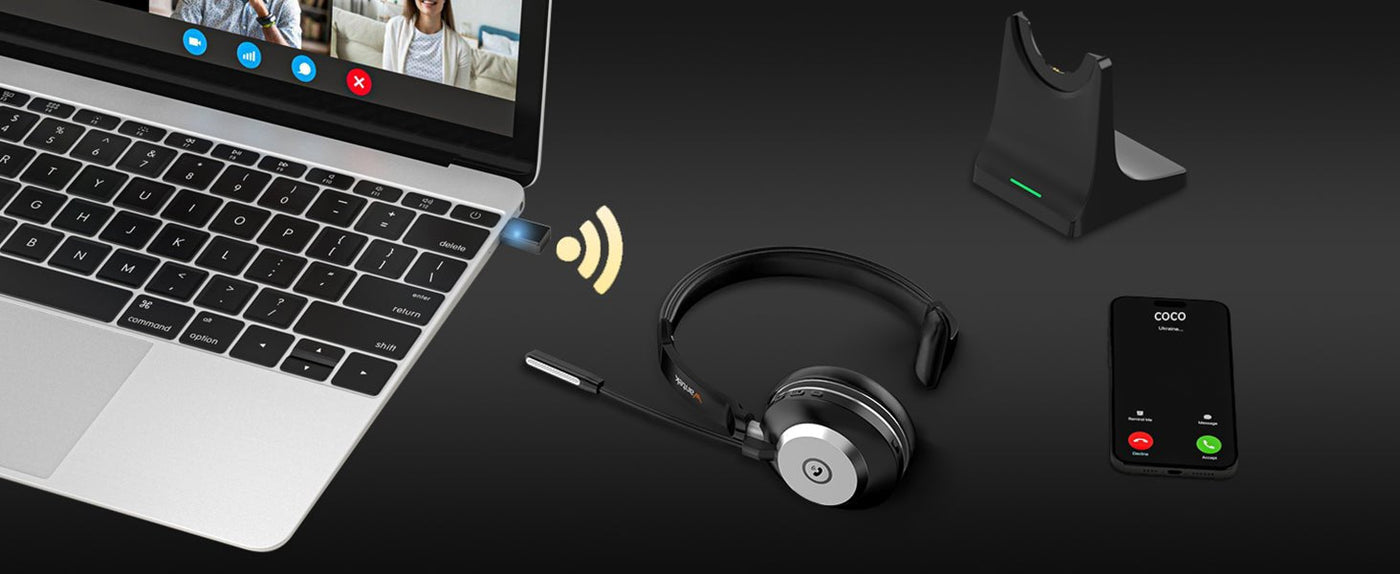
The best Bluetooth headphones for phone calls are not always the best music headphones. Call quality depends on microphone design, noise handling, fit, controls, connection behavior, and the device or app carrying the call.
Current shortlist: Jabra Evolve3 85 is a call-focused over-ear option with current independent testing behind it; Sony WH-1000XM6 is a strong premium choice when you also want high-end listener-side ANC; HP Poly Voyager Legend 50 is a current mono option for mobile calls. Wantek WK881BT and WK882BT are lower-cost work-headset starting points based on their published specifications, not measured microphone rankings.

Best Bluetooth Headphones for Phone Calls: Current Shortlist
| Priority | Model to compare | Why it belongs on the shortlist |
|---|---|---|
| Call-focused premium over-ear | Jabra Evolve3 85 | Bluetooth 5.3, multipoint, ANC, and up to 25 hours of published talk time; RTINGS currently places it at the top of its tested Bluetooth call-headset list. |
| Premium ANC plus everyday listening | Sony WH-1000XM6 | Over-ear ANC, multipoint, Bluetooth 5.3, up to 24 hours of continuous communication with noise cancelling on, and a multi-microphone call system. |
| Mono mobile calls | HP Poly Voyager Legend 50 | Mono fit, aerodynamic boom, four noise-canceling microphones, WindSmart, NoiseBlockAI, physical call controls, and up to 10 hours of talk time. |
| Lower-cost single-ear work option | Wantek WK881BT | Single-ear design, Bluetooth 5.2, boom microphone, PNC, one-key mute, and up to 45 hours of listed battery life. |
| Lower-cost dual-ear work option | Wantek WK882BT | Dual-ear design, Bluetooth 5.2, boom microphone, PNC, one-key mute, and up to 45 hours of listed battery life. |
This table mixes independent test evidence with manufacturer specifications, so it is not a single lab ranking. RTINGS has tested the Jabra and Sony models; Wantek’s own models are included as specification-based options and should not be read as measured winners over the third-party products.
Call Quality Starts With the Microphone Path
A boom microphone has one practical advantage: it places the pickup point closer to your mouth and keeps that position more consistent. Integrated microphones can still perform well, especially when a manufacturer uses multiple microphones and signal processing, but performance varies widely by model.
Independent call testing matters because microphone count alone does not tell you how natural your voice will sound or how well the system separates speech from background noise. RTINGS’ current Bluetooth headset call comparison is useful because it considers recording quality and noise handling rather than only product-page claims.
ANC and Microphone Noise Reduction Are Different
Active noise cancellation mainly changes what the wearer hears. Microphone noise reduction changes the outgoing voice signal. A headset can have excellent ANC for travel and still be only average at separating your voice from a noisy office.
Sony’s WH-1000XM6 is a good example of why the distinction matters: Sony documents both listener-side noise cancellation and a separate call system that captures speech with multiple microphones and AI beamforming. Treat those as related but different functions.
Single-Ear vs. Dual-Ear for Calls
A single-ear headset keeps one ear uncovered and can work well when you need to hear nearby people or room activity. A dual-ear or over-ear model can make it easier to focus on incoming speech when your environment is distracting.
Neither wearing style guarantees better microphone quality. If you are still deciding between the two, the Bluetooth headset for phone calls buying guide explains wearing style, multipoint, desk-phone compatibility, and connection paths in more detail.
Multipoint Helps Only If the Switching Behavior Fits Your Workflow
If calls move between a smartphone and laptop, look for explicit multipoint documentation. Bluetooth version alone does not prove that a headset keeps two devices connected or switches calls the way you expect.
Jabra documents Bluetooth multipoint on Evolve3 85, and Sony lists multipoint on WH-1000XM6. For any headset, confirm whether your calling apps, USB adapter, or operating system add their own connection requirements.
Talk Time Is Not the Same as Music Battery Life
Compare the metric that matches your workday. A product may publish music playback, continuous communication, standby, or a general battery figure under different settings. Do not treat those numbers as interchangeable.
Jabra lists up to 25 hours of talk time for Evolve3 85 with ANC and busylight off, while Sony lists up to 24 hours of continuous communication with noise cancelling on for WH-1000XM6. HP lists up to 10 hours of talk time for Voyager Legend 50 before adding charge-case capacity.
What to Test Before the Return Window Ends
- Use your real call device. Test the phone, laptop, or tablet you will actually use.
- Use your real app. Make calls through the same phone app, Zoom, Teams, softphone, or browser workflow you rely on.
- Record speech in a quiet room. Listen for clipping, thin speech, excessive processing, or unstable volume.
- Add realistic background sound. Test keyboard noise, nearby conversation, HVAC, or moderate street noise without assuming every headset will suppress it equally.
- Test mute and switching. Confirm you can mute quickly and move between devices without losing the call path.
- Wear it long enough to judge fit. Pressure, heat, earcup space, glasses, and headband tension become clearer after more than a few minutes.
Where Wantek Fits
Wantek’s WK881BT and WK882BT are work-focused Bluetooth headsets with boom microphones, PNC, one-key mute, Bluetooth 5.2, and up to 45 hours of listed battery life. WK881BT is single-ear; WK882BT is dual-ear.
Those specifications make them relevant lower-cost starting points for work calls, but Wantek does not present the table above as proof that their microphone performance equals the independently tested Jabra, Sony, or Poly models.
Compare Wantek Bluetooth Work Headsets
Choose by single- or dual-ear fit, boom microphone, mute controls, battery documentation, and the devices you use for calls.
Frequently Asked Questions
What Bluetooth headphones are best for phone calls?
Start with call-focused microphone evidence, noise handling, comfort, controls, and connection needs. Jabra Evolve3 85, Sony WH-1000XM6, and HP Poly Voyager Legend 50 cover different premium use cases.
Is a boom mic better for phone calls?
A boom keeps the microphone closer to your mouth and can provide more consistent placement. It does not guarantee better noise handling; the microphone system and processing still need to be evaluated on the exact model.
Does ANC make my voice clearer to callers?
Not necessarily. ANC primarily reduces noise for the wearer. Caller-side clarity depends on the microphone system and its noise processing, which should be evaluated separately.
Should I choose a single-ear or dual-ear Bluetooth headset?
Choose single-ear when room awareness matters and dual-ear when listening focus matters more. Microphone quality should be compared separately because wearing style does not determine outgoing call quality.

