
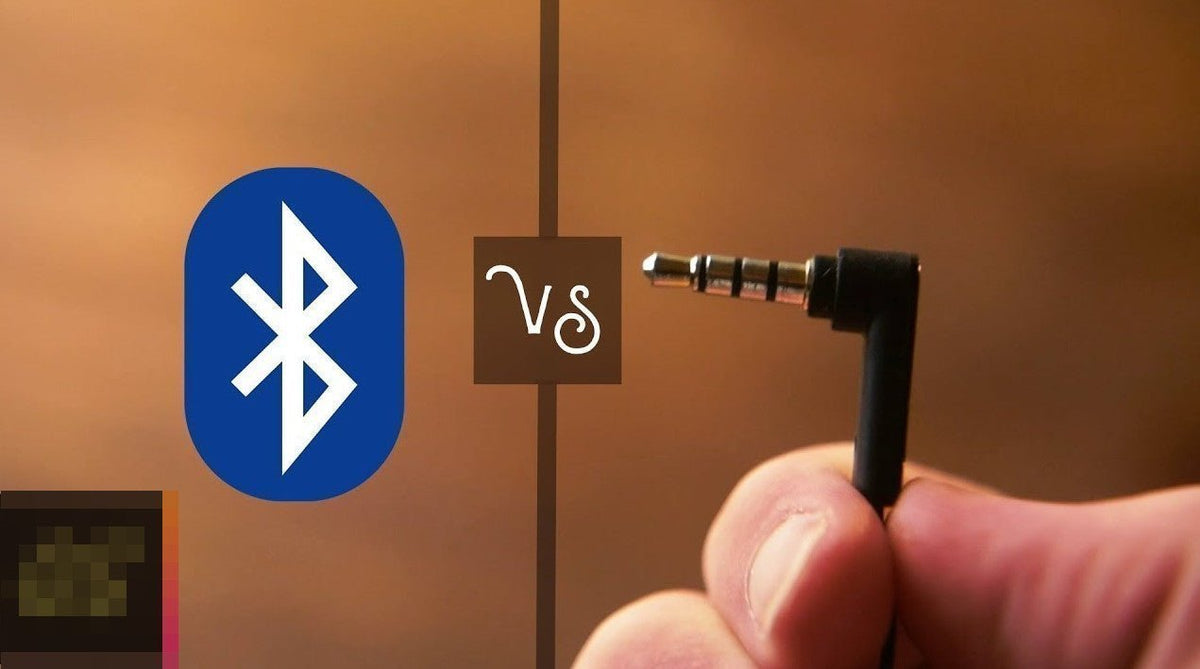
If your definition of “safer” is “less radiofrequency exposure next to the head,” wired headphones have the simpler answer: a passive wired headset does not need a Bluetooth transmitter at the ear. That does not mean Bluetooth headphones have been shown to be dangerous.
The practical answer: current evidence has not established that Bluetooth headphones cause brain damage or cancer. For both wired and wireless headphones, the clearest preventable health risk is still excessive sound exposure—how loud you listen and for how long.
That distinction matters. “Wired uses less RF” and “wired is healthier” are not the same claim. The first is technically true for the headset connection. The second would require evidence that normal Bluetooth-headphone exposure causes a meaningful health problem, and that evidence has not been established.
Wired vs. wireless: what actually changes the safety picture?
| Question | Wired headphones | Bluetooth headphones | What matters most |
|---|---|---|---|
| RF transmitter at the headset | Wired headphones: No Bluetooth transmitter is required in a passive wired headset. | Bluetooth headphones: Uses short-range radiofrequency signals to carry audio. | What matters most: Relevant if your goal is simply to minimize RF exposure near the head. |
| Hearing-loss risk | Wired headphones: Can damage hearing at excessive volume or duration. | Bluetooth headphones: Can damage hearing at excessive volume or duration. | What matters most: Sound level and listening time matter more than the connection type. |
| Long sessions | Wired headphones: No headset battery or pairing routine. | Bluetooth headphones: Requires power management and a wireless connection. | What matters most: Mostly a workflow difference, not evidence of a health advantage. |
| Noisy environments | Wired headphones: Fit and isolation vary by model. | Bluetooth headphones: Fit, isolation and ANC vary by model. | What matters most: A design that lets you listen at a lower level can be useful for hearing protection. |

What Bluetooth radiation actually is
Bluetooth is a short-range radio system operating in the 2.4 GHz ISM band. The Bluetooth Core Specification lists the operating band as 2.400–2.4835 GHz.
These signals are non-ionizing radiofrequency electromagnetic fields. That is different from ionizing radiation such as X-rays. The important scientific question is not whether RF exists—it does—but whether the exposure level and pattern produce an established harmful effect.
The National Cancer Institute notes that RF from mobile phones is non-ionizing and does not have enough energy to damage DNA by ionization. It also states that Bluetooth devices such as wireless headphones typically transmit at much lower power than cell phones.
Avoid fixed “X times safer” numbers. One real-world exposure study found Bluetooth headset power-density exposure roughly 10–400 times lower than the connected phones it tested, but the result depended on the headset and phone conditions. The ratio is therefore useful for context, but it should not be treated as a fixed Bluetooth-to-phone exposure rule.
The underlying exposure study is available through PubMed. It is useful for scale, but it does not prove that one specific headset has a fixed exposure ratio under every condition.
Do Bluetooth headphones cause brain damage or cancer?
Current evidence has not established that they do. The U.S. Food and Drug Administration says the weight of scientific evidence has not linked cell-phone RF exposure with health problems. The NCI likewise concludes that evidence to date does not show that cell-phone use causes brain or other cancers in humans.
That cell-phone evidence is relevant context because phones can produce substantially greater RF exposure than Bluetooth headsets, but it is not identical to direct long-term research on Bluetooth headphones. The better conclusion is therefore “no established harm at typical exposure levels,” not “zero risk has been proved.”
A 2024 systematic review of human observational studies, conducted within the World Health Organization’s RF-health evidence program, concluded that mobile-phone RF exposure likely does not increase the risk of several heavily studied brain tumors. The review can be checked on PubMed. Direct long-term epidemiology focused specifically on Bluetooth headphones is much thinner, which is another reason not to overstate certainty in either direction.
For symptoms such as headache and sleep disturbance, a separate 2024 systematic review of controlled human experiments found no meaningful acute symptom effect from RF exposure below regulatory limits. It also noted limitations: experimental exposures differ from real life, and the evidence does not answer every question about long-term exposure. See the systematic review on PubMed.

The better-established risk: listening too loud for too long
For everyday headphone use, hearing damage has a far clearer evidence base than Bluetooth-health fears. The World Health Organization’s safe-listening guidance explains that risk rises with both sound level and exposure time. As one reference point, WHO gives about 40 hours per week at 80 dB, but only about four hours per week at 90 dB.
WHO also recommends keeping device volume below about 60% of maximum when practical, monitoring listening levels where possible, and using well-fitting or noise-cancelling headphones in noisy places so you are less tempted to turn the volume up.
The CDC makes the same basic point: louder sound and longer exposure increase the risk of noise-induced hearing loss. Turning the volume down and taking breaks are useful regardless of whether the cable is physical or the audio link is Bluetooth.
So, are wired headphones actually safer?
For minimizing RF exposure from the headset itself: yes. A passive wired headset avoids the Bluetooth radio next to the ear.
For preventing hearing loss: not inherently. A wired pair played loudly can be more damaging to hearing than a wireless pair used at a moderate level. Connection type does not override acoustics.
For people worried specifically about long-term Bluetooth health effects: wired is a reasonable preference. It reduces one source of RF exposure without requiring you to accept a claim that Bluetooth is proven harmful.
For people who need mobility: wireless remains a reasonable choice based on current evidence. The more practical health decision is to control listening level, duration and fit instead of treating Bluetooth itself as the primary danger.
How to reduce risk with either wired or wireless headphones
- Control sound exposure first. Lower volume and shorter listening time directly address the best-established headphone-related health risk.
- Use a fit that works in your environment. Better isolation or effective noise cancellation can reduce the urge to overpower background noise.
- Take listening breaks. Long continuous sessions increase total sound exposure even when the volume does not feel extreme.
- Do not confuse the headset with the source device. A wired headset removes Bluetooth transmission at the headset, but a connected phone can still use cellular, Wi-Fi or other radios unless those radios are disabled.
- Choose wired if lower RF exposure is your personal priority. It is a simple way to reduce that exposure without claiming that wireless headphones have been shown to cause disease.
When wired or wireless makes more sense
| Your priority | Better starting point | Why |
|---|---|---|
| Minimize RF exposure near the head | Better starting point: Wired | Why: Removes the Bluetooth transmitter from the headset connection. |
| Move during calls or workouts | Better starting point: Wireless | Why: Mobility may be more valuable than eliminating a low-power short-range radio link. |
| Long desk sessions | Better starting point: Often wired | Why: No headset charging or pairing routine; hearing safety still depends on sound exposure. |
| Noisy commute | Better starting point: Either | Why: Fit and noise control that let you keep the volume lower matter more than the connection type. |
Frequently asked questions
Are wired headphones safer than wireless headphones?
Wired headphones reduce RF exposure from the headset because they do not need a Bluetooth transmitter. Current evidence has not established normal Bluetooth-headphone use as a cause of cancer or brain damage.
Do Bluetooth headphones emit radiation?
Yes. Bluetooth uses low-power, non-ionizing radiofrequency signals in the 2.4 GHz band. “Radiation” describes the energy transfer; it does not by itself mean the exposure is hazardous.
Can Bluetooth headphones cause hearing loss?
Bluetooth itself is not the hearing-loss mechanism. Any headphones can contribute to noise-induced hearing loss when sound is too loud or listening sessions are too long.
Do wired headphones emit radiation?
A passive wired headset does not transmit Bluetooth RF. Electrical currents in the cable can produce electromagnetic fields, while the connected phone or computer may still use its own wireless radios.
Which is safer for long work calls?
For hearing, volume and total exposure time matter most. Wired headsets can simplify long desk sessions by removing charging and pairing, while wireless models are useful when movement is essential.
Bottom line
If you want to minimize RF exposure next to your head, choose wired headphones. That is a straightforward technical difference. But the evidence does not support turning that difference into the stronger claim that Bluetooth headphones are proven to damage the brain or cause cancer.
For most listeners, the more useful safety habit is simpler: keep the level reasonable, limit high-volume listening time, and use a headset that lets you hear clearly without pushing the volume higher than necessary.

