
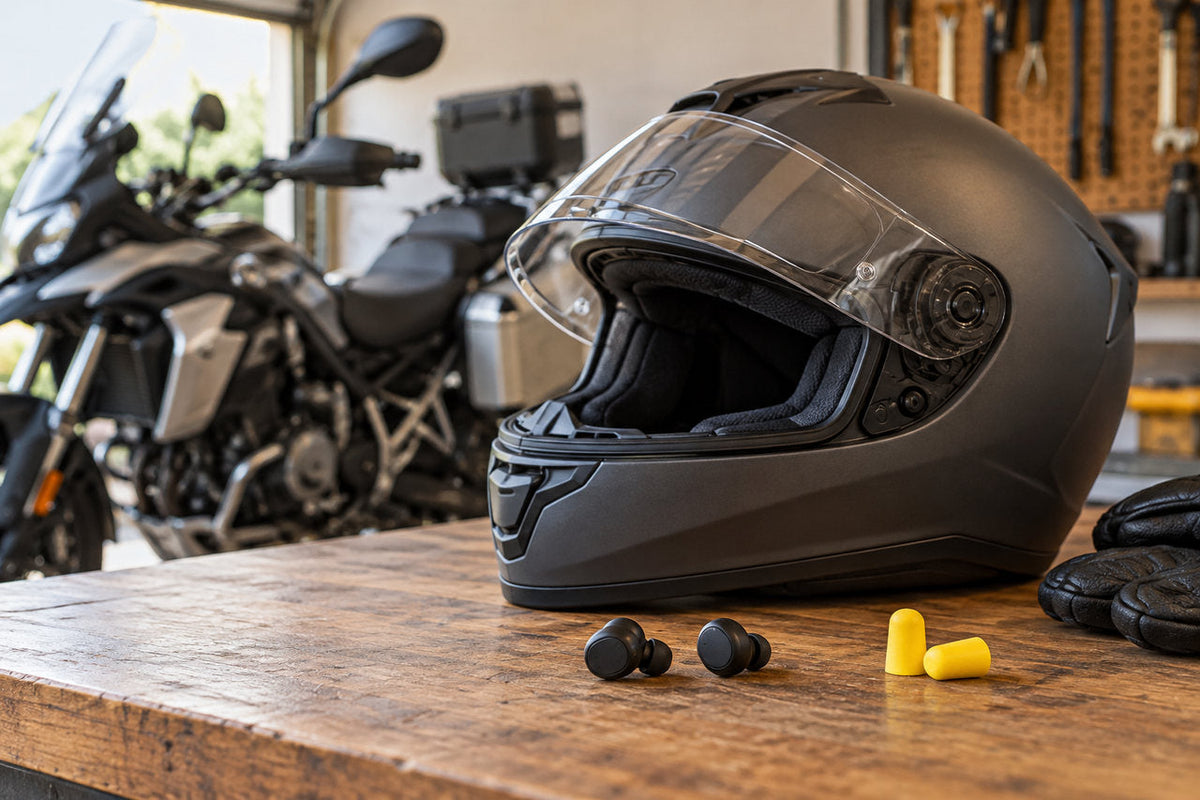
Motorcycle earbuds need to do more than fit your ears: they must sit comfortably beneath a helmet, stay secure when you put it on or take it off, and be suitable for the laws and conditions where you ride. Ordinary wireless earbuds may work for some stationary or permitted uses, but they are not automatically motorcycle communication systems or certified hearing protection.
Can you wear earbuds under a motorcycle helmet?
Some low-profile earbuds can fit beneath a motorcycle helmet, but compatibility is not universal. A bud that feels comfortable without a helmet may press painfully against the ear once the cheek pads and liner are in place. The helmet must still fit as its manufacturer intends; do not remove protective padding or alter the shell to make an earbud fit.
Test the fit while parked. Put the helmet on and remove it several times, paying attention to pressure points, loose earbuds, displaced ear tips, and cables that catch on the lining. If the earbuds interfere with the helmet's fit or retention, choose a different audio arrangement.
Choose the setup for the job
Low-profile wired or wireless earbuds
Earbuds can provide personal audio or navigation prompts when their use is permitted. Their main advantage is portability. The trade-off is fit: protruding housings can press against the ear, true wireless buds can shift as the helmet comes off, and wired buds add a cable that needs careful routing. Do not assume a built-in microphone will deliver understandable speech in wind and traffic noise.
Helmet speakers and motorcycle intercoms
Purpose-built helmet communication systems typically place speakers in the helmet's ear recesses and provide a separate microphone and controls. They are the more relevant category for passenger or rider-to-rider communication. Features differ by model: do not assume every system supports group intercom, two-device audio, or a particular helmet. Follow the equipment and helmet manufacturers' installation instructions.
Hearing-protection earplugs
If your priority is reducing wind and engine noise, look for hearing protection designed for that purpose. Ordinary ANC earbuds are not a substitute for rated hearing protectors. The CDC's NIOSH hearing-protection guidance distinguishes active noise cancellation from hearing protection with an appropriate noise reduction rating (NRR). Proper fit also matters.

| Option | Purpose and checks |
|---|---|
| Low-profile earbuds | Personal audio or navigation where permitted. Check helmet pressure, retention, and controls; ordinary earbuds are not automatically rated hearing protection. |
| Helmet speakers or intercom | Rider or passenger communication. Verify installation instructions and the specific communication features supported. |
| Hearing-protection earplugs | Attenuation of riding noise. Check the stated rating, fit, and intended use; earplugs alone do not provide music playback. |
What to check when comparing motorcycle earbuds
- Profile and pressure: Check whether the earbud sits flush enough to avoid pressure from helmet padding. Ear shape, helmet model, and liner fit all matter.
- Retention: Confirm the earbud stays in position when the helmet goes on and comes off. A secure fit while walking does not prove it will remain secure beneath a helmet.
- Noise and hearing: Separate passive isolation, ANC, microphone noise reduction, and tested hearing protection. These terms describe different functions.
- Controls: Set audio and navigation before moving. Tiny touch controls can be difficult to use beneath a helmet or with gloves.
- Connection: A Bluetooth connection to a phone does not by itself provide rider-to-rider intercom. Wired earbuds require a compatible audio jack or system output.
- Weather and care: Check the actual water-resistance rating and usage limits for the device. An IP rating does not establish motorcycle suitability.
For a breakdown of sealed, open-fit, clip-on, and ear-hook designs, see our guide to types of earbuds. It explains fit categories, not motorcycle certification.
Are motorcycle earbuds legal?
There is no single U.S. rule covering every rider and every listening device. Laws can depend on the state, whether the device is in one or both ears, its purpose, and the type of vehicle. A transparency mode or open-ear label is not a blanket legal exception.
For example, Washington's motorcycle operator manual says in-ear hearing protection is legal in the state but in-ear speakers are not. California Vehicle Code 27400 generally restricts devices in or over both ears, with specific exceptions for qualifying hearing protectors and other uses. Check the law for your actual route, not a generic nationwide list.
Our state headphone-law guide compares selected U.S. statutes and their exceptions. It is a starting point, not an all-state motorcycle legal clearance.
A practical pre-ride check
- Check your helmet manufacturer's instructions and the listening-device rules for the places you will ride.
- Try the full helmet-and-earbud combination while stationary; confirm the helmet still fits correctly.
- Check for pressure, movement, snagged cables, and displaced ear tips while putting on and removing the helmet.
- Set navigation and audio before departure. Keep volume low enough to detect important traffic sounds, and do not adjust devices while riding.
- For wind-noise exposure, evaluate suitable hearing protection separately from music playback or intercom features.
Frequently Asked Questions
Are noise-canceling earbuds hearing protection for motorcycling?
Not automatically. ANC is an audio-processing feature; it does not establish a tested NRR or prove that the earbuds protect against harmful riding noise. Check the product's stated hearing-protection rating and permitted use.
Can regular Bluetooth earbuds replace a motorcycle intercom?
They may play compatible phone audio, but ordinary Bluetooth earbuds do not automatically provide rider-to-rider communication, a helmet microphone, or glove-friendly controls. A dedicated intercom is a different equipment category.
Are open-ear earbuds better under a helmet?
Not necessarily. Their hooks or housings may conflict with helmet padding, and an open ear canal does not resolve legal, wind-noise, or retention concerns. Test the actual device and helmet combination before relying on it.

