
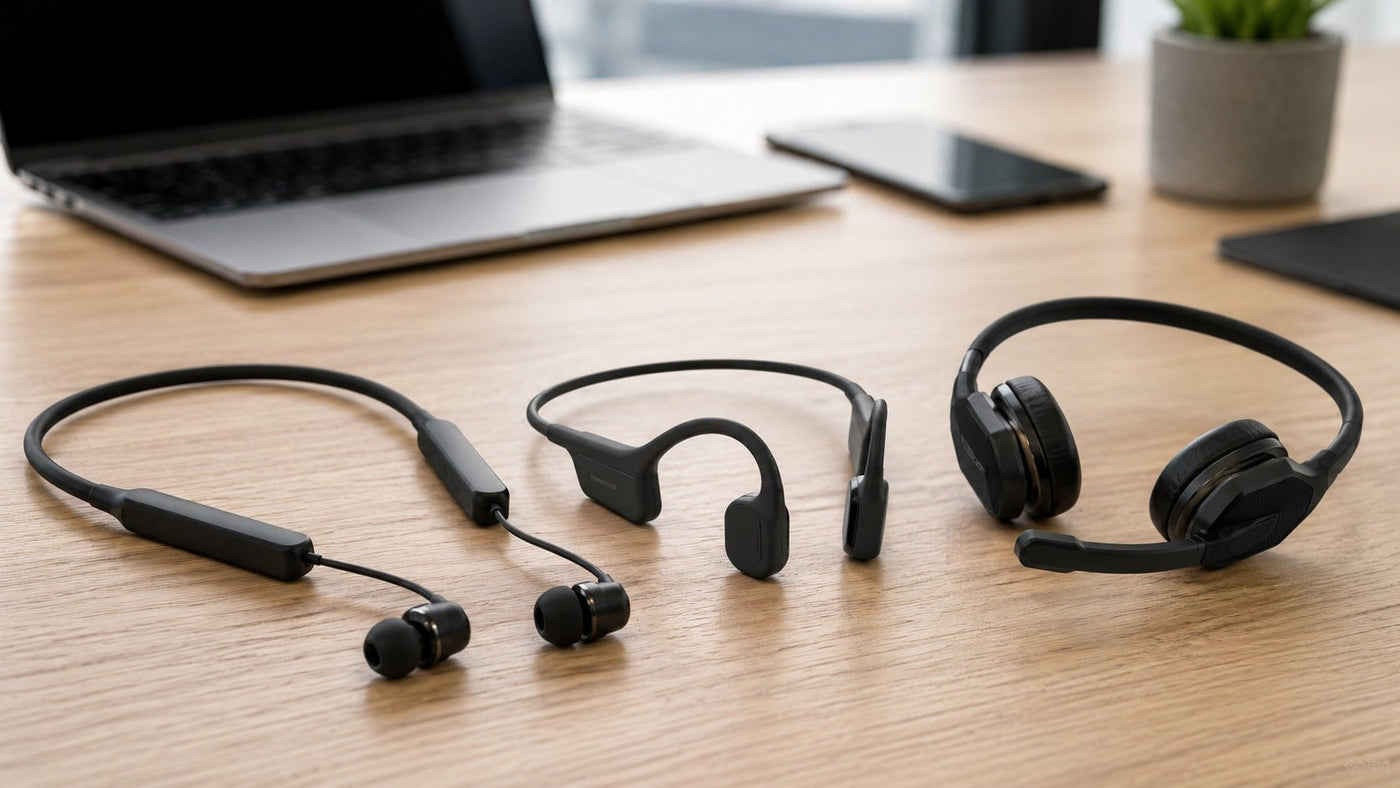
Selecting the optimal behind-the-head Bluetooth headset requires matching the specific design variant to your primary activity and comfort needs. For athletes, outdoor enthusiasts, and professionals requiring situational awareness, open-ear bone conduction headsets (e.g., Shokz) are the definitive choice. For gamers and media consumers seeking immersive, long-wear comfort without "headphone hair," a dedicated behind-the-head gaming headset (e.g., SteelSeries Arctis Nova) is superior. For hybrid use—commuting, office calls, and fitness—the versatile neckband headset (e.g., Jabra Elite) offers the best balance of stability, battery life, and call quality. Your decision should pivot on three core factors: environmental awareness needs, audio fidelity priorities, and microphone requirements.
The Ergonomic Evolution of Personal Audio
In an audio market saturated with near-identical true wireless earbuds and bulky over-ear cans, the behind the head headset represents a deliberate and ergonomic divergence. This form factor, far from a niche relic, has undergone a significant renaissance, propelled by advancements in Bluetooth 5.3 connectivity, battery miniaturization, and material science. Once primarily the domain of telephony, the modern behind-the-neck design now serves a spectrum of high-fidelity use cases, from competitive esports to marathon training.
The fundamental appeal is biomechanical: by redistributing weight and pressure away from the pinna (the outer ear) and the crown of the head, these devices solve common pain points associated with traditional designs. For users who wear glasses, hats, or helmets, or those who simply experience fatigue during extended wear, this architecture is not just convenient—it’s transformative. This guide will provide a comprehensive, entity-driven analysis of behind the head headphones Bluetooth variants, dissecting their technological underpinnings, ideal applications, and key differentiators to deliver a definitive framework for your purchase decision.

Entity Deep Dive: Key Brands, Technologies, and Their Market Positions
To navigate this landscape effectively, one must understand the major entities—the brands and core technologies—that define it. Their specializations create clear lanes in the market, aligning with specific user intents.
- Shokz (formerly AfterShokz): The paramount entity in bone conduction technology. Utilizing patented Pitch+™ transducers, Shokz headsets bypass the eardrum entirely, transmitting sound waves through the cheekbones to the cochlea. This makes them the uncontested leader for situational awareness and safety-critical applications. Key product clusters: OpenRun (fitness), OpenComm (business), and OpenFit (open-ear earbuds).
- Jabra (a GN Audio company): A dominant force in professional unified communications (UC) and fitness audio. Jabra’s expertise in multi-microphone arrays with advanced noise cancellation (like Jabra Advanced Noise Cancellation™) makes their neckbands (e.g., Evolve2 series) industry standards for call clarity. Their Jabra Elite sport line exemplifies the durable, secure-fit neckband for active users.
- SteelSeries & Turtle Beach: These are the definitive entities for the behind the head gaming headset category. They focus on audio engineering for spatial awareness (like SteelSeries Sonar software), low-latency wireless connections (often via proprietary USB dongles), and broadcast-quality boom microphones (e.g., Turtle Beach’s ProSpecs Glasses-Friendly Design). Their designs prioritize multi-hour comfort for seated immersion.
- Poly (formerly Plantronics & Polycom): With a heritage in enterprise telephony, Poly is the authoritative entity for mission-critical business communication. Their Voyager series behind-the-head headsets are engineered for all-day contact center wear, featuring Acoustic Fence™ technology to isolate speech from ambient noise.
- Bose & Sony: While their flagship products are over-ear noise-cancellers, both have invested in neckband form factors (e.g., Bose QuietComfort® neckbands, Sony WI-1000XM2) that house larger batteries and superior drivers for audiophile-grade sound in a portable format, targeting commuters and travelers.
Architectural Analysis: The Three Core Variants Explained
The term "behind the head" is an umbrella for three distinct product architectures, each with a unique relationship to the user’s anatomy and auditory goals.
1. The Neckband Headset: The Versatile Workhorse
Entity Relationships: Connects Jabra, Sony, Bose to concepts of Hybrid Work, Commuting, and Fitness Tracking.
This design features a flexible, often rubberized band that rests on the nape of the neck, with cables or rigid arms leading to in-ear or on-ear buds. It represents a compromise of stability and audio immersion.
- Ideal User Intent: "Bluetooth headset for work and gym," "hands-free calling while multitasking."
-
Core Advantages:
- Extended Battery Life: The larger form factor accommodates a bigger battery, often delivering 18-24 hours of playtime.
- Inherent Stability: Virtually impossible to dislodge during movement, ideal for dynamic work environments or HIIT workouts.
- Ease of Use: Physical controls are mounted on the band for tactile, gloved, or blind operation.
- Superior Call Quality: Houses more sophisticated microphone arrays than most earbuds.
- Limitations: Can feel restrictive when lying down; some perceive the neck weight; not fully compatible with high-collared clothing.
- Semantic & Long-Tail Keyword Integration: wearable neckband headphones for all-day wear, best Bluetooth neckband for iPhone and Android, behind-the-neck headset with noise cancelling mic.
2. The True Open-Ear / Bone Conduction Headset: The Safety & Awareness Specialist
Entity Relationships: Anchored by Shokz, linked to Running Safety, Workplace Compliance, Hearing Health, and Cycling.
This is the most radical departure from traditional audio. By leaving the ear canal completely open, it maintains a direct acoustic relationship with the environment.
- Ideal User Intent: "Headphones for running near traffic," "headset for wearing with hearing protection," "comfortable headphones for glasses."
-
Core Advantages:
- Uncompromised Situational Awareness: The primary benefit. Critical for road safety, warehouse operations, or parental supervision.
- Eliminated Ear Fatigue: No pressure in or on the ear canal, enabling literal all-day wear.
- Hygienic & Universal Fit: Ideal for shared environments or users with sensitive ears; compatibility with eyewear, helmets, and hats is seamless.
-
Limitations:
- Audio Fidelity Trade-off: Bass response and overall audio privacy are reduced. Sound leakage occurs in quiet settings.
- Environmental Noise Dependency: Performance degrades in very loud environments (e.g., subway platforms).
- Semantic & Long-Tail Keyword Integration: bone conduction headphones for safe cycling, OSHA-compliant listening device, open-ear headphones for tinnitus sufferers, best headset for wearing with glasses all day.
3. The Behind-the-Head Gaming Headset: The Immersive Entertainment Platform
Entity Relationships: Connects SteelSeries, Turtle Beach to Esports, Streaming, Discord, and Spatial Audio.
This variant reconfigures the over-ear headphone by replacing the overhead band with a single, padded band that arcs behind the occipital bone. The ear cups typically feature memory foam and premium drivers.
- Ideal User Intent: "Gaming headset that doesn't mess up my hair," "comfortable headphones for long streaming sessions," "wireless headset for PS5 and PC."
-
Core Advantages:
- Eliminates "Headphone Hair": A major, often-underrated quality-of-life benefit.
- Optimized Long-Session Comfort: Distributes weight more evenly around the head, avoiding hot spots on the crown.
- Dedicated, High-Fidelity Microphone: Includes a flip-to-mute boom mic superior for in-game communication and content creation.
- Audiophile-Grade Features: Often includes high-resolution drivers, Dolby Atmos support, and customizable EQ via software.
- Limitations: Less portable; not designed for athletic activity; can sometimes feel less secure than a full headband if leaning forward aggressively.
- Semantic & Long-Tail Keyword Integration: behind the head gaming headset for glasses wearers, wireless esports headset low latency, streaming headset with broadcast quality mic, PC headset for large heads.

Decision Matrix: Matching Variant to Primary Use Case
To satisfy user search intent directly, apply this actionable matrix. It maps your dominant activity to the optimal architectural variant and specific feature priorities.
| Primary Use Case & User Intent | Recommended Variant | Critical Features to Prioritize | Topical Authority Brand Examples |
|---|---|---|---|
|
Running, Cycling, Outdoor Fitness ("safe headphones for running") |
Open-Ear / Bone Conduction | IP67/68 waterproof rating, secure fit (no bounce), 8+ hour battery, minimal sound leakage. | Shokz OpenRun Pro, Haylou PurFree |
|
Corporate & Contact Center Work ("UC headset for Microsoft Teams") |
Professional Neckband | Certified for Zoom/Teams, exceptional mic noise cancellation, busy light indicator, multi-device pairing. | Jabra Evolve2 65, Poly Voyager 4320 |
|
Competitive & Immersive Gaming ("wireless headset for FPS gaming") |
Behind-the-Head Gaming Headset | Sub-20ms latency (via USB dongle), surround sound software, breathable ear cushions, microphone monitoring. | SteelSeries Arctis Nova 7P, Turtle Beach Recon Air |
|
Hybrid Commuting & Travel ("neckband with active noise cancellation") |
Audiophile Neckband | Active Noise Cancellation (ANC), Hi-Res audio codec support (LDAC, aptX HD), fast charging (15 min = 3 hrs). | Sony WI-1000XM2, Bose QuietComfort® Neckband |
|
Industrial & Safety-Critical Work ("headset for wearing with hard hat") |
Rugged Bone Conduction | Intrinsically safe designs, high ambient noise performance, ANSI/OSHA compliance considerations. | Shokz OpenComm, Safe Hear SH2 |
Technical Evaluation: The Specification Deep Dive
Beyond form, these technical entities determine real-world performance. Understanding their relationships is key.
-
Bluetooth Codecs & Latency: The relationship between your source device and headset codec dictates quality.
- SBC: Standard, higher latency. Fine for calls.
- AAC: Optimal for Apple ecosystem, good music quality.
- aptX Adaptive/LL: Essential for gaming and video sync on Android, minimizing audio lag.
- LDAC: For high-resolution music streaming on supported devices.
-
Microphone Technology: This is a primary differentiator.
- Boom Mics (Gaming Headsets): Provide proximity and directionality, offering the clearest voice capture.
- Beamforming Arrays (Neckbands): Use multiple mics to algorithmically focus on your voice while cancelling side noise.
- Bone Conduction Mics (Shokz): Pick up speech via cheekbone vibrations, excellent in windy environments.
-
Durability & IP Ratings: A direct relationship to activity level.
- IPX4: Splash resistance for workouts.
- IP55: Dust protected and water jet resistant—the sweet spot for serious training.
- IP67: Fully dustproof and immersible in 1m of water for 30 minutes.
- Battery Life & Management: Note that manufacturer ratings are for medium volume. ANC and high volume can reduce this by 30-40%. Fast charging (e.g., 5-minute charge for 1 hour of play) is a highly practical feature.
Comprehensive FAQ: Targeting "People Also Ask" Snippets
Are behind-the-head Bluetooth headsets better for people who wear glasses?
Can you use a behind-the-head gaming headset for professional Zoom calls?
What is the actual audio quality difference between bone conduction and traditional headphones?
How secure are neckband headsets during high-intensity exercise like running or jumping?
Do all behind-the-head gaming headsets work wirelessly with PlayStation, Xbox, and Nintendo Switch?
Actionable Insights & Final Recommendations
To transform this analysis into a confident purchase, follow this final checklist:
- Audit Your Primary Activity: Honestly assess where you'll use the headset 80% of the time. This dictates the variant.
- Prioritize Your Top Two Needs: Is it all-day comfort, crystal-clear calls, immersive game audio, or unbroken environmental awareness? You rarely get all four.
- Check Ecosystem Compatibility: Verify codec support (aptX for Android gaming), software compatibility (SteelSeries GG for PC), and console-specific wireless protocols.
- Consider Your Physical Environment: Do you work in a noisy office? Need a headset for windy outdoor runs? Your environment dictates the needed microphone and driver technology.
Final Verdict: The behind the head headset category proves that thoughtful ergonomics drive enduring innovation. For the athlete and safety-conscious user, the Shokz OpenRun Pro represents the pinnacle of open-ear design. For the hybrid professional and commuter, the Jabra Evolve2 65 neckband delivers unmatched call clarity and versatility. For the dedicated gamer and streamer, the SteelSeries Arctis Nova 7 provides a flawless blend of comfort, immersive audio, and communication prowess.
By aligning the inherent strengths of each architectural variant—neckband, open-ear, or gaming band—with your specific user intent, you don't just buy a headset. You invest in an ergonomic tool designed to enhance, rather than intrude upon, your daily life. In the quest for the perfect personal audio solution, understanding these relationships between form, function, and technology is the key to finding your ideal match.
Find Your Perfect Fit with Wantek's Behind-the-Head Collection
Whether you're gaming, working calls, or staying active, Wantek delivers the ergonomic comfort and audio clarity you've just learned about—without the premium price tag. Engineered for all-day wear across every use case.
→ Explore Wantek's Behind-the-Head Headsets | Free Shipping $20+

