
Les fonctionnalités des casques à réduction de bruit ne sont pertinentes que lorsqu'elles résolvent le problème auquel vous êtes réellement confronté. La réduction active du bruit (ANC) peut atténuer certains sons extérieurs pour l'auditeur, mais la puissance de l'ANC, la qualité du microphone, le mode transparence, le multipoint, l'autonomie de la batterie, les codecs, l'audio spatial et la réparabilité sont des capacités distinctes. Pour prendre une meilleure décision d'achat, commencez par isoler ces fonctions plutôt que de considérer chaque étiquette « haut de gamme » comme un tout indissociable.
Réponse rapide : Commencez par les performances de l'ANC et le confort, puis vérifiez le mode transparence, l'autonomie dans le mode que vous utiliserez, le comportement du microphone et la commutation entre appareils. Considérez l'audio spatial, les codecs avancés, le son personnalisé et la réparabilité comme des fonctionnalités secondaires, sauf s'ils correspondent directement à votre usage.

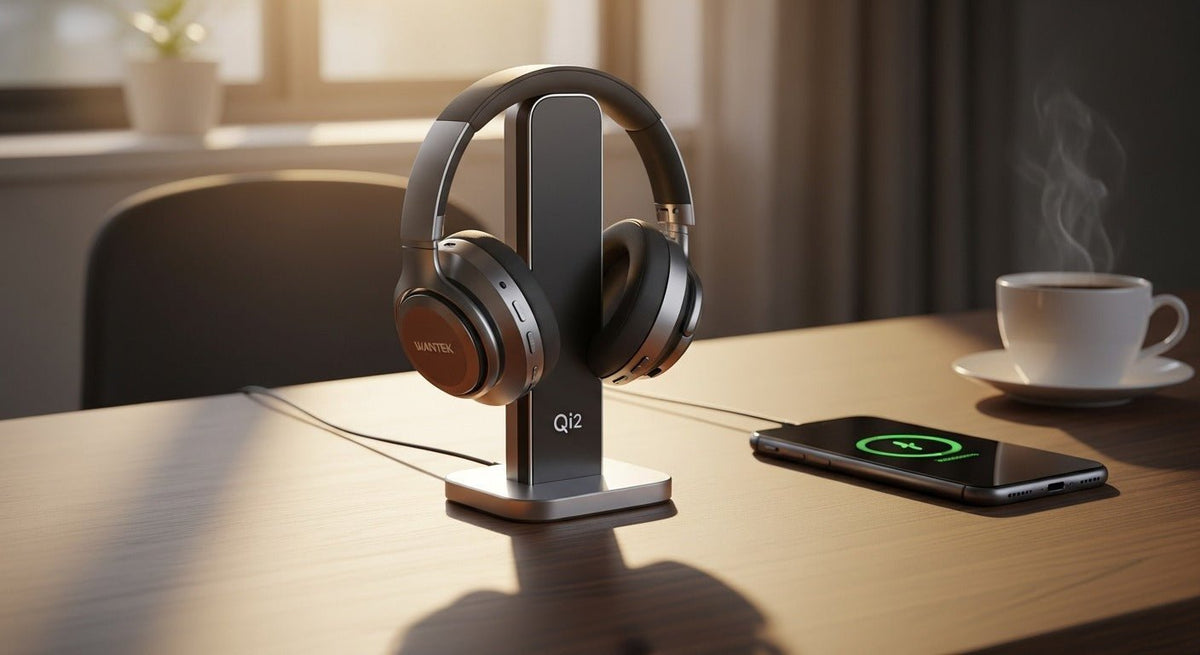
La disponibilité des fonctionnalités dépend du modèle. Une image produit, une version Bluetooth, un connecteur de charge ou un argument marketing ne garantissent pas la prise en charge de la charge Qi/Qi2, du multipoint, de l'ANC adaptatif, de l'audio spatial ou de toute autre fonctionnalité spécifique. Vérifiez les caractéristiques techniques exactes du produit.
1. Réduction active du bruit : la fonctionnalité essentielle
La réduction active du bruit utilise des microphones et un traitement du signal pour détecter les sons indésirables et générer un signal opposé qui réduit une partie de ce qui parvient à vos oreilles. Elle est particulièrement utile contre les bruits répétitifs à basse fréquence, comme le ronronnement d'un moteur ou d'une climatisation. Elle est généralement moins efficace contre les sons irréguliers à haute fréquence, comme les conversations à proximité.
L'explication de Sennheiser sur l'ANC note également que les performances varient selon le modèle et la qualité de l'ajustement du casque. C'est pourquoi l'étiquette « ANC » seule ne suffit pas à comparer deux produits.
L'isolation passive reste importante
L'ANC et l'isolation passive jouent des rôles différents. L'isolation passive provient de l'étanchéité physique créée par les coussinets. Une mauvaise étanchéité peut réduire l'efficacité du système global de contrôle du bruit, tandis qu'une bonne isolation peut aider même lorsque l'ANC est désactivé.
Si vous achetez un casque pour des appels professionnels, faites la distinction entre l'ANC pour l'auditeur et la réduction de bruit du microphone. Le guide des casques à réduction de bruit pour le travail de Wantek explique pourquoi réduire le bruit que vous entendez n'est pas la même chose que réduire le bruit que les autres entendent via votre microphone.
2. ANC adaptatif et mode transparence
L'ANC adaptatif modifie le niveau ou le comportement du contrôle du bruit en fonction des conditions détectées par le casque. Les modes transparence, ambiant ou d'écoute ont le rôle inverse : ils utilisent les microphones pour laisser passer davantage de sons extérieurs sans que vous ayez besoin de retirer le casque.
Ces fonctionnalités ne sont pas universelles et ne sont pas identiques d'une marque à l'autre. Par exemple, la documentation actuelle d'Apple sur les modes d'écoute distingue la réduction active du bruit, le mode transparence et l'audio adaptatif comme des modes distincts sur les modèles d'AirPods pris en charge.

Les étiquettes de processeur ne sont pas des scores de performance. Une puce dédiée, une étiquette « IA » ou un nombre de microphones plus élevé peuvent décrire une implémentation, mais aucune de ces spécifications ne garantit à elle seule une ANC plus puissante ou des appels plus clairs.
3. Autonomie et charge : comparez le mode de fonctionnement exact
Les chiffres d'autonomie ont besoin de contexte. L'activation ou non de l'ANC, le mode transparence, le temps d'appel par rapport à la lecture musicale, le choix du codec, le niveau du volume et d'autres fonctionnalités peuvent modifier la durée d'utilisation. Comparez le chiffre correspondant au mode que vous comptez réellement utiliser plutôt que de supposer qu'une autonomie globale s'applique à toutes les situations.
La charge dépend tout autant du modèle. La charge USB-C est courante, mais l'audio USB filaire, la charge rapide, la charge sans fil et la prise en charge Qi/Qi2 sont des capacités distinctes. Si une fonctionnalité de charge est importante pour vous, confirmez-la dans la documentation du produit plutôt que de la déduire du connecteur ou de la forme d'un support.
4. Multipoint et commutation d'appareil
Le multipoint est précieux lorsque vous utilisez régulièrement un ordinateur portable et un téléphone avec le même casque. Sur les modèles compatibles, il permet de maintenir deux appareils sources connectés et facilite la commutation, évitant de devoir déconnecter et reconnecter manuellement le Bluetooth à chaque fois.
Cependant, « Bluetooth » ne signifie pas automatiquement « multipoint ». La documentation de Sony sur le support multipoint traite explicitement la connexion simultanée à deux appareils comme une fonctionnalité qui doit être prise en charge et activée sur les casques compatibles.
5. La qualité du microphone est une décision d'achat distincte
L'ANC d'un casque est principalement conçue pour ce que l'utilisateur entend. La qualité des appels dépend d'une chaîne différente : le positionnement des microphones, la conception de la matrice de microphones, le traitement du signal, la gestion du vent, l'appareil connecté et l'application utilisée.
Cette distinction est importante pour le travail hybride. Un casque d'écoute haut de gamme peut avoir une excellente ANC tout en étant un choix moins pertinent pour les appels qu'un casque professionnel doté d'une perche micro bien positionnée et de commandes de coupure du son fiables. Le nombre de microphones ne constitue pas, en soi, un verdict de qualité d'appel.
6. Codecs Bluetooth et LE Audio
La prise en charge des codecs affecte la manière dont l'audio Bluetooth est encodé et transmis, mais le casque et l'appareil source doivent tous deux prendre en charge la même option pour que vous puissiez l'utiliser. Une étiquette de codec ne remplace pas les fondamentaux : l'ajustement, le réglage sonore, les performances de l'ANC, la fiabilité de la connexion et le comportement du microphone restent essentiels.
Le Bluetooth LE Audio introduit le codec LC3. La spécification LC3 du Bluetooth SIG définit le LC3 comme un codec efficace pour les applications vocales et musicales. La prise en charge du LE Audio ou du LC3 doit toujours être vérifiée sur le casque et l'appareil source exacts plutôt que d'être déduite uniquement du numéro de version Bluetooth.
7. Audio spatial, suivi des mouvements de tête et son personnalisé
L'audio spatial et le suivi des mouvements de tête peuvent modifier le rendu des films, jeux ou musiques compatibles, tandis qu'un égaliseur personnalisé ou des profils auditifs peuvent adapter le réglage à chaque auditeur. Ce sont des fonctionnalités utiles, mais elles ne mesurent pas la puissance de l'ANC.
Lorsque ces fonctionnalités comptent pour vous, vérifiez trois choses : si le casque les prend en charge, si votre téléphone ou votre ordinateur les prend en charge, et si l'application ou le format de contenu spécifique les utilise. La compatibilité de l'écosystème peut être plus importante que le nom de la fonctionnalité imprimé sur la boîte.
8. Réparabilité, pièces remplaçables et possession à long terme
Des coussinets remplaçables, un service de remplacement de batterie, un support logiciel (firmware) et l'accès à des pièces détachées peuvent être plus importants sur plusieurs années qu'un mode logiciel rarement utilisé. Ne supposez pas que des coussinets amovibles signifient que la batterie est remplaçable par l'utilisateur, ou qu'une conception modulaire implique que des pièces de réparation officielles sont disponibles.

La réparabilité doit être vérifiée, non déduite. Vérifiez la documentation du fabricant concernant les pièces, le service après-vente, la garantie et le remplacement de la batterie pour le modèle exact. Une image conceptuelle n'est pas la preuve qu'un produit est modulaire ou réparable par l'utilisateur.
Quelles fonctionnalités de casque à réduction de bruit sont les plus importantes ?
| Cas d'utilisation | Priorité n°1 | Puis vérifiez |
|---|---|---|
| Vols et transports | ANC efficace, étanchéité confortable, autonomie avec ANC activé | Mode transparence, portabilité, secours filaire si nécessaire |
| Concentration au bureau | ANC et isolation passive, confort pour les longues sessions | Multipoint, commandes via application, mode transparence |
| Appels et réunions | Comportement du micro, commandes de coupure du son, connexion | ANC pour l'utilisateur, compatibilité de la plateforme, multipoint |
| Musique et films | Réglage sonore, ajustement, performances de l'ANC | Support des codecs, audio spatial, égaliseur et personnalisation |
| Longévité du produit | Confort, fabrication, pièces d'usure remplaçables | Service batterie, support logiciel, disponibilité des pièces |
Une liste de contrôle pratique pour l'achat
Définissez votre problème de bruit.
Déterminez si vous avez principalement besoin de moins de ronronnement moteur, moins de distractions au bureau, de meilleurs appels, ou un mélange des trois. Ce sont des exigences différentes.
Vérifiez la fonctionnalité réelle, pas l'étiquette de catégorie.
Vérifiez si le modèle prend réellement en charge l'ANC adaptatif, la transparence, le multipoint, le codec dont vous avez besoin et la méthode de charge que vous attendez.
Comparez les chiffres d'autonomie dans des conditions identiques.
Utilisez les chiffres d'autonomie avec ANC activé ou en temps de communication lorsqu'ils correspondent à votre usage réel. Ne comparez pas des mesures de batterie disparates comme si elles étaient équivalentes.
Vérifiez l'ajustement et le confort avant de rechercher des fonctionnalités optionnelles.
L'étanchéité affecte l'isolation et l'ANC, tandis que la pression du serre-tête, le poids, la chaleur des coussinets et la profondeur des oreillettes déterminent si vous porterez réellement le casque sur de longues sessions.
Utilisez des tests indépendants pour les affirmations de performance.
Les spécifications du fabricant confirment qu'une fonctionnalité existe. Les mesures indépendantes et les tests reproductibles d'appels ou d'ANC sont plus utiles pour comparer l'efficacité de deux produits.
L'écoute sécurisée dépend toujours du niveau et de la durée
La réduction du bruit permet d'entendre plus facilement le contenu sans lutter contre le bruit de fond, mais elle ne rend pas les niveaux d'écoute élevés inoffensifs. Les recommandations de l'Organisation mondiale de la santé sur l'écoute sans risque soulignent l'importance du niveau sonore et de la durée d'exposition, et recommandent spécifiquement des casques à réduction de bruit bien ajustés comme moyen de réduire le besoin d'augmenter le volume dans les lieux bruyants.
En résumé
Les fonctionnalités les plus utiles d'un casque à réduction de bruit ne sont pas celles qui portent les noms les plus récents. Commencez par vos besoins mesurables : quel niveau de bruit indésirable vous souhaitez réduire, combien de temps vous portez le casque, si les appels sont importants, et entre quels appareils vous basculez.
Pour la plupart des acheteurs, les performances de l'ANC, le confort, le mode transparence, l'autonomie, le comportement du micro et le multipoint méritent plus d'attention que l'audio spatial, la marque du processeur ou des allégations génériques d'« IA ». Les fonctionnalités optionnelles ne deviennent précieuses que lorsqu'elles correspondent à un cas d'usage réel et fonctionnent avec vos appareils.
Découvrez une option ANC de Wantek
Le Wantek T3 est le modèle circum-auriculaire actuel de Wantek, doté d'une ANC éprouvée, d'un mode transparence, du Bluetooth 5.3, d'un microphone intégré et d'une autonomie allant jusqu'à 60 heures. Vérifiez la fiche produit pour les spécifications exactes avant d'acheter.
Questions fréquemment posées
Quelle est la différence entre l'ANC et l'ANC adaptatif ?
L'ANC réduit électroniquement certains sons extérieurs. L'ANC adaptatif modifie automatiquement le comportement de réduction en fonction des conditions ou de l'ajustement. Les entrées exactes et la plage de réglage dépendent du modèle de casque.
Qu'est-ce que le mode transparence ?
Le mode transparence ou ambiant utilise les microphones du casque pour laisser passer davantage de sons extérieurs vers l'utilisateur. C'est utile lorsque vous avez besoin d'être attentif à votre environnement ou de converser rapidement sans retirer le casque.
Un nombre de microphones plus élevé signifie-t-il une meilleure ANC ou de meilleurs appels ?
Non. Le nombre de microphones décrit une partie de la conception matérielle, pas la performance globale. Le placement, la conception acoustique, le traitement du signal, l'ajustement, la gestion du vent et le logiciel influencent tous le résultat.
Le multipoint Bluetooth est-il la même chose que le jumelage de plusieurs appareils ?
Non. De nombreux casques peuvent mémoriser plusieurs appareils jumelés, tandis que le multipoint permet spécifiquement aux modèles compatibles de maintenir des connexions simultanées avec plus d'une source. Vérifiez le comportement documenté du modèle.
Ai-je besoin de l'audio spatial sur un casque à réduction de bruit ?
Pas pour la réduction de bruit elle-même. L'audio spatial est une fonctionnalité de lecture distincte pour les contenus et appareils compatibles. Priorisez-la uniquement si vous utilisez régulièrement des médias ou des applications qui la prennent en charge.

