
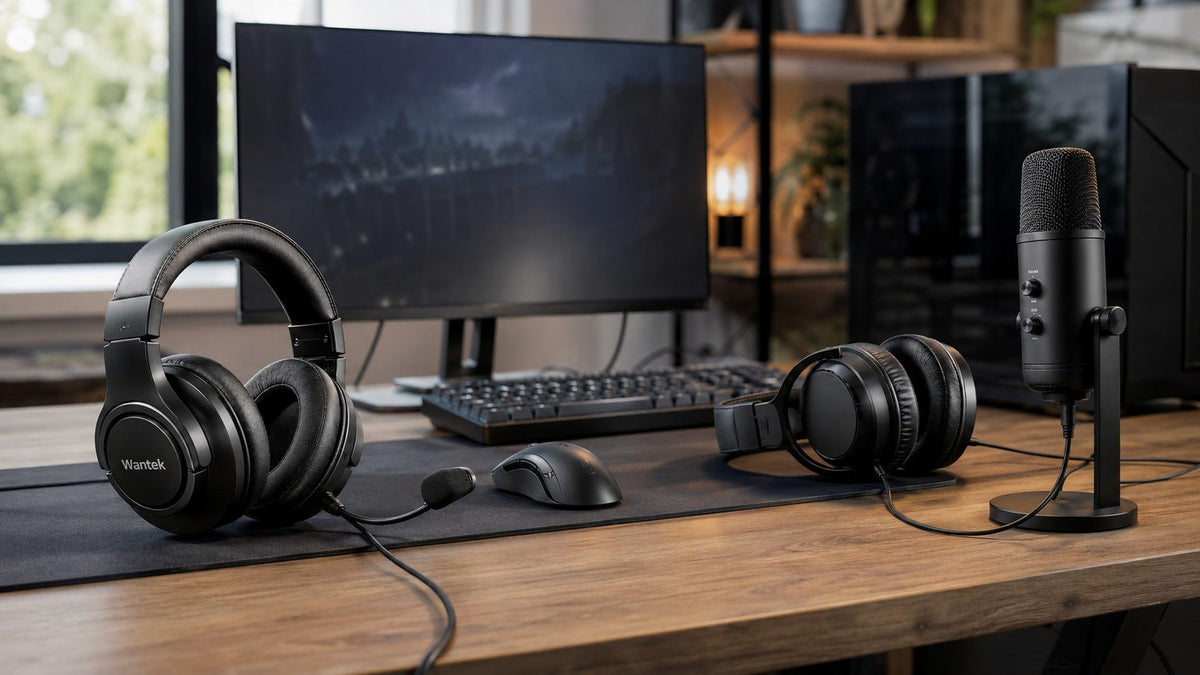
Un casque gaming est généralement le choix le plus simple lorsque vous souhaitez disposer de l'audio du jeu, du chat vocal et des commandes dans un seul appareil. Les écouteurs combinés à un microphone séparé constituent généralement le choix le plus flexible lorsque vous souhaitez sélectionner, positionner et mettre à niveau les aspects écoute et enregistrement de manière indépendante.
Réponse rapide : aucune configuration n'est automatiquement meilleure en termes de qualité sonore ou de jeu compétitif. Choisissez en fonction de la plateforme, du type de connexion, du bruit ambiant, des besoins en microphone, du confort et du coût total du système. Le principal compromis réside dans l'intégration par rapport à la modularité.
Casque gaming vs écouteurs + micro : la comparaison rapide
Commencez par la tâche que l'installation complète doit accomplir, et non par l'étiquette sur les oreillettes.
| Facteur de décision | Casque gaming | Écouteurs + micro séparé |
|---|---|---|
| Simplicité d'installation | Généralement plus simple car la lecture et l'entrée vocale sont intégrées. | Nécessite des appareils d'entrée et de sortie séparés et peut occuper plus d'espace sur le bureau. |
| Chat vocal | Un micro sur perche ou intégré reste avec le casque et est facile à maintenir à une distance constante. | Plus de choix pour le type de microphone, le placement, le gain et les futures mises à niveau. |
| Flexibilité de lecture | Un seul produit détermine les écouteurs, le microphone, les commandes et souvent les fonctionnalités logicielles. | Vous pouvez choisir les écouteurs en fonction du son, de la conception, de l'ajustement et de l'usage musical sans lier ce choix au micro. |
| Possibilité de mise à niveau | Une défaillance majeure ou un besoin de mise à niveau peut signifier remplacer tout le casque. | Les écouteurs et le microphone peuvent être remplacés indépendamment. |
| Confort sur console | Peut être plus facile lorsque le casque exact et la méthode de connexion sont documentés pour la console. | Peut nécessiter plus d'attention concernant les ports de manette, la prise en charge USB, les adaptateurs ou le routage séparé du microphone. |
| Streaming et enregistrement | Efficace pour le chat vocal et le streaming occasionnel avec un minimum de matériel. | Donne un contrôle plus indépendant sur le type de microphone, la position et le trajet du signal. |
La différence fondamentale : intégration vs modularité
Les casques gaming intègrent le système audio
Un casque gaming combine la lecture audio et l'entrée microphone dans un seul appareil portable. Selon le modèle, il peut également inclure des commandes de sourdine et de volume, un récepteur sans fil, un retour de voix (sidetone), un logiciel d'égalisation, des commandes de chat ou des fonctionnalités audio spatiales.
L'avantage pratique est la coordination. Vous n'avez qu'un seul appareil à porter, un microphone qui suit les mouvements de votre tête, et généralement moins de composants distincts à configurer. Cela peut être attrayant pour le jeu multijoueur, le chat sur console, les petits bureaux et les configurations où la simplicité est primordiale.
Les écouteurs et un micro séparé divisent les tâches
Une configuration modulaire permet aux écouteurs de gérer la lecture tandis qu'un appareil séparé gère votre voix. Ce microphone peut être un micro USB de bureau, un micro monté sur perche, une perche amovible ou un microphone XLR connecté via une interface audio.
L'avantage est l'indépendance. Vous pouvez conserver un microphone tout en changeant d'écouteurs, ou améliorer le micro sans remplacer la partie écoute. Si vous construisez une configuration PC, le guide des écouteurs et casques PC filaires de Wantek montre comment les écouteurs destinés uniquement à l'écoute et les casques à micro intégré s'adaptent à des tâches différentes.

Qualité sonore : la catégorie ne détermine pas le vainqueur
Le réglage et l'imagerie importent plus que l'étiquette
Les produits gaming ne partagent pas une signature sonore universelle, et les écouteurs conventionnels ne sont pas automatiquement neutres. Les modèles individuels peuvent différer en termes de basses, médiums, aigus, distorsion, équilibre des canaux, imagerie, ajustement et isolation.
Pour les jeux compétitifs, l'objectif n'est pas simplement d'avoir plus de basses ou d'aigus. Vous avez besoin d'une présentation qui permet de distinguer facilement les indices sonores utiles du jeu sans devenir fatigante. Pour les jeux narratifs, l'immersion, les dialogues, la musique et l'impact des basses fréquences peuvent être plus importants.
Le design ouvert ou fermé peut compter plus que la distinction casque vs écouteurs
Les conceptions à dos ouvert (open-back) permettent à plus de son de circuler entre les oreillettes et la pièce. Ils peuvent paraître plus aérés, mais offrent peu d'isolation et laissent échapper davantage de son. Cela peut être inadapté pour les pièces partagées ou les configurations de microphones sensibles.
Les écouteurs et casques à dos fermé (closed-back) offrent une séparation physique plus importante par rapport à la pièce et laissent généralement échapper moins de son. Cela peut être plus pratique lorsque d'autres personnes sont à proximité, que le bruit extérieur est distrayant ou que la fuite sonore vers le microphone est une préoccupation.
Ne classez pas les écouteurs uniquement par la taille des haut-parleurs ou l'impédance
Les grands haut-parleurs, les plages de fréquences annoncées étendues et les valeurs d'impédance élevées ne garantissent pas à eux seuls un meilleur son de jeu. Le guide des spécifications des écouteurs de Shure note spécifiquement qu'une valeur d'impédance plus élevée ne doit pas être confondue avec une meilleure qualité.
L'impédance et la sensibilité doivent être prises en compte avec l'appareil source et le niveau d'écoute requis. Un DAC ou un amplificateur séparé n'est donc pas une mise à niveau automatique pour le jeu ; ajoutez-en un lorsque vos écouteurs ou les fonctionnalités requises le justifient.
Qualité du microphone et chat vocal
Pourquoi un micro sur perche intégré est pratique
Un microphone sur perche reste près de la bouche et suit les mouvements du casque. Cela permet de maintenir une distance de parole plus constante qu'avec un microphone situé plus loin sur un bureau. Pour la communication multijoueur, un positionnement répétable peut être plus important que de posséder un microphone plus sophistiqué mais mal placé.
Ne supposez pas que tous les micros de casque rejettent le bruit de fond de la même manière. La directivité, la conception de la capsule, le placement, le gain, le traitement, l'acoustique de la pièce, le bruit du clavier et le niveau de parole affectent tous ce que vos coéquipiers entendent. Si la performance du microphone est un critère d'achat majeur, comparez les enregistrements et les preuves spécifiques aux modèles dans le guide des casques gaming avec de bons microphones.
Pourquoi un microphone séparé vous donne plus de contrôle
Un microphone séparé vous offre plus d'options pour la directivité, le placement, le gain, le monitoring, l'utilisation d'un filtre anti-pop et les mises à niveau ultérieures. Cette flexibilité devient plus utile à mesure que vos besoins évoluent du simple chat de jeu vers le streaming, l'enregistrement, le podcasting ou d'autres travaux de production.
Séparé ne signifie pas automatiquement meilleur. Un microphone mal positionné dans une pièce réfléchissante ou bruyante peut produire une communication de moindre qualité qu'une perche de casque bien positionnée. Comparez le trajet complet du signal et l'environnement dans lequel vous jouez réellement.
L'audio spatial n'est pas exclusif aux casques gaming
L'audio spatial est un système de traitement, et non la preuve qu'un casque contient plusieurs haut-parleurs physiques autour de votre tête. Microsoft documente Windows Sonic for Headphones, Dolby Atmos for Headphones et DTS Headphone:X comme des options de son spatial pouvant être rendues via des écouteurs stéréo.
PlayStation propose également l'audio 3D pour casque sur PS5, incluant des profils personnalisés et des options prédéfinies. Un produit n'a donc pas besoin de l'étiquette « casque gaming 7.1 » simplement pour participer au rendu spatial basé sur un casque.
Pour le jeu compétitif, comparez les modes stéréo et spatial dans les jeux que vous utilisez réellement. Les moteurs audio des jeux, le moteur de rendu, le réglage des écouteurs, votre audition et vos préférences peuvent tous changer la présentation la plus facile à interpréter.
Vérifiez la plateforme et la connexion avant la préférence de marque
Un casque ou des écouteurs ne sont utiles que si votre appareil peut acheminer la lecture et les chemins de microphone dont vous avez besoin. Avant d'acheter, identifiez le trajet de connexion complet au lieu de supposer que « compatible PC », « sans fil » ou « gaming » signifie une prise en charge universelle.
- Analogique 3,5 mm : vérifiez si l'appareil ou la manette utilise une prise casque combinée ou des connexions séparées pour les écouteurs et le microphone.
- USB : vérifiez que la plateforme exacte prend en charge l'appareil à la fois pour la sortie audio et l'entrée microphone.
- Sans fil : vérifiez le récepteur ou le mode sans fil documenté du modèle. Une méthode de connexion prise en charge sur une plateforme ne doit pas être supposée fonctionner de manière identique sur une autre.
- Microphone séparé : confirmez où le microphone se connecte et si le jeu ou l'application de chat peut le sélectionner indépendamment des écouteurs.
Le PC vous offre généralement plus de flexibilité de routage car il peut prendre en charge des appareils de lecture et d'enregistrement séparés, mais vous devez tout de même sélectionner les points de terminaison d'entrée et de sortie corrects dans le système d'exploitation et dans l'application de jeu ou de chat.
Vous n'êtes pas sûr de la connexion dont votre installation a besoin ?
Envoyez à Wantek votre PC, console, manette ou modèle d'appareil ainsi que la connexion que vous souhaitez utiliser avant de choisir un casque.
Coût, durabilité et évolutivité
Un casque gaming peut être rentable car un seul achat couvre l'écoute et la communication vocale. Avec des écouteurs et un microphone séparés, comparez le coût total du système plutôt que le prix des seuls écouteurs. Un support, un bras articulé, une interface audio, un séparateur, un adaptateur, un câble ou un amplificateur peuvent s'ajouter à l'installation finale.
L'approche modulaire peut devenir plus facile à entretenir au fil du temps car un composant peut être conservé tandis qu'un autre est remplacé. Si le microphone tombe en panne, vous pouvez remplacer le microphone. Si vous voulez des écouteurs différents pour la musique ou le jeu, vous ne pouvez changer que la partie écoute.
La durabilité dépend du produit. Inspectez les charnières, la construction du bandeau, le serre-câble, les câbles détachables, les coussinets remplaçables, la réparabilité de la batterie, la fixation du microphone et la disponibilité des pièces de rechange. Il n'existe pas de règle fiable à l'échelle de la catégorie selon laquelle les casques gaming ou les écouteurs classiques dureraient universellement plus longtemps.
Quelle configuration choisir ?
Adaptez l'architecture à votre façon réelle de jouer.
| Votre situation | Meilleur point de départ | Pourquoi |
|---|---|---|
| Chat vocal multijoueur fréquent | Casque gaming | Un microphone et des commandes intégrés réduisent la complexité d'installation. |
| Vous possédez déjà un bon microphone | Écouteurs classiques | Vous pouvez choisir des écouteurs en fonction du son, de l'ajustement et de la conception sans payer pour un autre micro intégré. |
| Jeu et écoute musicale sérieuse | Écouteurs + micro | Une configuration modulaire vous offre un plus large éventail de choix d'écouteurs axés sur la lecture. |
| Jeu sur console avec espace bureau limité | Casque gaming compatible | Une connexion unique documentée peut être plus facile qu'un routage avec un microphone séparé. |
| Streaming ou enregistrement sont une priorité majeure | Écouteurs + micro séparé | Vous gagnez un contrôle indépendant sur la sélection et le placement du microphone. |
| Pièce bruyante ou partagée | Conception à dos fermé (quelle que soit la catégorie) | L'isolation de la pièce et la fuite sonore peuvent être plus importantes que le fait que le produit soit appelé casque ou écouteurs. |
La règle d'achat la plus forte est simple : choisissez d'abord l'architecture, puis comparez les modèles individuels. Un casque gaming bien adapté peut être un meilleur système que des écouteurs et un microphone mal choisis, tandis qu'une configuration modulaire bien équilibrée peut être meilleure qu'un casque qui ne correspond pas à vos besoins d'écoute, d'enregistrement ou de mise à niveau.

Vous préférez un casque gaming tout-en-un ?
Comparez les modèles gaming actuels de Wantek selon la connexion filaire ou sans fil, la conception du microphone, les commandes et les exigences de la plateforme.
Questions fréquemment posées
Puis-je utiliser des écouteurs classiques pour jouer ?
Oui. Les écouteurs classiques peuvent gérer l'audio du jeu sans étiquette gaming. Pour le chat vocal multijoueur, ajoutez un microphone compatible ou utilisez une autre entrée microphone prise en charge.
Les écouteurs ont-ils un meilleur son que les casques gaming ?
Pas automatiquement. La qualité sonore dépend du modèle individuel, du réglage, de la distorsion, de l'ajustement, de l'isolation et de la source. Comparez des produits spécifiques plutôt que de considérer l'une ou l'autre catégorie comme intrinsèquement supérieure.
Un microphone séparé est-il toujours meilleur qu'un micro de casque ?
Non. Un micro séparé offre plus d'options de placement et de mise à niveau, mais une perche de casque bien positionnée peut être plus pratique pour le chat vocal qu'un microphone de bureau mal placé.
Les écouteurs à dos ouvert sont-ils meilleurs pour le jeu compétitif ?
Pas universellement. Certains joueurs préfèrent leur présentation ouverte, mais les conceptions à dos ouvert laissent échapper le son et offrent peu d'isolation. Une conception à dos fermé peut mieux fonctionner dans des pièces bruyantes ou partagées.
Ai-je besoin d'un DAC ou d'un amplificateur pour les écouteurs gaming ?
Généralement non comme achat séparé. Ajoutez-en un lorsque les exigences électriques de vos écouteurs ou les fonctionnalités dont vous avez besoin dépassent ce que votre PC, manette, interface ou appareil actuel fournit.
Ai-je besoin du son surround 7.1 pour jouer ?
Non. Les écouteurs stéréo peuvent reproduire un audio de jeu traité spatialement. Testez les modes stéréo et spatiaux pris en charge dans vos propres jeux au lieu de considérer une étiquette 7.1 comme une exigence.

