
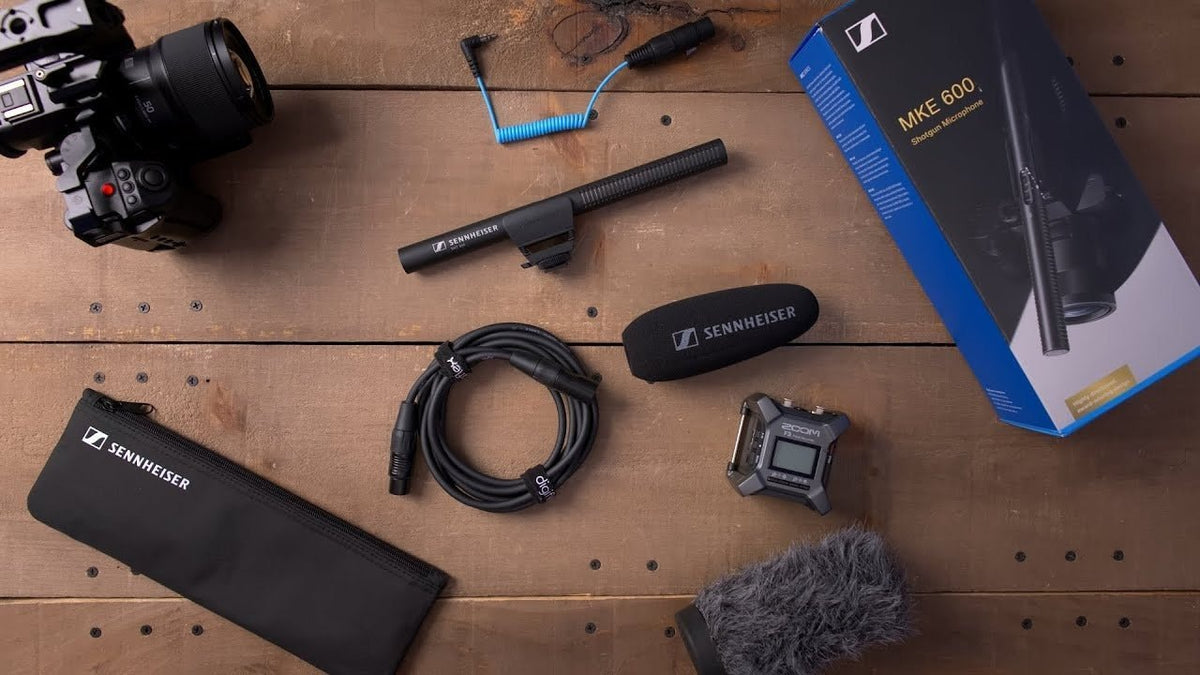
The Sennheiser MKE 600 and MKH 416 are both directional shotgun microphones, but they target different workflows. MKE 600 prioritizes flexibility with phantom or AA-battery power and an included camera adapter. MKH 416 uses Sennheiser’s RF condenser design, requires 48 V phantom power, and is built around demanding film, broadcast, and exterior recording.
Choose by production requirements, not a universal winner. MKE 600 is easier to integrate with cameras and battery-powered rigs. MKH 416 offers lower published self-noise, higher sensitivity, RF-condenser humidity resistance, and the long-established professional film/broadcast workflow.

MKE 600 vs. MKH 416: Current Specifications
| Feature | MKE 600 | MKH 416 |
|---|---|---|
| Transducer | Condenser shotgun | RF condenser shotgun |
| Pickup pattern | Supercardioid/lobar | Supercardioid/lobar |
| Frequency response | 40 Hz–20 kHz | 40 Hz–20 kHz |
| Sensitivity | 21 mV/Pa on P48; 19 mV/Pa on battery | 25 mV/Pa ±1 dB |
| A-weighted self-noise | 15 dB(A) P48; 16 dB(A) battery | 13 dB(A) |
| Maximum SPL | 132 dB P48; 126 dB battery | 130 dB SPL |
| Power | 48 V phantom or AA battery | 48 V phantom |
| Weight | 128 g without battery | 175 g |
| Length | 256 mm | 250 mm |
See Sennheiser’s current MKE 600 specifications and MKH 416 product page.
Choose MKE 600 When Power Flexibility Matters
MKE 600 can run from standard 48 V phantom power or an AA battery. Sennheiser rates battery operation at approximately 150 hours and includes a low-battery indicator.
That makes it practical on camera rigs, small recorders or production setups where phantom power may not always be available. Sennheiser also includes a shock mount, foam windshield and KA 600 adapter cable for cameras with a 3.5 mm connection.
Choose MKH 416 for the RF-Condenser Workflow
MKH 416 uses Sennheiser’s RF condenser principle and is specifically described for film, radio, television and exterior applications. Sennheiser states that the RF design makes it highly immune to humidity and suitable for adverse climatic conditions.
It requires 48 V phantom power, so a recorder, mixer or camera must supply the correct power. That is less flexible than the MKE 600 battery option but fits professional boom and location-sound systems that already provide phantom power.
Self-Noise and Sensitivity
MKH 416 has the lower published A-weighted equivalent noise level at about 13 dB(A), compared with 15 dB(A) for MKE 600 on phantom power. It also has the higher published sensitivity at 25 mV/Pa versus 21 mV/Pa.
Those specifications can matter for quiet dialogue and gain structure, but room noise, microphone distance, wind protection, boom technique, preamp quality and actor level often dominate real production results.
Directivity Is Not a Substitute for Placement
Both microphones use interference-tube designs with supercardioid/lobar behavior. Neither can magically remove side noise or isolate a distant voice in a reverberant space.
Get the microphone as close to the speaker as the frame allows, aim it consistently, and choose overhead or below-frame placement based on reflections and practical obstacles. Good boom placement usually matters more than moving from one competent shotgun microphone to another.
Wind Protection Is a Separate System
Both microphones include basic foam windscreens, but exterior production often requires stronger wind protection. Sennheiser explicitly recommends additional wind protection for outdoor MKH 416 use.
Match a blimp, windshield, suspension and furry cover to the microphone and wind conditions. A premium shotgun microphone without adequate wind protection can still produce unusable exterior audio.
Camera-Mounted vs. Boomed Use
MKE 600’s battery power and included camera adapter make it an easier starting point for DSLR/camcorder work. On-camera placement is convenient, but distance still limits dialogue quality.
Both microphones can be used on a boom. If dialogue quality is the priority, moving the microphone closer above or below the talent usually improves the voice-to-room ratio more than leaving it on the camera.
What the Old “Which Mic Wins?” Framing Got Wrong
The previous version declared MKH 416 the “undisputed king,” invented personal test experience, and used unsupported claims such as “90% of the quality at 40% of the cost.” Those statements have been removed.
The microphones are better understood as two price and workflow tiers: MKE 600 offers broad power/device flexibility; MKH 416 offers a lower-noise RF-condenser design for professional location and broadcast systems.
Which One Fits Your Production?
- Small camera rig / no guaranteed phantom power: MKE 600.
- Professional boom with P48 recorder or mixer: compare MKH 416.
- Humid exterior production: MKH 416’s RF-condenser design is specifically built for adverse conditions.
- Lower equipment budget: compare current dealer prices for MKE 600 before committing to the higher-tier MKH system.
- Voice-over in a normal indoor room: first consider whether a shotgun is the correct mic type for the room acoustics.
Frequently Asked Questions
Does MKE 600 need phantom power?
No. It can use 48 V phantom power or an AA battery. Sennheiser rates battery operation at approximately 150 hours.
Does MKH 416 need phantom power?
Yes. The current MKH 416-P48U3 specification requires 48 V phantom power.
Which has lower self-noise?
Sennheiser publishes approximately 13 dB(A) for MKH 416 and 15 dB(A) for MKE 600 on phantom power.
Is MKH 416 always better than MKE 600?
No. MKH 416 has advantages for professional RF-condenser location workflows, while MKE 600 offers battery power, lower system cost and simpler camera integration.

