
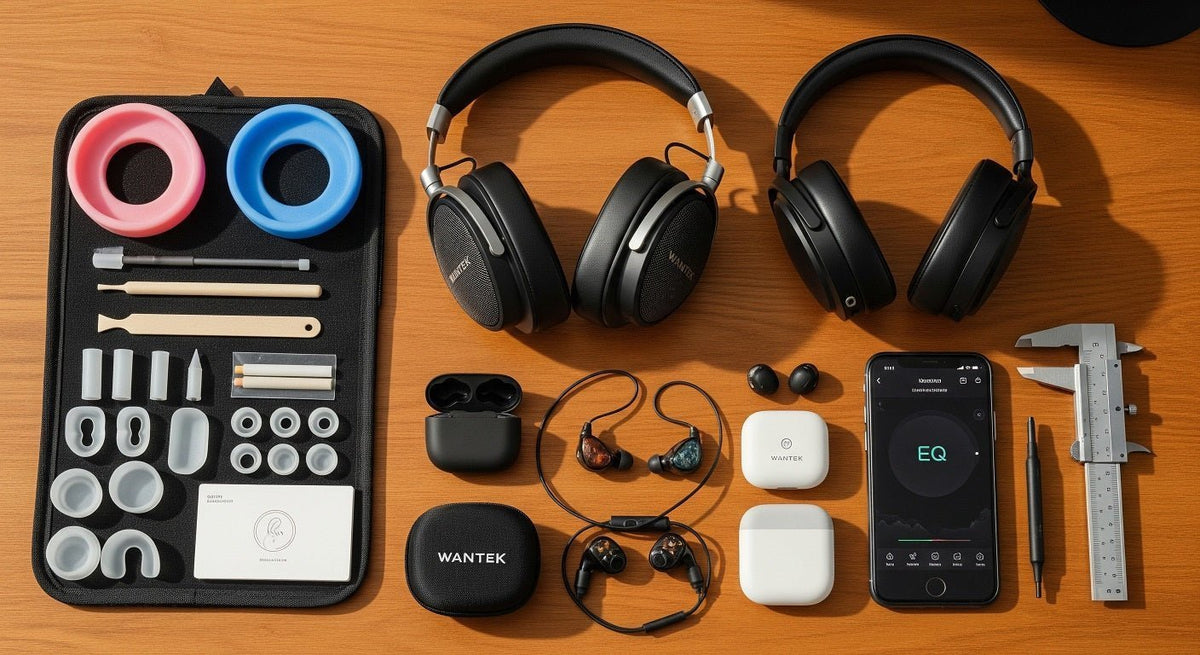
“Custom headphones” can mean three different things: custom-fit in-ear monitors built from your ear impressions, cosmetic personalization such as colors or artwork, or software-based sound personalization. These are different products and processes. Start by deciding which kind of customization you actually need.
Quick answer: custom-fit IEMs make the most sense when secure fit, repeatable seal, stage monitoring, or long-term professional use justifies the extra process and cost. Cosmetic customization changes appearance, not fit or acoustics. Personalized EQ changes sound without creating a custom physical shell.

Three Meanings of “Custom Headphones”
| Type | What changes | Best reason to choose it |
|---|---|---|
| Custom-fit IEM | The physical earpiece is built from an impression or scan of your ears. | Secure fit, repeatable seal, professional monitoring, or long wear where universal tips are not working well. |
| Cosmetic customization | Colors, faceplates, artwork, engraving, shields, cables, or case details. | Personal identity, stage branding, team branding, or a distinctive look. |
| Sound personalization | EQ, hearing-profile processing, app presets, or user-selected tuning. | Changing tonal balance without ordering a physically custom shell. |
How Custom-Fit In-Ear Monitors Are Made
True custom-fit IEMs begin with ear geometry, not a generic small/medium/large tip. The exact workflow varies by manufacturer. Ultimate Ears PRO instructs customers to obtain detailed impressions from an audiologist and send those molds to the company, which then builds and tunes the monitor. 64 Audio describes a workflow that scans the impressions, digitally refines them, 3D-prints the shells, and hand-assembles the remaining components.
Choose the IEM model and intended job
Stage monitoring, broadcast, studio work, and personal listening can favor different tuning, driver configurations, isolation, and service options.
Follow the manufacturer’s impression requirements
Do not assume one impression format works for every brand. 64 Audio, for example, requires approved ear impressions for its custom IEM orders and publishes specific impression guidance.
Select cosmetic options separately
Shell colors, faceplates, artwork, engraving, and cable choices can personalize appearance, but they do not turn one acoustic model into another.
Check the fit policy when the monitors arrive
Custom does not mean every first fit is automatically perfect. 64 Audio, for example, publishes a 30-day fit guarantee for approved impressions and may adjust or rebuild shells when needed.
Custom Fit Can Improve Consistency, but It Does Not Guarantee “Perfect Sound”
A well-made custom shell is designed to match the wearer’s ear geometry and maintain a repeatable fit. That can be valuable for musicians and other users who need the earpieces to stay secure through long sessions. It can also reduce the trial-and-error involved in finding universal tips that seal consistently.
The fit is only one part of sound quality. Driver design, crossover, acoustic path, tuning, insertion depth, source, recording, and listener preference still matter. A custom shell therefore should not be described as automatically more accurate or better sounding than every universal IEM.
For live-performance use specifically, Wantek’s IEM guide for stage monitoring separates earpiece fit from the wired or wireless monitoring system that feeds the performer.
Cosmetic Customization Is a Separate Decision
Custom-fit IEM makers often offer extensive visual choices. Ultimate Ears PRO’s current designer, for example, lets buyers choose among supported models and customize faceplate, engraving, cable, case, and other available options. 64 Audio’s current custom-product terms likewise document shell and faceplate colors plus supplied artwork, while noting that the final placement and color can differ from the generated preview.

For over-ear DJ headphones, historical examples need a current-status check. V-MODA was well known for customizable shields, but its current U.S. site states that customized shields—including printed and engraved logos and designs—are no longer offered at this time. That makes old buying guides describing V-MODA engraving as an active service outdated for current U.S. shoppers.
Custom-Fit vs. Universal IEMs
Universal IEMs use standardized shells with replaceable ear tips. They are easier to audition, resell, share, and replace. Custom IEMs require an impression or scan workflow, take longer to produce, and are built for one wearer.
- Choose custom fit when: universal tips repeatedly fail to stay secure, stage monitoring is central to the job, you wear IEMs for long sessions, or you specifically value a shell made for your ears.
- Choose universal when: you want easier returns, resale, sharing, immediate availability, or the ability to compare several models without an impression process.
- Do not buy by driver count alone: more balanced-armature, dynamic, or planar drivers do not automatically produce better tuning or a better fit.
- Check service terms: custom products can have special fit, remake, repair, cancellation, and return rules.
Price and Build Time Vary by Model and Manufacturer
There is no reliable universal “custom IEM price” or “standard four-to-eight-week wait.” Current products span a wide range. Ultimate Ears PRO’s current custom designer, for example, lists models from the UE 5 PRO at $599 through the UE PREMIER at $2,999, while its support page says custom IEM production typically takes up to 10 business days after the company receives ear impressions. Other makers publish different prices and build-time policies.
Use the current manufacturer page when budgeting. A model page from a few years ago can be useful background, but it should not be treated as current price, availability, turnaround time, or customization policy.

What to Verify Before Ordering
- Impression requirements: which audiologist instructions, bite position, canal depth, file format, or physical mold the manufacturer accepts.
- Fit policy: how long you have to report a fit problem and who pays shipping or remake costs.
- Sound signature: whether the chosen model’s tuning suits your task before committing to a custom shell.
- Connector and cable: the exact connector standard, replacement availability, and whether third-party cables are supported.
- Artwork rules: accepted file types, placement limits, trademark requirements, and extra charges.
- Return and resale constraints: physically customized products can have different return options and limited resale value because they are made for one wearer.
If your priority is high-fidelity listening rather than a custom physical fit, start with Wantek’s audiophile headphone guide before paying for a custom process. The right category depends on the listening job, not on how bespoke the product sounds in marketing copy.
Frequently Asked Questions
What are custom headphones?
The term can mean custom-fit IEMs molded to your ears, cosmetic personalization such as artwork or engraving, or software-based sound personalization. Those forms of customization should not be treated as the same feature.
Do custom IEMs always sound better than universal IEMs?
No. A custom shell can provide a more repeatable personal fit, but sound also depends on the model’s drivers, tuning, acoustic design, source, recording, insertion, and your preferences.
Do I need an audiologist for custom IEMs?
Follow the manufacturer’s current instructions. Ultimate Ears PRO and 64 Audio both direct customers toward manufacturer-specific ear-impression requirements, and 64 Audio requires approved impressions for custom orders.
Can I still order V-MODA custom engraved shields?
V-MODA’s current U.S. site says it no longer offers customized headphone shields, including logo/design printing and engraving, at this time. Older pages or regional pages may still describe historical programs.

