
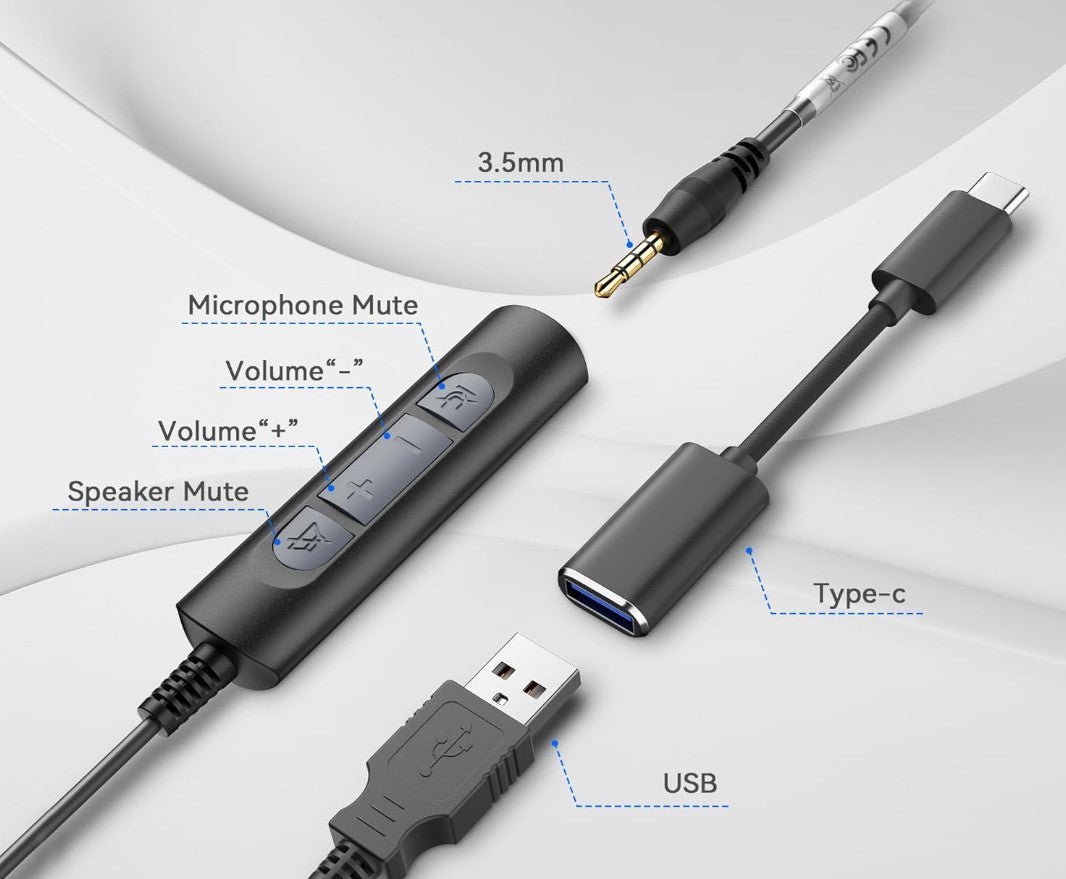
“USB to headphone adapter” can describe several different devices. The useful distinction is not simply male versus female: it is which side is the digital USB source, which side is analog audio, and whether the 3.5 mm connection carries headphones only or a headset microphone too.
Quick answer: Match the USB connector first, then confirm the direction of conversion and the 3.5 mm wiring. A USB-C plug to 3.5 mm jack is common for connecting analog headphones to a digital device, but not every adapter supports TRRS microphones or inline controls.

“Male” and “Female” Describe Shape, Not Function
A male connector is a plug and a female connector is a receptacle. Those terms do not tell you whether a device converts digital audio, accepts microphone input or supports inline controls. Use them only after the signal direction is clear.
| Check | Question | Why it matters |
|---|---|---|
| USB side | USB-C or USB-A? | The adapter must physically and electronically match the source device. |
| 3.5 mm side | Plug or jack? | A jack accepts a headphone/headset plug; a plug connects to an audio socket. |
| TRS vs TRRS | Headphones only or headset mic too? | Microphone input needs the adapter and source to support the required headset wiring. |
| Conversion direction | USB digital to analog audio, or something else? | Passive wiring cannot replace a required DAC/ADC function. |
Most USB-to-3.5 mm Dongles Are Source-Side Adapters
A common adapter has a USB-C or USB-A plug on one end and a 3.5 mm female jack on the other. It lets a USB host send audio to analog headphones or speakers. Apple's current USB-C to 3.5 mm Headphone Jack Adapter is one example of this direction: a USB-C device connects to a standard 3.5 mm audio plug.
For a general buying checklist covering DACs, headset microphones and operating-system support, see Wantek's USB-to-headphone-jack compatibility guide.
TRRS Microphone Support Must Be Explicit
A 3.5 mm socket can carry stereo output without accepting microphone input. If you need a wired headset for calls, verify TRRS microphone support, the required wiring standard, and whether inline buttons are supported on the source device.
USB-C Does Not Guarantee the Same Audio Behavior Everywhere
USB-C describes the connector. Audio support depends on the device and adapter implementation. A digital USB audio adapter with its own conversion electronics is usually the clearer choice when compatibility matters.
Apple's USB-C to 3.5 mm adapter is a current example for USB-C devices, but other computers, phones and tablets can have different microphone and control behavior.
USB Headphone Adapter FAQ
What does a female 3.5 mm jack mean?
It is the socket that receives a 3.5 mm plug. It does not by itself confirm microphone input, TRRS wiring or inline-control support.
Does every USB-C headphone adapter contain a DAC?
No. Designs vary. When the source requires digital USB audio, choose an adapter documented for that purpose rather than assuming a passive cable will work.
Can a USB adapter support a headset microphone?
Yes, if the adapter and source explicitly support headset microphone input and the required 3.5 mm wiring. Headphone output alone is not enough.

