
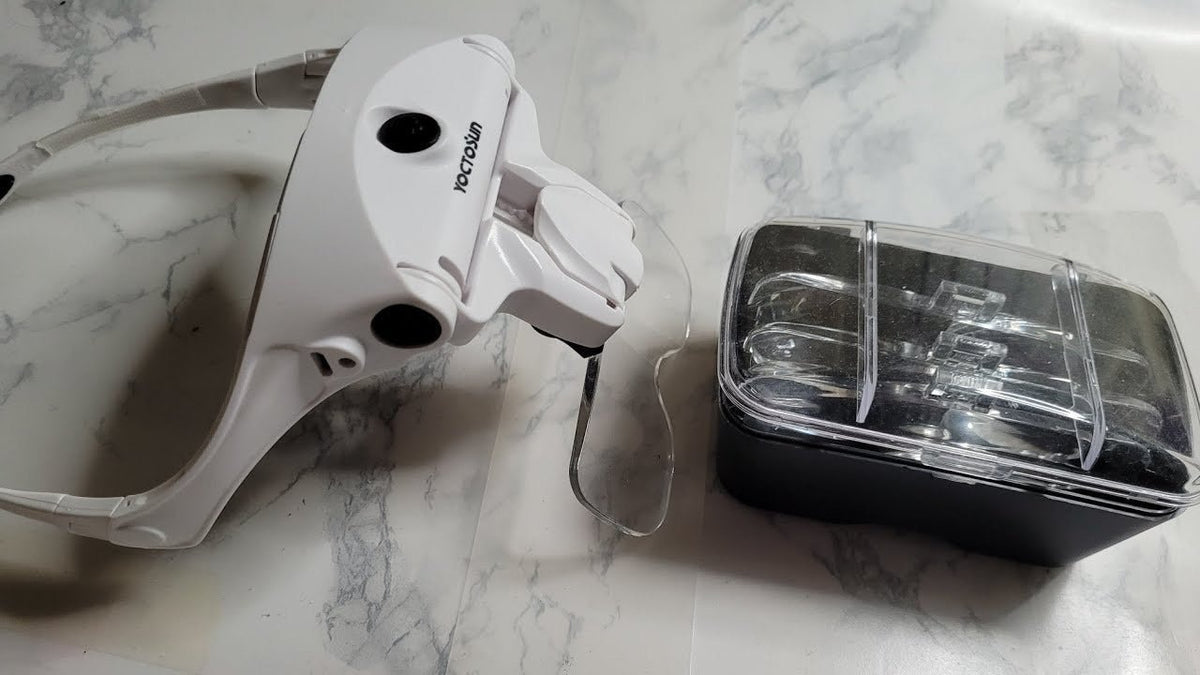
A magnifying headset is a head-worn magnifier that keeps both hands free for close work. The right choice depends less on chasing the highest magnification and more on matching magnification, working distance, lens design, lighting, and fit to the task.
Quick answer: Donegan OptiVISOR offers the widest documented choice of working distances in this comparison, from 20 inches at 1.5x to 4 inches at 3.5x. Carson MagniVisor Deluxe CP-60 is the option here with an integrated removable LED and four interchangeable lens powers. OptiVISOR LX and OptiSIGHT cover mid-range magnification choices with different lens materials and configurations.
This guide compares four current manufacturer-documented models. It is not a hands-on ranking, and Wantek has not lab-tested these magnifiers side by side.
How to choose a magnifying headset for precision work
Start with working distance, not maximum magnification
Higher magnification usually means a shorter working distance. Donegan makes that trade-off explicit: its OptiVISOR lens plates range from 1.5x at a 20-inch focal length to 3.5x at 4 inches. If you need room for a soldering iron, tweezers, a brush, or other tools, a longer working distance can be easier to use than a higher-power lens.
Check the lens system
Interchangeable lenses are useful when one task needs a wider working area and another needs more detail. OptiVISOR uses interchangeable optical-glass prismatic lens plates. OptiSIGHT uses optical-grade acrylic prismatic lenses. Carson CP-60 includes four interchangeable lenses at 1.5x, 2x, 2.5x, and 3x.
Decide whether the light needs to be built in
Task lighting matters when your hands, tools, or the workpiece create shadows. The Carson CP-60 includes a removable LED lamp powered by three AAA batteries. The Donegan models compared below focus on the visor and lens system rather than an integrated lamp, so plan your lighting separately if illumination is a priority.
Confirm fit with your existing eyewear
Donegan states that both OptiVISOR and OptiSIGHT can be worn over prescription or safety eyeglasses. Fit is still personal, so check headband adjustment, lens clearance, and the working position you expect to use for long sessions.

Four current magnifying headsets to compare in 2026
| Model | Verified optical range | What distinguishes it |
|---|---|---|
| Donegan OptiVISOR | 1.5x at 20 in to 3.5x at 4 in, depending on lens plate | Optical-glass prismatic lenses and the broadest documented working-distance range in this comparison |
| Donegan OptiVISOR LX | 1.75x at 14 in, 2x at 10 in, 2.5x at 8 in, or 2.75x at 6 in | Molded optical prismatic lenses, tilting visor, and dial-adjustment headband |
| Donegan OptiSIGHT | 1.75x, 2x, and 2.5x included; 2.75x optional | Optical-grade acrylic prismatic lenses and compatibility with prescription or safety glasses |
| Carson MagniVisor Deluxe CP-60 | 1.5x, 2x, 2.5x, and 3x | Removable LED lamp, four-lens case, 0.33 lb listed weight, and three-AAA power |
Donegan OptiVISOR: widest documented working-distance choice
OptiVISOR provides the broadest documented power-and-distance range in this four-model comparison. Donegan offers six lens plates: 1.5x/20 inches, 1.75x/14 inches, 2x/10 inches, 2.5x/8 inches, 2.75x/6 inches, and 3.5x/4 inches. The optical-glass lens plates are interchangeable, and the visor tilts up when magnification is not needed.
Donegan OptiVISOR LX: a narrower mid-range set
OptiVISOR LX covers four documented choices from 1.75x at 14 inches to 2.75x at 6 inches. Donegan specifies molded optical prismatic lenses, adjustable side pivots, a dial-adjustment headband, and a padded leather comfort band. It makes sense when those mid-range working distances match the bench task and you do not need the OptiVISOR's 1.5x or 3.5x endpoints.
Donegan OptiSIGHT: acrylic lenses with three included powers
OptiSIGHT includes 1.75x, 2x, and 2.5x interchangeable acrylic prismatic lens plates, with a 2.75x plate available separately. The visor flips up for normal viewing and can be worn over prescription or safety glasses. Choose it when that lens range and eyewear clearance match your work setup.
Carson MagniVisor Deluxe CP-60: integrated removable LED
Carson's CP-60 combines four lens powers—1.5x, 2x, 2.5x, and 3x—with a removable LED lamp. Carson lists the visor at 0.33 lb and specifies three AAA batteries. The light can also be removed for separate use. It is the only model in this four-model comparison with a documented integrated removable LED.
Match the magnifier to the task
Electronics and soldering
Favor a working distance that leaves enough room for your hands and tools. A lower-power lens with a longer focal length may be more practical than maximum magnification when you need to move a soldering iron, probes, or tweezers around the workpiece.
Jewelry, watch work, and miniature parts
Higher power can reveal smaller details, but it also brings the work closer. Compare the required detail level with the focal distance you can actually maintain at your bench rather than choosing by magnification alone.
Sewing, crafts, and model building
A moderate lens power is often easier to manage when you need to see both the detail and the surrounding work area. Interchangeable lens systems are useful if you regularly switch between broad positioning and closer inspection.
Selection rule: choose the lowest magnification that shows the detail you need at a comfortable working distance, then treat lighting, fit, and lens material as tie-breakers.
Frequently asked questions
Is 3.5x magnification always better than 2x?
No. Higher magnification shortens working distance and narrows how you position the work. OptiVISOR, for example, lists 2x at 10 inches and 3.5x at 4 inches.
Can a magnifying headset fit over prescription glasses?
Some can. Donegan specifically states that OptiVISOR and OptiSIGHT can be worn over prescription or safety eyeglasses. Check clearance and headband fit for your own frames.
Do I need a magnifying headset with a light?
Not always. Good bench lighting may be enough. If you want illumination attached to the visor, Carson CP-60 includes a removable LED lamp powered by three AAA batteries.
What is the best magnifying headset for precision work?
There is no universal winner. Match working distance and magnification to the task first, then compare lens material, lighting, eyewear clearance, headband adjustment, and weight.

