
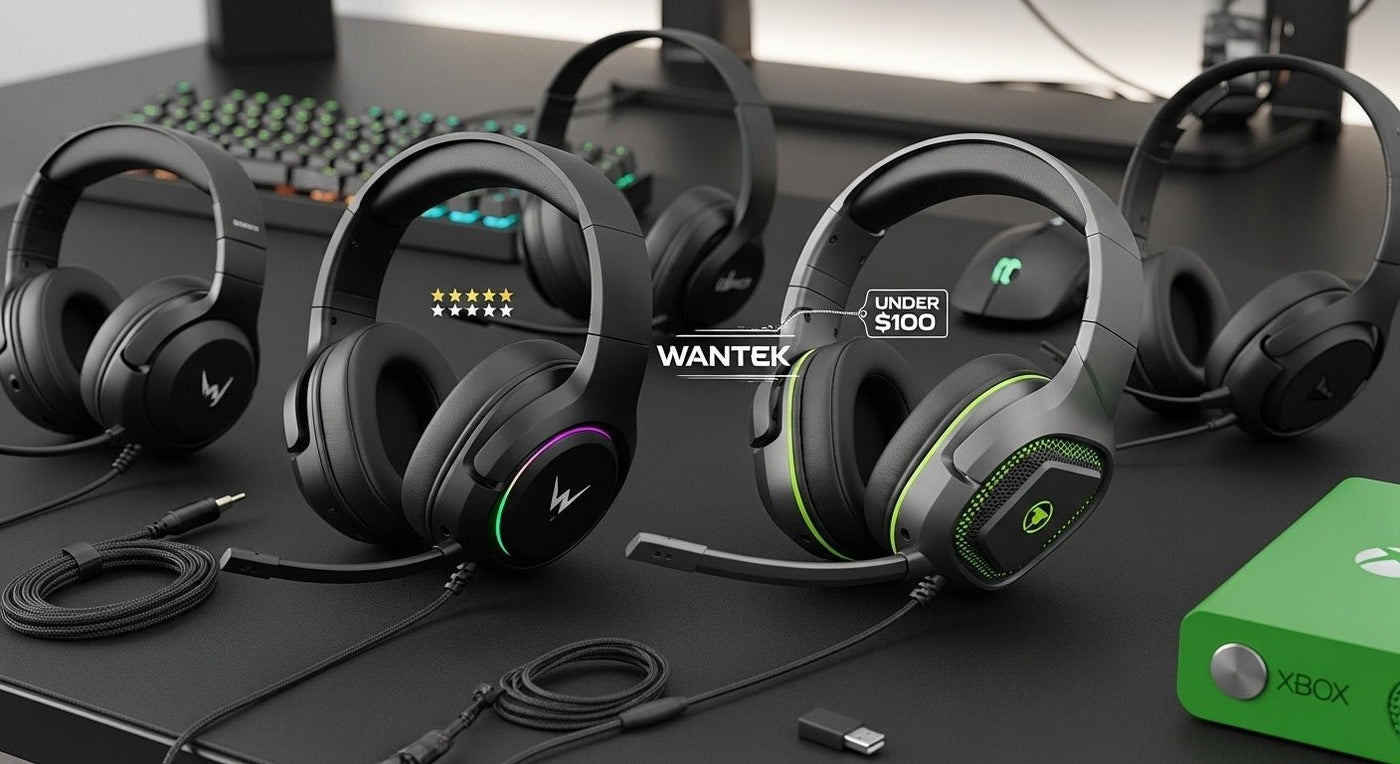
A gaming headset under $100 should be judged first by platform compatibility, microphone usability and connection type—not by RGB or virtual-surround labels. Prices change frequently, so this guide uses current manufacturer listings as a snapshot and focuses on models that are at or below the $100 mark when checked.
Current examples: HyperX Cloud III wired, Logitech G321 LIGHTSPEED, Logitech G325 LIGHTSPEED and Razer BlackShark V3 X HyperSpeed for PlayStation are all currently listed at $100 or less on their manufacturers' US stores. Verify the live price and exact platform before ordering.

Budget Gaming Headsets: Start With the Platform
PC, PlayStation, Xbox and Nintendo Switch do not share one universal wireless headset path. A 3.5 mm wired headset can be broadly compatible when the controller or device provides the right jack, while USB and wireless dongles must explicitly support the target platform.
| Model | Connection | Current manufacturer positioning |
|---|---|---|
| HyperX Cloud III | 3.5 mm, USB-C and USB-A wired | PC, PS5/PS4, Xbox Series/One, Switch, Mac and mobile compatibility listed |
| Logitech G321 LIGHTSPEED | Dedicated wireless | Current lower-cost Logitech G wireless model; verify target platform on product page |
| Logitech G325 LIGHTSPEED | Dedicated wireless | Current Logitech G wireless model listed below $100 at time checked |
| Razer BlackShark V3 X HyperSpeed for PlayStation | HyperSpeed wireless | PlayStation-specific current model listed at $99.99 when checked |
HyperX Cloud III: Wired and Broadly Compatible
HyperX currently lists the Cloud III with 3.5 mm, USB-C and USB-A connectivity, a detachable 10 mm microphone and compatibility across PC, PS5, PS4, Xbox Series X|S, Xbox One, Switch, Mac and mobile. The wired path removes charging from the decision.
Logitech G321 and G325: Lower-Cost Wireless Options
Logitech G's current gaming-audio catalog lists G321 LIGHTSPEED and G325 LIGHTSPEED below $100. Because prices and platform variants can change, treat the live product page—not a roundup—as the final compatibility and price source.
Razer BlackShark V3 X HyperSpeed: Check the Platform Variant
Razer currently lists a BlackShark V3 X HyperSpeed for PlayStation at $99.99. The “for PlayStation” wording matters: do not assume that one wireless SKU supports every console family.
Wireless vs. Wired Under $100
- Wired: no battery management; often simpler cross-platform use through 3.5 mm or supported USB.
- Dedicated wireless: more freedom of movement but requires platform-compatible transmitter support and charging.
- Bluetooth: useful for phones and some PCs, but not a universal console game-audio solution.
Microphone Quality Is Not a Driver-Size Spec
A larger headphone driver does not make the microphone clearer. For chat, compare boom position, mute method, sample recordings, background-noise handling and whether the mic works over the connection you plan to use.
Wantek Budget Gaming Options
Wantek's current range includes the Voistek V9 Pro wired gaming headset and Wantek V10 cat-ear gaming headset below $100, plus the T2L wireless model. Use the individual product page to confirm the exact PC, PS5 or Xbox connection path before buying.
Price is volatile. A headset included here because it is under $100 today can move above that threshold later. Compatibility changes more slowly than promotions, so prioritize platform fit first.
Frequently Asked Questions
What is the best gaming headset under $100?
There is no universal winner. Cloud III favors wired compatibility; current Logitech and Razer models provide lower-cost wireless choices for supported platforms.
Is wireless worth it under $100?
Yes when the transmitter supports your platform and you value movement. Wired remains simpler when charging and wireless compatibility are bigger concerns.
Will a PS5 wireless headset work on Xbox?
Do not assume so. Console wireless support can be platform-specific. Check the exact headset SKU and manufacturer compatibility list.
Does 7.1 or spatial audio guarantee better positional sound?
No. Game mix, software, HRTF processing, headphone tuning and your own hearing all affect positional perception.

