
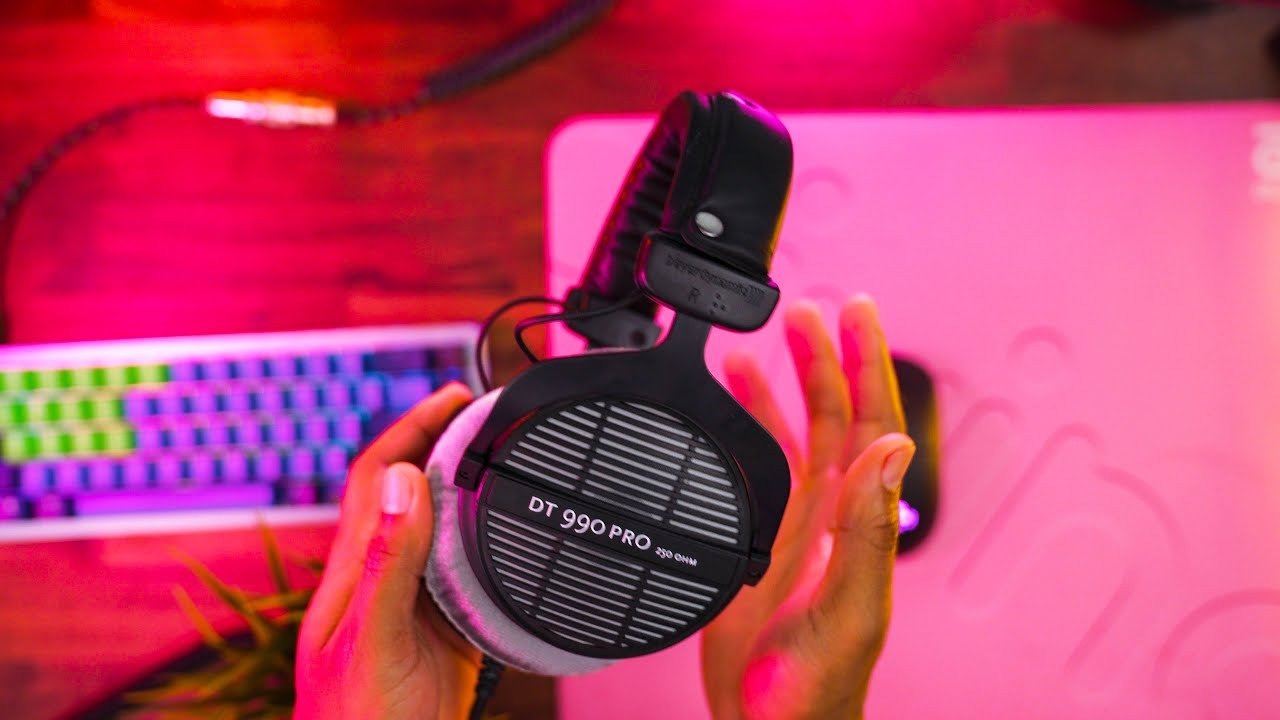
The beyerdynamic DT 770 PRO and DT 990 PRO solve different studio problems. DT 770 PRO is closed-back for monitoring and recording when isolation and lower leakage matter. DT 990 PRO is open-back for critical listening and editing when a quieter room and more open presentation are acceptable.
Choose by enclosure first, impedance second. DT 770 PRO is currently offered in 32, 80 and 250 ohms. DT 990 PRO is currently offered in 80 and 250 ohms. The impedance changes source requirements and cable configuration; it does not turn the closed model into the open model or vice versa.

DT 770 PRO vs. DT 990 PRO
| Feature | DT 770 PRO | DT 990 PRO |
|---|---|---|
| Enclosure | Closed-back | Open-back |
| Primary manufacturer positioning | Control and monitoring; recording and use where isolation matters | Critical listening and precise editing |
| Current impedance options | 32, 80 and 250 ohms | 80 and 250 ohms |
| Leakage / isolation | Lower leakage and more passive isolation | High leakage and little isolation by design |
| Cable | Fixed cable; length/type varies by impedance version | Fixed cable; straight on current 80-ohm version, coiled on 250-ohm version |
| Replaceable parts | Replaceable pads and serviceable parts | Replaceable pads and serviceable parts |
See the current DT 770 PRO and DT 990 PRO product pages for current variants and specifications.
Choose DT 770 PRO for Tracking and Shared Rooms
The closed DT 770 PRO reduces sound leakage into nearby microphones and provides more passive isolation from the room. That makes it the more natural choice for vocal tracking, instrument monitoring, editing around other people, or situations where open-back leakage would be disruptive.
Closed-back does not mean active noise cancellation. The isolation comes from the earcups and pads, and fit still affects the result.
Choose DT 990 PRO for Quiet-Room Critical Listening
The open DT 990 PRO lets sound pass through the earcups. beyerdynamic positions it for critical listening and editing, where the open design can provide a more spacious presentation and room noise is controlled.
It is a poor choice near a sensitive live microphone because the playback can leak outward. It also does little to block office, travel, or household noise.
32 vs. 80 vs. 250 Ohms
Impedance is not a quality ladder. beyerdynamic positions the DT 770 PRO 32-ohm version toward mobile devices, 80 ohms as a general studio option, and 250 ohms toward professional devices. DT 990 PRO currently offers 80- and 250-ohm versions.
The actual level you get also depends on headphone sensitivity and the source's voltage/current capability. Check the audio interface, headphone amp, laptop or other source rather than assuming every 250-ohm output will be too quiet or every 32-ohm version will be ideal.
The Cable Difference Matters in Daily Studio Use
The classic DT 770 PRO and DT 990 PRO use fixed cables. The exact cable differs by impedance variant. This is worth checking if the workstation is close to an interface, if a coiled cable is preferred, or if field recording requires a shorter cable.
If a detachable cable is important, beyerdynamic now offers PRO X versions. The current DT 770 PRO X uses a 48-ohm STELLAR.45 driver and a locking mini-XLR detachable cable.
DT 770 PRO X Is a Different Product, Not Just an Impedance Option
beyerdynamic explicitly distinguishes the DT 770 PRO X from the classic DT 770 PRO. The PRO X uses a 48-ohm STELLAR.45 driver, detachable cable and updated headband comfort features, while the classic model remains available in three impedance versions with a fixed cable.
Do not mix PRO X specifications into a DT 770 PRO review or buying comparison.
Sound Signature Is Not “Closed = Bass, Open = Accurate”
Enclosure type affects the acoustic design, but it does not create a universal sound signature. DT 770 PRO and DT 990 PRO have their own tuning choices, and both should be evaluated with measurements and familiar reference material.
Neither is automatically the correct mixing reference for every engineer. Translation to speakers and other headphones remains part of the workflow.
Comfort and Serviceability
Both classic models use circumaural pads and spring-steel headbands. beyerdynamic sells replacement parts, which matters for headphones used daily in studios.
Pad wear changes the seal and acoustics over time, so replacing worn pads is not just cosmetic maintenance.
Which One Should You Buy?
- Recording vocals or instruments: start with DT 770 PRO.
- Editing or critical listening in a quiet room: compare DT 990 PRO.
- Mobile source: consider the source output and the DT 770 PRO 32-ohm option.
- General studio use: 80-ohm versions can be practical, but confirm source level.
- Detachable cable requirement: compare the newer PRO X family instead of assuming the classic models have removable cables.
For the broader recording-vs-mixing decision, see Studio Headphones for Recording & Mixing.
Frequently Asked Questions
Is DT 770 PRO better than DT 990 PRO?
They are designed for different environments. DT 770 PRO is closed for isolation and monitoring; DT 990 PRO is open for critical listening where leakage is acceptable.
Which DT 770 PRO impedance should I choose?
Match the version to the source. beyerdynamic currently positions 32 ohms for mobile devices, 80 ohms for general studio use and 250 ohms for professional devices.
Does DT 990 PRO leak sound?
Yes. It is intentionally open-back, so it leaks audio outward and provides little isolation from the room. That makes it unsuitable near many live microphones.
Do DT 770 PRO and DT 990 PRO have detachable cables?
The classic PRO models use fixed cables. Newer PRO X models such as DT 770 PRO X use detachable locking mini-XLR cables.

