
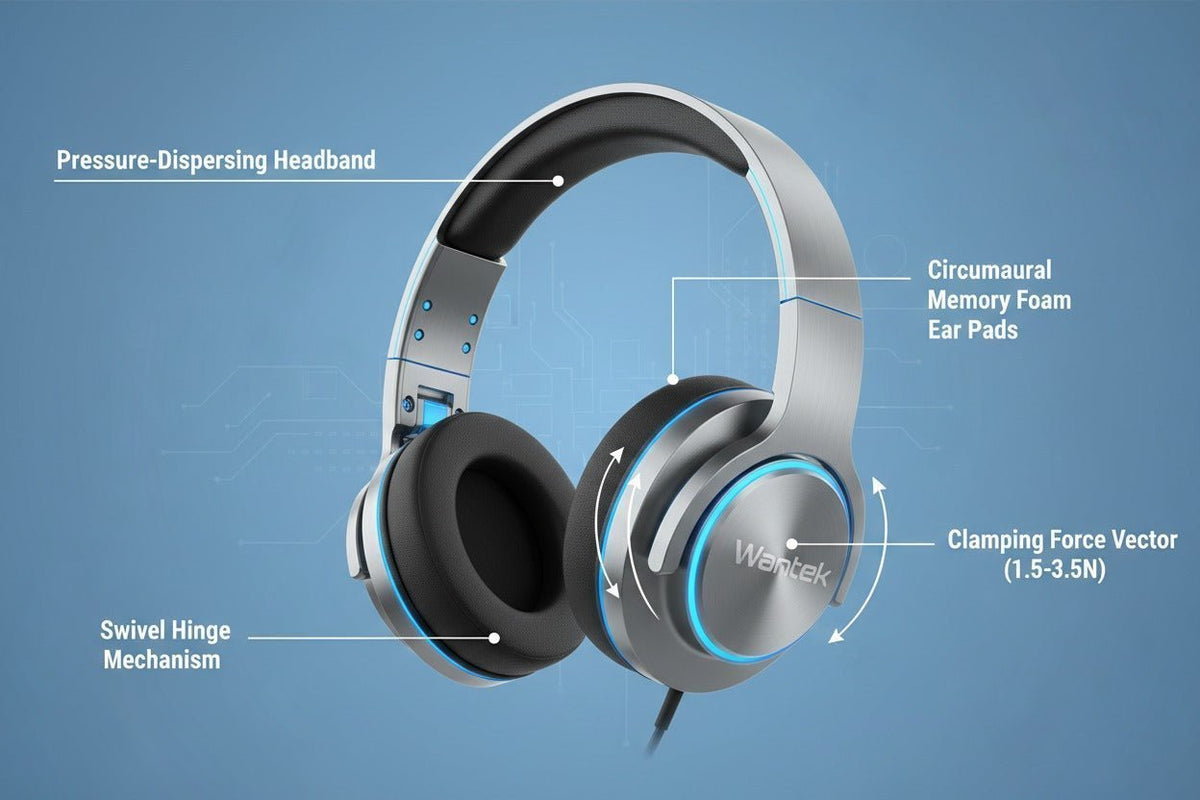
Le confort d'un casque pour de longues sessions d'écoute ne se définit pas par un chiffre unique. Le poids compte, mais la pression de l'arceau, l'espace disponible dans les oreillettes, la matière des coussinets, l'accumulation de chaleur, le port de lunettes et la répartition du poids sur la tête sont tout aussi importants. Ce guide compare cinq modèles circum-auraux actuels en utilisant la documentation des fabricants et des tests de confort indépendants disponibles au 21 septembre 2026. Wantek n'a pas testé ces cinq casques en laboratoire les uns par rapport aux autres.
Réponse rapide : Le casque Bose QuietComfort Ultra (2e gén.) bénéficie actuellement du signal de confort indépendant le plus fort de ce groupe. Le Sony WH-1000XM6 est une alternative sans fil plus légère, le Sennheiser MOMENTUM 5 Wireless met l'accent sur l'autonomie de la batterie, le beyerdynamic DT 770 PRO reste une option filaire de studio respirante, et l'AirPods Max 2 utilise une suspension en maille pour répartir la pression, mais au prix d'un poids important.
Qu'est-ce qui rend un casque réellement confortable pour de longues sessions ?
Le confort est une notion personnelle. Une comparaison utile doit donc se concentrer sur des variables physiques vérifiables plutôt que sur un chiffre universel de « force de serrage idéale ». Commencez par ces cinq facteurs :
- Répartition de la pression : Un arceau plus large ou mieux rembourré peut réduire la pression concentrée sur le sommet du crâne.
- Ajustement des oreillettes : Vos oreilles doivent tenir à l'intérieur des coques sans contact persistant avec la grille des haut-parleurs ou les coutures des coussinets.
- Matière et chaleur des coussinets : Des coussinets souples peuvent être très agréables au début, mais devenir chauds lors d'une session de plusieurs heures.
- Poids et équilibre : Une masse plus faible peut aider, mais un casque plus lourd peut rester confortable si son poids est bien réparti.
- Votre usage : Les déplacements, le travail au bureau, l'écoute critique, les jeux et les appels imposent des exigences différentes en termes d'ajustement, d'isolation, de mobilité et d'autonomie.
Si vous hésitez encore entre différents formats (circum-aural, supra-aural, intra-aural), commencez par le guide des types de casques de Wantek avant de comparer les modèles individuels.

5 casques confortables à comparer pour de longues sessions d'écoute
Comment lire cette sélection : Il s'agit de cinq modèles actuels présentant des caractéristiques de conception axées sur le confort et des cas d'utilisation distincts. Il ne s'agit pas d'un classement universel de 1 à 5, car la forme de la tête, la taille des oreilles, le port de lunettes, la sensibilité à la température et le serrage préféré peuvent modifier le résultat.
| Modèle | Faits liés au confort | Principal compromis |
|---|---|---|
| Bose QuietComfort Ultra Headphones (2e gén.) | Coussinets doux et moelleux ; arceau réglable ; choix de confort indépendant actuel de SoundGuys | Prix élevé ; l'ajustement dépend toujours de la forme de la tête et des oreilles |
| Sony WH-1000XM6 | Conception circum-aurale ; environ 254 g ; jusqu'à 30 heures avec réduction de bruit | Le poids faible ne garantit pas que les oreillettes conviennent à toutes les oreilles |
| Sennheiser MOMENTUM 5 Wireless | Ajustement circum-aural ; environ 290 g ; jusqu'à 57 heures avec ANC activée | L'autonomie ne remplace pas un essai réel de confort et de chaleur |
| beyerdynamic DT 770 PRO | Coussinets en velours respirant ; arceau en acier à ressort sécurisé ; composants remplaçables | Conception filaire ; poids de 375 g câble inclus selon la fiche produit |
| AirPods Max 2 | Suspension en maille tricotée respirante ; coussinets à mémoire de forme ; 386,2 g avec coussinets | Beaucoup plus lourd que le Sony WH-1000XM6 et le MOMENTUM 5 Wireless |
1. Bose QuietComfort Ultra Headphones (2e gén.) : La référence actuelle en matière de confort
Parmi ces cinq modèles, le Bose QuietComfort Ultra (2e gén.) présente l'argument de confort indépendant le plus clair actuellement. Dans sa mise à jour du 17 septembre 2026, SoundGuys l'a désigné comme le casque le plus confortable, citant un rembourrage généreux, une construction principalement en plastique et des haut-parleurs inclinés qui entourent les oreilles au lieu d'exercer une pression directe sur elles.
Bose met également en avant des coussinets doux et moelleux ainsi qu'un arceau réglable conçus pour offrir un ajustement léger et une étanchéité sécurisée. Cela fait de ce modèle une première comparaison logique pour les longs voyages, le travail au bureau ou pour les acheteurs privilégiant les casques à réduction de bruit confortables.
À noter : « Confortable » ne signifie pas « adapté à tout le monde ». La forme des branches de lunettes, de la mâchoire, la hauteur des oreilles et la sensibilité à la chaleur peuvent modifier l'expérience après la première heure.

2. Sony WH-1000XM6 : Une option sans fil plus légère
Le Sony WH-1000XM6 est une comparaison pratique lorsque la masse compte. Sony indique que ce casque circum-aural pèse environ 254 g, avec jusqu'à 30 heures de lecture musicale continue avec la réduction de bruit activée.
Cela rend le XM6 nettement plus léger que l'AirPods Max 2 et un peu plus léger que le MOMENTUM 5 Wireless. La question pertinente n'est pas de savoir si 254 g est une valeur « idéale », mais si les oreillettes libèrent bien vos oreilles et si l'arceau reste confortable tout au long de votre session habituelle.
Idéal pour : les navetteurs, les voyageurs et les utilisateurs mobiles souhaitant un casque sans fil circum-aural relativement léger avec ANC.
3. Sennheiser MOMENTUM 5 Wireless : Une longue autonomie sans poids excessif
Sennheiser présente le MOMENTUM 5 Wireless comme un modèle circum-aural pesant environ 290 g. Son autonomie annoncée est de 57 heures de lecture musicale avec ANC activée, selon les conditions de test de Sennheiser, et la batterie est remplaçable par l'utilisateur.
Pour les longues sessions, cette autonomie réduit les interruptions de charge, mais elle ne doit pas être confondue avec un confort physique garanti. La température des coussinets, le serrage, la pression sur le crâne et l'interaction avec les lunettes nécessitent toujours un essai personnel.
Idéal pour : les auditeurs sans fil qui privilégient l'autonomie et souhaitent une conception circum-aurale pour une utilisation prolongée à la maison, en voyage ou au bureau.
4. beyerdynamic DT 770 PRO : Velours respirant pour une station d'écoute fixe
Le modèle filaire DT 770 PRO reste utile lorsque l'autonomie et la mobilité sans fil ne sont pas prioritaires. beyerdynamic souligne ses coussinets en velours doux et respirant, son arceau en acier à ressort sécurisé et ses composants remplaçables. La fiche produit actuelle indique un poids de 375 g, câble inclus.
La conception filaire est la plus logique pour une utilisation sur bureau, en studio ou toute autre position d'écoute fixe. Les coussinets remplaçables sont également un atout précieux, car l'usure ou l'affaissement des coussinets peut altérer l'ajustement et le confort au fil du temps.
Idéal pour : l'écoute sédentaire, le montage, la production ou les jeux vidéo, où un câble est acceptable et où les coussinets respirants sont une priorité.
5. AirPods Max 2 : Répartition intelligente du poids malgré un compromis sur la masse
L'approche d'Apple concernant le confort est différente. L'entreprise affirme que la suspension en maille respirante répartit le poids pour réduire la pression sur la tête, tandis que les coussinets utilisent une mousse à mémoire de forme. Cette conception peut améliorer la sensation du port, mais le casque reste lourd.
Apple indique un poids de 386,2 g avec les coussinets pour les AirPods Max 2, avec jusqu'à 20 heures d'écoute avec l'ANC activée. Pour les sessions prolongées, un essai physique est particulièrement important plutôt que de supposer que la suspension compensera la masse supplémentaire pour votre morphologie.
Idéal pour : les utilisateurs déjà investis dans l'écosystème Apple qui apprécient ses fonctionnalités et sont à l'aise avec le poids après un essai représentatif.
Comment tester le confort d'un casque avant de le conserver
Un essai rapide peut masquer les problèmes qui apparaissent lors d'une véritable session de travail, d'un vol, d'un film ou d'une partie de jeu. Utilisez les mêmes conditions que celles que vous prévoyez après l'achat.
Portez-le pour une session représentative.
Laissez suffisamment de temps à la pression et à la chaleur pour se manifester au lieu de juger l'ajustement dans les premières minutes.
Portez vos lunettes et coiffures habituelles.
Vérifiez si les coussinets appuient sur les branches de vos lunettes au niveau des tempes ou si l'arceau crée un point de pression concentré.
Vérifiez l'espace pour les oreilles et la chaleur.
Notez si vos oreilles touchent la grille des haut-parleurs ou la couture des coussinets et si les oreillettes deviennent inconfortablement chaudes.
Bougez comme vous le faites normalement.
Tournez la tête, regardez vers le bas, levez-vous et utilisez les commandes. Un ajustement confortable ne devrait pas nécessiter de repositionnement constant.
Séparez le confort physique de l'attrait des fonctionnalités.
L'ANC, l'audio spatial, l'autonomie et la qualité sonore peuvent améliorer l'expérience globale, mais ne corrigent pas un point de pression ou un mauvais ajustement des oreillettes.
Pour le travail impliquant de nombreuses réunions, la liste de contrôle pour casques de bureau de Wantek utilise la même approche pratique : testez la pression, la chaleur, le glissement et les lunettes lors d'une réunion représentative plutôt que de vous fier à une promesse de « confort toute la journée ».
Le confort inclut également des habitudes d'écoute sûres
L'ajustement physique n'est qu'une partie d'une longue session d'écoute. Les conseils de l'Organisation mondiale de la Santé sur l'écoute sûre soulignent que le risque dépend à la fois du niveau sonore et de la durée. Elle cite 80 dB jusqu'à 40 heures par semaine à titre d'exemple et recommande des casques bien ajustés avec réduction de bruit lorsqu'ils permettent de réduire la nécessité d'augmenter le volume dans des environnements bruyants.
C'est une règle plus pertinente que de supposer que l'ANC rend n'importe quel niveau d'écoute sûr. Gardez le volume et le temps d'exposition sous contrôle, même lorsque le casque semble physiquement confortable.
Besoin plutôt d'un casque pour vos appels professionnels ?
Si votre priorité est l'utilisation du microphone, la compatibilité avec vos appareils, le format (filaire ou sans fil) et le confort pour de longs appels, le sélecteur de Wantek peut affiner la catégorie de casque pertinente, sans prétendre qu'un casque pour appels est le même produit qu'un casque circum-aural destiné avant tout à la musique.
Questions fréquentes
Quel modèle est le meilleur point de départ si le confort est ma priorité ?
Le Bose QuietComfort Ultra (2e gén.) présente les preuves de confort indépendant les plus solides parmi ces cinq modèles. Le Sony WH-1000XM6 est une alternative plus légère, mais dans les deux cas, un essai personnel reste nécessaire.
Les casques plus légers sont-ils toujours plus confortables ?
Non. Un poids moindre peut aider, mais la pression de l'arceau, l'espace des oreillettes, la chaleur des coussinets et la répartition du poids peuvent être tout aussi importants lors d'une longue session.
Que doivent tester en priorité les porteurs de lunettes ?
Portez le casque avec vos lunettes habituelles et vérifiez la pression sur les tempes, l'étanchéité des coussinets, la chaleur et le glissement lors d'une session représentative. Un coussinet souple ne garantit pas un ajustement confortable avec des lunettes.
L'ANC rend-elle le casque plus confortable pour de longues sessions ?
L'ANC peut réduire la nécessité d'augmenter le volume dans les endroits bruyants, ce qui peut améliorer l'expérience globale. Elle ne corrige pas l'inconfort physique lié au serrage, au poids, à la chaleur ou à un mauvais ajustement.

