
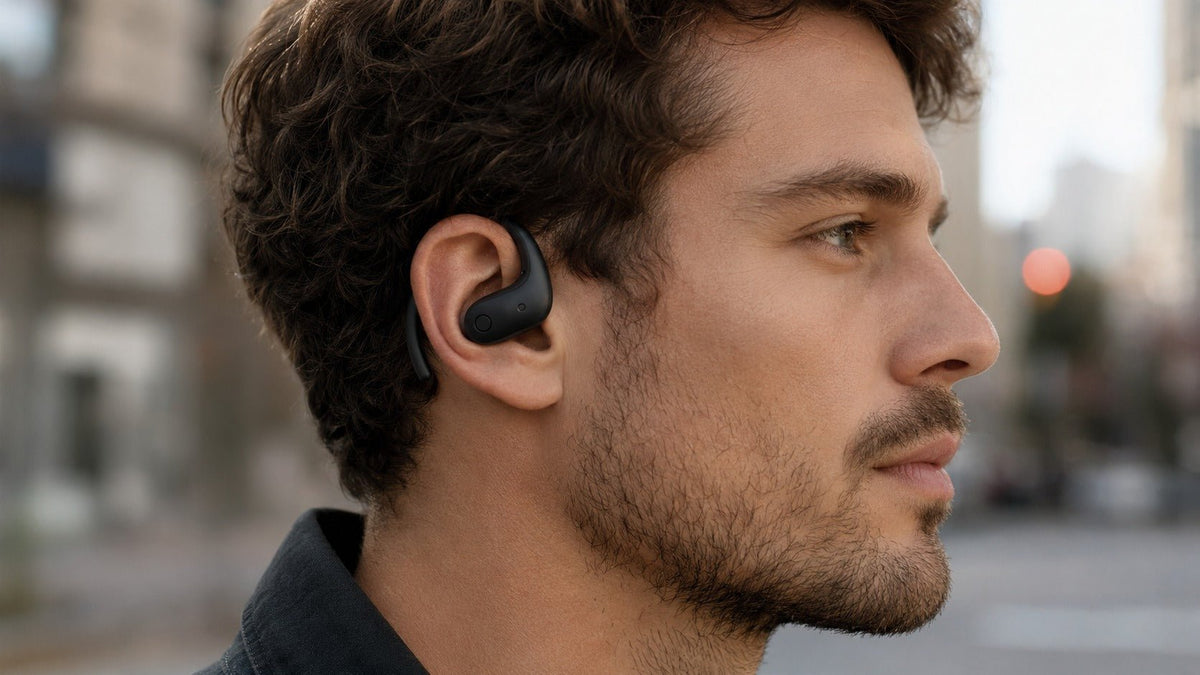
Ear-Cuff-Kopfhörer sind offene Clip-on-Ohrhörer, die einen Lautsprecher in der Nähe des Gehörgangs halten, ohne diesen zu verschließen. Der Cuff oder Bügel umschließt die Ohrmuschel, sodass Sie Musik hören können, während Umgebungsgeräusche weiterhin an Ihr Ohr dringen. Das macht dieses Format ideal für den Arbeitsweg, Spaziergänge, entspannte Arbeitssituationen und für Hörer, die In-Ear-Aufsätze nicht mögen.
Ein wichtiger Unterschied ist, dass „Ear Cuff“ nicht automatisch Knochenschall bedeutet. Die meisten der aktuellen Cuff-Modelle in diesem Leitfaden verwenden Luftschall-Lautsprecher. Shokz beispielsweise beschreibt seine OpenDots 2 ausdrücklich als Luftschallprodukt, obwohl sie für Anrufe auch ein Knochenschall-Mikrofon nutzen.
Welche Clip-on-Ohrhörer sollten Sie in Betracht ziehen? Achten Sie zuerst auf den Sitz: Ein Cuff sollte sicher an der Ohrmuschel sitzen, ohne zu drücken oder den Gehörgang zu blockieren. Für den Sport sollten Sie die Bewegungsfreiheit und die genaue Wasserschutzklasse prüfen; für Arbeitsanrufe ist die Mikrofonleistung in Ihrer spezifischen Umgebung entscheidend; für den Arbeitsweg sollten Sie entscheiden, ob es Ihnen wichtiger ist, Ihre Umgebung wahrzunehmen, als Lärm auszublenden.
Dies ist ein auf Spezifikationen basierender Kaufratgeber, kein Praxistest. Die engere Auswahl basiert auf Herstellerinformationen und trennt dokumentierte Funktionen von redaktionellen Anwendungsvorschlägen.
Was zählt als Ear-Cuff-Kopfhörer?
Auf Shopping-Seiten finden sich verschiedene, sich überschneidende Bezeichnungen: Ear-Cuff-Kopfhörer, Ear-Cuff-Ohrhörer, Clip-on-Ohrhörer und offene Clip-on-Ohrhörer. Dieser Leitfaden konzentriert sich auf die offene Cuff-Form, bei der der Lautsprecher außerhalb des Gehörgangs sitzt. Wenn Sie zusätzlich In-Ear-Bügel und klassische On-Ear-Clips vergleichen möchten, finden Sie hier unseren Leitfaden zu Arten und Sitz von Ear-Clip-Kopfhörern.
| Design | Platzierung | Typischer Schallweg | Was Sie erwartet |
|---|---|---|---|
| Ear Cuff / Clip-on | Platzierung: Klemmen oder Bügel an der Ohrmuschel | Typischer Schallweg: Meist Luftschall | Was Sie erwartet: Offener Kanal, kompakte zweiteilige Cuff-Form |
| Offener Ohrbügel | Platzierung: Haken über oder um das Ohr | Typischer Schallweg: Meist Luftschall | Was Sie erwartet: Sichtbarere Unterstützung um das Ohr |
| Knochenschall-Headset | Platzierung: Wandler liegen seitlich am Kopf an | Typischer Schallweg: Knochenschall | Was Sie erwartet: Oft mit Nackenbügel oder Rahmen hinter dem Kopf |
| In-Ear-Ohrhörer | Platzierung: Im oder am Gehörgang | Typischer Schallweg: Luftschall mit versiegeltem oder halb versiegeltem Sitz | Was Sie erwartet: Bessere Isolation, der Kanal ist jedoch blockiert |
Ein Cuff-förmiges Produkt kann dennoch Mikrofone oder Sensoren nutzen, die auf Knochenschwingungen basieren. Das macht den Lautsprecher selbst jedoch nicht zu einem Knochenschall-Wandler. Wenn dieser Unterschied für Sie relevant ist, prüfen Sie die vom Hersteller angegebene Lautsprechertechnologie, anstatt sie von der Form abzuleiten.
Sechs aktuelle Ear-Cuff-Kopfhörer zum Vergleich im Jahr 2026
Es gibt kein einzelnes Modell, das für jedes Ohr perfekt ist. Anpressdruck, Ohrform, Akkubedarf, Gerätewechsel, Wasserschutz, Mikrofonnutzung und Budget können die Antwort beeinflussen. Die folgende Tabelle ist eine engere Auswahl basierend auf veröffentlichten Spezifikationen, nicht auf gemessenen Klang- oder Komfortwerten.
| Modell | Angegebener Sitz / Gewicht | Angegebener Akku | Multipoint | Wasserschutz |
|---|---|---|---|---|
| Wantek OBT030 | Sitz / Gewicht: Offener Clip-on; 8,5 g | Akku: Bis zu 50 Std. gesamt mit Case | Multipoint: Nicht auf aktuellem Datenblatt angegeben | Wasserschutz: Nicht auf aktuellem Datenblatt angegeben |
| ambie AM-TW02 | Sitz / Gewicht: Sound Earcuff; 4,4 g | Akku: Ca. 6 Std.; 24 Std. mit Case | Multipoint: Ja | Wasserschutz: IPX5 Ohrhörer |
| Bose Ultra Open Earbuds | Sitz / Gewicht: Cuff-förmiger Sitz | Akku: Bis zu 7 Std. ohne Immersive Audio | Multipoint: Ja | Wasserschutz: IPX4 Ohrhörer |
| Shokz OpenDots 2 | Sitz / Gewicht: Clip-on; 6,4 g ± 0,2 g | Akku: Bis zu 10 Std.; 40 Std. mit Case | Multipoint: Verbindung mit zwei Geräten über App möglich | Wasserschutz: IP57 Ohrhörer |
| Soundcore AeroClip | Sitz / Gewicht: Offener Clip-on; 6,0 g | Akku: 8 Std.; 32 Std. mit Case | Multipoint: Ja | Wasserschutz: IP55 |
| Sony LinkBuds Clip | Sitz / Gewicht: Offener Clip; ca. 6,5 g pro Stück | Akku: Bis zu 9 Std. Musikwiedergabe | Multipoint: Ja | Wasserschutz: IPX4 |
Wantek OBT030: eine einfache offene Clip-on-Option
Die Produktseite des Wantek OBT030 führt ein offenes Clip-on-Design, ein Gewicht von 8,5 g, Bluetooth 5.4 und ein integriertes Mikrofon auf. Die Akkuangaben sind unterschiedlich: 8 Stunden für die Ohrhörer und bis zu 50 Stunden insgesamt bei Aufladung über das Case. Er positioniert sich als Begleiter für Workouts, Pendeln, Anrufe und tägliches Hören.
Die aktuelle Produktseite bestätigt kein Multipoint und keine Wasserschutzklasse, daher sollten diese Funktionen nicht vorausgesetzt werden. Wenn eine dieser Funktionen für Sie unerlässlich ist, prüfen Sie die genaue Produktdokumentation vor der Bestellung.

ambie AM-TW02: ein leichtes Sound-Earcuff-Design
Die Spezifikationen des ambie AM-TW02 listen 4,4 g pro Ohrhörer, Bluetooth 5.3, ca. 6 Stunden Laufzeit, bis zu 24 Stunden mit Case, Multipoint-Unterstützung und IPX5-Wasserschutz. Die Seite nennt SBC- und AAC-Codecs.
Dies ist das literalste „Earcuff“-Design in dieser Auswahl. Es ist nützlich, wenn geringes Gewicht und eine schmuckähnliche Form wichtiger sind als die längste Akkulaufzeit pro Ladung.
Bose Ultra Open Earbuds: Cuff-Sitz mit Multipoint
Bose beschreibt die Ultra Open Earbuds als Cuff-förmige offene Ohrhörer mit Bluetooth-Multipoint. Bose nennt Bluetooth 5.3, IPX4-Wasserschutz, kein Active Noise Cancelling und bis zu 7 Stunden Akkulaufzeit bei ausgeschaltetem Immersive Audio.
Diese Angaben beziehen sich auf die ursprünglichen Ultra Open Earbuds. Im Jahr 2026 stellte Bose zudem Ultra Open Earbuds (2. Generation) vor, mit bis zu 9 Stunden Wiedergabe und einem überarbeiteten Ladecase. Prüfen Sie die Generation, bevor Sie Akkuwerte vergleichen. Keine der Versionen sollte wegen Active Noise Cancellation gewählt werden: Das offene Design bietet kein ANC.
Shokz OpenDots 2: längere Einzellaufzeit und IP57
Die aktuelle OpenDots 2-Seite von Shokz listet ein 6,4 g schweres Clip-on-Design, bis zu 10 Stunden pro Ladung und 40 Stunden mit Case, kabelloses Laden und IP57-Wasserschutz. Shokz gibt an, dass das System Luftschall statt Knochenschall nutzt.
Vergleichen Sie die OpenDots 2, wenn Ihnen eine 10-stündige Wiedergabe, die IP57-Zertifizierung und der Wechsel zwischen zwei Geräten wichtig sind. Shokz nutzt für ein Mikrofon Knochenschall, nicht für die Musikwiedergabe: Das Lautsprechersystem ist ein Luftschall-System.
Soundcore AeroClip: ein funktionsreicher 6-g-Clip-on
Die aktuelle Seite zum Soundcore AeroClip listet ein 6,0 g schweres Clip-on-Design, Bluetooth 5.4, 8 Stunden Wiedergabe, 32 Stunden mit Case, Multipoint und eine IP55-Zertifizierung.
Das macht ihn interessant, wenn Sie Multipoint und einen leichten Clip suchen, ohne einen Nackenbügel tragen zu wollen. Wie bei allen offenen Designs garantieren Treibergröße oder Funktionen keine perfekte Passform oder Klangqualität in einer lauten Umgebung.
Sony LinkBuds Clip: Multipoint und bis zu neun Stunden Laufzeit
Die Spezifikationen der Sony WF-LC900 listen ein offenes Design, Bluetooth 5.3, Multipoint, IPX4-Wasserschutz und bis zu 9 Stunden kontinuierliche Musikwiedergabe. Sony nennt SBC und AAC als unterstützte Formate.
Ziehen Sie dieses Modell in Betracht, wenn Sie ein aktuelles Clip-on von Sony suchen und Multipoint Teil Ihres Workflows ist. Der IPX4-Schutz ist für Spritzwasser im Rahmen der Bedingungen geeignet, jedoch kein Hinweis auf Schwimmfähigkeit.
Wie man Ear-Cuff-Kopfhörer auswählt
Starten Sie mit dem Anpressdruck und der Ohrform
Clip-on-Ohrhörer lösen das Problem mit dem Gehörgang, indem sie den Kontaktpunkt an die Ohrmuschel verlagern. Das wirft jedoch neue Fragen auf: Wo drückt der Bügel und bleibt der Lautsprecher optimal zur Gehöröffnung ausgerichtet? Ein Modell kann leicht sein und sich trotzdem unbequem anfühlen, wenn die Klemmgeometrie nicht zu Ihrem Ohr passt.
Priorisieren Sie Rückgabemöglichkeiten oder die Chance, das Produkt zu testen. Prüfen Sie, ob Brillen, Ohrringe, Kopfbedeckungen oder Haare den Bügel stören. Testen Sie beim Sport Gehen, Kopfdrehungen und leichtes Joggen, bevor Sie allein aufgrund der Form von einem sicheren Sitz ausgehen.

Vergleichen Sie Akkuwerte auf derselben Basis
Vergleichen Sie nicht die Laufzeit einer einzelnen Ladung eines Modells mit der Gesamtlaufzeit inklusive Case eines anderen. Ein Modell mit 40 oder 50 Stunden Gesamtlaufzeit muss nach einer kurzen Sitzung eventuell trotzdem wieder ins Case. Prüfen Sie auch, ob Spatial-Audio, Anrufe oder hohe Lautstärke die Laufzeit beeinflussen.
Entscheiden Sie, ob Multipoint wichtig ist
Wenn Sie zwischen Laptop und Smartphone wechseln, suchen Sie nach einer expliziten Angabe zur Multipoint-Unterstützung (zwei Geräte gleichzeitig). Die Bluetooth-Version allein ist kein Indiz für gleichzeitige Verbindungen. Daher ist eine Pauschalaussage wie „Bluetooth 6.0 ist erforderlich“ nicht hilfreich: Aktuelle Cuff-Modelle umspannen viele Bluetooth-Generationen mit unterschiedlichen Verbindungsfunktionen.
Lesen Sie IP-Schutzklassen wörtlich
Wasserschutzwerte sind modellspezifisch. Ein IPX4- oder IPX5-Ohrhörer sollte nicht als Schwimm-Headset behandelt werden, nur weil das Design den Gehörgang offen lässt. Prüfen Sie außerdem, ob die Zertifizierung für die Ohrhörer, das Case oder beides gilt.
Prüfen Sie Anrufbedürfnisse separat von der Musik
Ein eingebautes Mikrofon bestätigt nur, dass Anrufe möglich sind; es garantiert keine gute Sprachaufnahme bei Wind oder in einem offenen Büro. Wenn Anrufe wichtig sind, machen Sie eine Testaufnahme in der Umgebung, in der Sie die Ohrhörer nutzen wollen, und prüfen Sie die Mikrofonkonfiguration an Ihrem Gerät.
Zu erwartende Kompromisse bei offenen Ohren
Clip-on-Ohrhörer verschließen den Gehörgang nicht. Sie hören Umgebungsgeräusche, haben aber weniger passive Isolation als mit versiegelten In-Ears. Basswiedergabe und Schallleckagen hängen vom Design, der Ohrform, der Lautstärke und der Umgebung ab; der Clip-on-Vergleich von SoundGuys diskutiert diese Kompromisse. Betrachten Sie eine angegebene Treibergröße nicht als Versprechen für die Klangqualität an Ihrem spezifischen Ohr.
Wenn Sie hauptsächlich in Flugzeugen, Zügen oder einem lauten Büro hören und Hintergrundgeräusche unterdrücken wollen, ist ein versiegelter ANC-Ohrhörer oder ANC-Kopfhörer die bessere Kategorie. Wenn das Hören von Sprache, Ansagen oder Verkehr wichtiger ist, passt das offene Cuff-Format besser zu Ihren Anforderungen.
Open-Ear bedeutet nicht automatisch, dass das Hören bei hoher Lautstärke sicherer ist. Die WHO-Richtlinien für sicheres Hören betonen sowohl die Lautstärke als auch die Hördauer. Vermeiden Sie es in lauten Umgebungen, das offene Design durch ständiges Erhöhen der Lautstärke auszugleichen.
Ear Cuffs vs. Knochenschall: Wählen Sie je nach Einsatzzweck
Verwenden Sie einen Clip-on-Ear-Cuff, wenn Sie eine kleine True-Wireless-Bauform, einen offenen Gehörgang und keinen Nackenbügel wünschen. Nutzen Sie Knochenschall, wenn Sie gezielt Wandler suchen, die Schwingungen über den seitlichen Kopfbereich übertragen, oft in Form eines sportorientierten Rahmens, der hinter dem Kopf verläuft. Verwenden Sie ein Open-Ear-Design mit Ohrbügel, wenn Sie mehr physischen Halt um das Ohr benötigen.
Vermischen Sie beim Vergleich der technischen Daten nicht die Kategorien. Ein Nackenbügel-Headset zum Schwimmen und ein schmuckartiger Ear-Cuff lösen unterschiedliche Anforderungen an Passform und Nutzung, auch wenn beide den Gehörgang offen lassen.
Häufig gestellte Fragen
Handelt es sich bei Ear-Cuff-Kopfhörern um Knochenschall?
Normalerweise nicht. Die meisten aktuellen Cuff-Style-Ohrhörer in diesem Leitfaden verwenden Luftschall-Lautsprecher in der Nähe des Gehörgangs; Knochenschall-Produkte nutzen Wandler, die gegen die Seite des Kopfes vibrieren.
Können andere Leute Ear-Cuff-Kopfhörer hören?
Sie können mehr Schall nach außen abgeben als geschlossene Ohrhörer, insbesondere bei höheren Lautstärken in ruhigen Räumen. Der Schallaustritt variiert je nach Design, Sitz, Abstimmung und Lautstärke. Testen Sie dies daher in Ihrer gewohnten Umgebung.
Sind Ear-Cuff-Kopfhörer sicherer für das Gehör?
Gehen Sie nicht davon aus. Das Gehörrisiko hängt stark von der Lautstärke und der Hördauer ab; ein offenes Design kann ebenfalls laut genug eingestellt werden, um eine gesundheitsgefährdende Belastung zu erzeugen.
Eignen sich Ear-Cuff-Kopfhörer zum Laufen?
Sie können sich zum Laufen eignen, wenn der Clip sicher sitzt und das Modell eine entsprechende Schweißresistenz aufweist. Die Passform ist individuell; testen Sie daher die Bewegungsstabilität und prüfen Sie die genaue IP-Schutzklasse, bevor Sie sich darauf verlassen.
Wie sollten Clip-on-Ohrhörer sitzen?
Der Clip sollte ohne zu drücken an der Ohrmuschel halten, und der Lautsprecher sollte nahe am – aber nicht im – Gehörgang sitzen. Probieren Sie Kopfdrehungen aus und machen Sie einen kurzen Spaziergang, besonders wenn Sie eine Brille tragen.
Kann man mit Ear-Cuff-Kopfhörern schwimmen?
Nur, wenn der Hersteller das Schwimmen oder Untertauchen für genau dieses Modell explizit unterstützt. Eine IP-Schutzklasse für Spritzwasser- oder Schweißfestigkeit sollte nicht als Erlaubnis für die Nutzung im Schwimmbad angesehen werden.

