
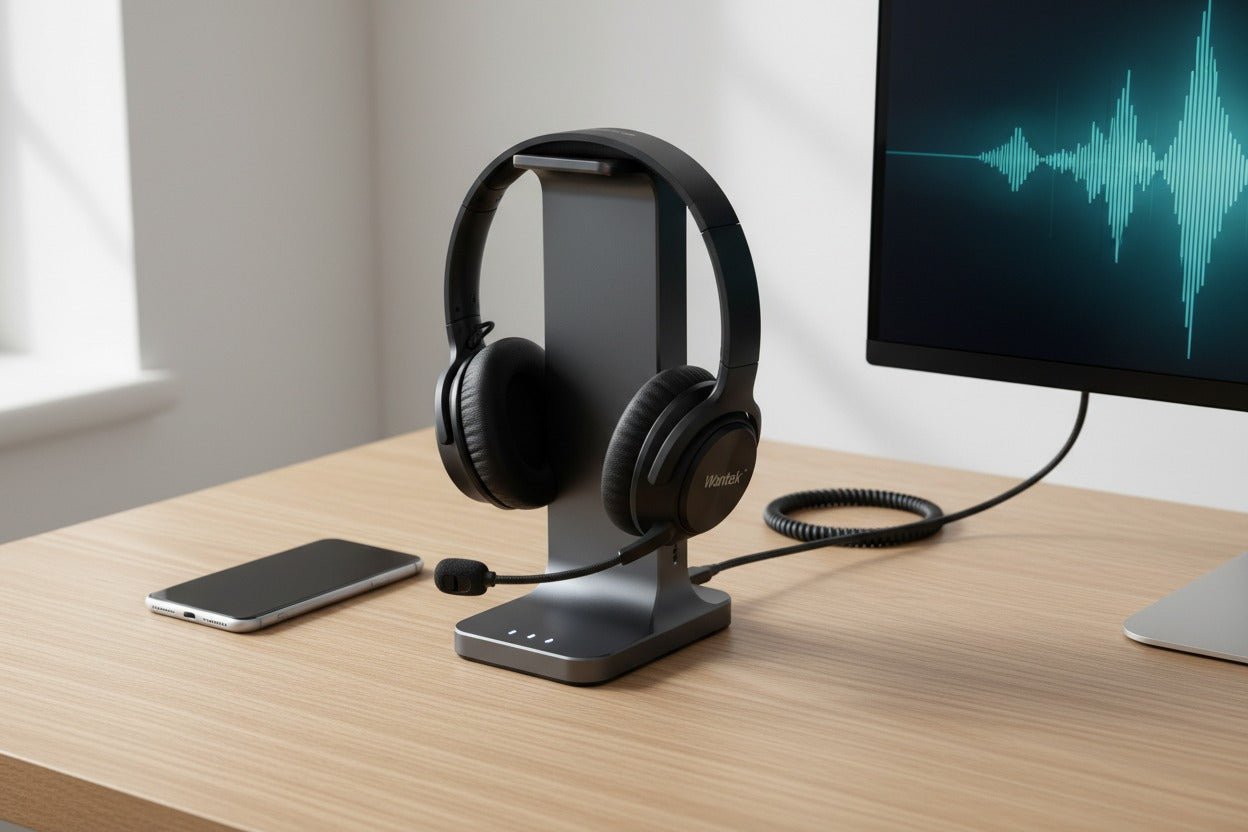
For 2026, a strong customer-service headset should balance microphone performance, wearer comfort, connectivity, reliability, and compatibility with the devices and communications platforms your team actually uses. Active Noise Cancellation (ANC) can help the wearer in noisy environments, while microphone noise reduction matters more to what the customer hears.
This guide compares five practical options across wired USB, Bluetooth, and DECT workflows. Rather than treating one model as universally best, the recommendations match different headsets to specific operating environments. For additional comparisons, see Best headsets for customer service.
The Evolution of Customer Experience Technology
Customer-service teams now work across offices, contact centers, home workspaces, and hybrid environments. That makes headset selection more than a question of sound quality. Device compatibility, microphone behavior, comfort over long sessions, mobility requirements, call controls, and IT manageability can all affect the day-to-day experience.
A Customer Service Headset should therefore be selected around the actual workflow rather than specifications in isolation.
This 2026 buying guide explains the core technologies, compares representative business headsets, and provides a practical framework for choosing equipment for customer support and contact-center work.

1. The Anatomy of a Great Customer Service Headset
Before comparing models, it helps to separate the technologies that affect what the agent hears from those that affect what the caller hears.
1.1 Active Noise Cancellation (ANC) vs. Passive Isolation
- Passive Isolation: Reduces external sound through the physical design and fit of the earcups or ear cushions. Performance varies significantly with seal, materials, wearing style, and frequency.
- Active Noise Cancellation (ANC): Uses microphones and signal processing to reduce ambient sound reaching the wearer. It can be useful in noisy offices, shared workspaces, commuting environments, or homes with persistent background noise.
ANC should not be confused with microphone noise reduction. ANC primarily improves the wearer's listening environment; microphone processing determines how much surrounding noise is transmitted to the other person.
1.2 Microphone Technology: What the Caller Hears
For customer-service work, microphone performance is often more important than music-oriented speaker tuning.
Important microphone concepts include:
- Directional or Unidirectional Microphones: Designed to be more sensitive to sound arriving from particular directions. A properly positioned boom microphone can improve the ratio between the user's voice and surrounding sound.
- Noise-Reducing Microphone Systems: May combine multiple microphones, directional pickup, beamforming, or digital signal processing to distinguish speech from competing noise.
- Omnidirectional Microphones: Capture sound more evenly from different directions. They are not inherently unsuitable for calls, but placement and signal processing become especially important in noisy environments.
Microphone quality cannot be judged from the term "DSP" alone. Microphone placement, array design, processing algorithms, acoustic environment, and boom position all affect the result.
1.3 Connectivity: Wired, DECT, and Bluetooth
- Wired USB: Removes battery management and wireless pairing from the workflow. It is well suited to fixed computer workstations and high-volume calling environments.
- Quick Disconnect (QD): A physical connector that lets compatible wired headset components separate without removing the entire lower cable from the workstation. QD does not provide wireless mobility.
- DECT: Designed for cordless communications and commonly used in professional office-headset systems. Depending on the product and deployment, DECT can provide substantial office range and support desk-phone or computer calling.
- Bluetooth: Useful when users need laptop, mobile-device, or multi-device flexibility. Multipoint support, range, codec behavior, and platform integration vary by model.
Do not choose between DECT and Bluetooth based on a universal claim that one is "better." Choose based on devices, range requirements, mobility, wireless density, and supported call controls.
1.4 Battery Life and Charging
There is no universal minimum talk-time specification that every professional headset must meet.
Instead, compare:
- Expected daily call duration
- Available charging opportunities
- Whether the headset can operate while charging
- Battery degradation over the intended replacement cycle
- Fast-charge performance for the specific model
A headset used for intermittent calls has different battery requirements from one used continuously throughout a long support shift.
2. Top Customer Service Headset Picks for 2026
The following models represent different use cases rather than an absolute ranking.
2.1 DECT for Desk Phone and PC: Jabra Engage 65 SE
The Jabra Engage 65 SE is a DECT business headset designed for desk-phone and softphone workflows.
- Key Features: Up to 150 m/490 ft stated wireless range, up to 13 hours of talk time, integrated busylight, and desk-phone plus computer connectivity.
- Best For: Fixed office environments where users need wireless movement while working between a desk phone and computer.
- Important Distinction: The Engage 65 SE itself is not a Bluetooth headset. Buyers who require direct Bluetooth mobile-device connectivity should evaluate a different model or configuration.
2.2 Bluetooth and ANC: Poly Voyager Focus 2
The Poly Voyager Focus 2 is a Bluetooth stereo headset designed for users who need mobility, ear-side ANC, and business-call microphone processing.
- Key Features: Three-level hybrid ANC, Acoustic Fence microphone technology with four microphones, up to 25 hours of stated talk time with ANC and online indicator disabled, and up to 50 m/164 ft stated wireless range.
- Best For: Hybrid and remote users who move between computer-based collaboration tools and mobile devices.
- Why Consider It: It combines wearer-side ANC with microphone-side noise reduction rather than treating them as the same feature.
2.3 DECT for Larger Office Environments: EPOS IMPACT 5000 / SDW 5061
The EPOS IMPACT 5000 family includes professional DECT configurations designed for office mobility and multi-device communications.
- Key Features: Up to 180 m/590 ft stated line-of-sight wireless range, two-microphone noise-canceling technology, and support for managing calls across PC/softphone, desk phone, and mobile-phone workflows on applicable configurations.
- Best For: Offices where users need to move away from the workstation while remaining available for calls.
- Buying Consideration: Range figures are maximum specifications. Walls, office layout, radio conditions, and deployment density can reduce real-world performance.
2.4 Budget-Focused Wired USB: Wantek H600
For fixed workstations, the Wantek H600 USB model provides a simpler wired configuration without batteries or wireless pairing.
- Key Features: Single-ear corded design, USB connection, adjustable boom microphone, inline volume and mute controls, and an approximately 85 g listed weight.
- Best For: Customer-support desks, reception work, temporary workstations, and teams that prioritize straightforward wired deployment.
- Buying Consideration: This USB configuration does not include Quick Disconnect, so QD requirements should be checked against the exact variant before purchase.
2.5 DECT with PC and Desk-Phone Integration: Yealink WH62
The Yealink WH62 is a DECT wireless headset available in mono and dual-ear configurations.
- Key Features: Dual-microphone Acoustic Shield processing, simultaneous PC and desk-phone connectivity, Teams and UC variants, and up to 14 hours of stated talk time for the dual-ear model.
- Best For: Office users who need DECT mobility while working across a computer and compatible desk-phone environment.
- Important Distinction: The WH62 is a DECT model, not a DECT/Bluetooth hybrid headset.
3. How to Match the Headset to Your Use Case
The strongest purchasing decision starts with the device and workflow rather than the brand.
| Use Case | Recommended Type | Priority Feature | Suitable Option |
|---|---|---|---|
| Open-Plan Office | Wired USB or DECT | Strong microphone noise rejection | EPOS IMPACT 5000 |
| Remote / Work-from-Home | Bluetooth | ANC + microphone noise reduction | Poly Voyager Focus 2 |
| High Call Volume at a Fixed PC | Wired USB | No battery management | Wantek H600 USB |
| Desk Phone + Computer | DECT | Dual-device call workflow | Jabra Engage 65 SE / Yealink WH62 |
| Large Office Mobility | DECT | Wireless range and call controls | EPOS IMPACT 5000 |
| Occasional Calls | Wired USB / 3.5 mm | Simplicity and compatibility | Device-dependent |
For a more detailed connector-first framework covering USB, USB-C, RJ9, wired, and wireless options, use the Call Center Headset buying guide.
Before standardizing any headset across a team, confirm:
- Computer, desk-phone, and mobile-device requirements
- USB-A, USB-C, RJ9, 3.5 mm, Bluetooth, or DECT connectivity
- Mono vs. stereo preference
- Required call-control integration
- Microphone performance in the actual acoustic environment
- Wearing comfort over realistic call durations
- Replacement cushions, cables, batteries, and other service parts
- Platform-certification requirements set by IT

4. The 2026 Trends: Beyond the Hardware
4.1 AI Integration and Real-Time Coaching
AI-assisted contact-center software increasingly analyzes conversations for functions such as transcription, quality assurance, summaries, and real-time agent guidance.
The headset's role is primarily to capture intelligible speech reliably. Cleaner microphone input can improve the quality of the audio supplied to downstream speech-recognition and analytics systems, but the headset itself should not be assumed to perform sentiment analysis, stress detection, or coaching unless those functions are explicitly documented for that product.
For AI-enabled contact centers, evaluate the entire signal path:
microphone → headset processing → operating system or softphone → communications platform → transcription or analytics software
A highly capable analytics platform cannot fully compensate for poor microphone positioning or severe background noise at the input stage.
4.2 Comfort for Hybrid and Long-Duration Work
Comfort is highly individual and cannot be reduced to headset weight alone.
Important variables include:
- Headband clamping force
- Ear-cushion material and shape
- Mono vs. stereo design
- Weight distribution
- Adjustability
- Heat buildup around the ears
- Eyeglass interaction
- Boom-microphone positioning
- Frequency and length of breaks
A heavier headset with good weight distribution may be more comfortable than a lighter model with excessive pressure. For large deployments, short wearer trials can be more informative than relying solely on product specifications.
4.3 Microsoft Teams Certification
Teams certification is useful when an organization wants tested device integration, predictable call controls, mute synchronization, and plug-and-play behavior.
Microsoft describes its certification program clearly:
“Certified devices work (plug & play) with no extra configuration required, and offer call control with Microsoft Teams.” — Microsoft, Personal peripherals certified for Microsoft Teams
Certification should therefore be treated as a procurement and interoperability advantage—not as a claim that every non-certified headset is incapable of carrying Teams audio.
5. Frequently Asked Questions
5.1 What are the best customer service headsets?
There is no single best model for every organization. The Jabra Engage 65 SE fits desk-phone and PC DECT workflows; Poly Voyager Focus 2 suits Bluetooth users who want ANC; EPOS IMPACT 5000 suits DECT mobility; WH62 fits PC-and-desk-phone DECT environments; and Wantek H600 provides a simpler wired USB option.
The correct choice depends on devices, mobility, acoustic conditions, wearing preference, IT requirements, and budget.
5.2 Wired vs. Wireless: Which Is Better for a Call Center?
Wired USB is often practical for fixed, high-volume workstations because it eliminates charging and wireless pairing.
DECT or Bluetooth is preferable when mobility is operationally important.
Security and compliance should be evaluated at the system level. A wired connection is not automatically compliant, and a wireless connection is not automatically insecure; configuration, encryption, endpoint controls, network design, software, and organizational policies all matter.
5.3 Does a More Expensive Headset Guarantee Better Call Quality?
No.
Higher-priced business headsets may add better microphone arrays, ANC, wireless mobility, certifications, management software, replacement parts, or premium materials, but price alone does not guarantee clearer calls.
Evaluate:
- Microphone performance
- Noise rejection
- Fit and comfort
- Connectivity
- Platform integration
- Durability
- Serviceability
- Warranty
- Total deployment cost
A basic wired headset can perform well in a quiet fixed workstation, while a more advanced headset may justify its cost in a difficult acoustic or mobility-intensive environment.
5.4 Is Active Noise Cancellation Necessary for Agents?
Not always.
ANC primarily benefits the wearer by reducing surrounding sound reaching the ears.
A noise-reducing microphone primarily benefits the other participant by reducing unwanted sound transmitted during the call.
In a quiet environment, microphone quality and correct boom placement may matter more than wearer-side ANC. In an open office or noisy home, having both can be useful.
5.5 Can I Use Gaming Headsets for Customer Service?
Yes, if the headset meets the actual requirements.
Gaming headsets are not inherently unsuitable for voice communication, and speaker bass tuning does not automatically determine microphone quality. However, professional business headsets may offer advantages such as:
- Better microphone noise rejection
- Dedicated call controls
- Teams or other UC certifications
- Fleet-management software
- Desk-phone integration
- Replaceable service parts
- Business-oriented warranty and support
Choose based on measured workflow requirements rather than the gaming or business label.
5.6 How Important Is the Quick Disconnect Feature?
QD can be useful in wired desk-phone environments where users frequently detach the headset from its lower cable.
It is a physical disconnect mechanism, not a wireless feature. Disconnecting a QD headset does not allow the wearer to continue a call while walking away from the workstation.
Whether QD matters depends on the connector system, desk-phone setup, and daily workflow.
6. Making the Final Decision for 2026
Selecting a business headset is a balance between microphone performance, wearer comfort, connectivity, mobility, compatibility, and lifecycle cost.
For fixed computer-based calling, a wired USB model can eliminate charging and pairing complexity. For users who regularly move around an office, DECT may provide a more appropriate workflow. For hybrid users switching between computers and mobile devices, Bluetooth can provide greater flexibility.
Before purchasing at scale:
- Identify every device the headset must connect to.
- Confirm the exact connector or wireless technology.
- Test microphone performance in the real working environment.
- Evaluate comfort across realistic call durations.
- Verify required Teams, Zoom, or other UC integrations.
- Check service parts, warranty, and replacement options.
- Pilot a small number of units before standardizing a large deployment.
The best buying decision is not the headset with the longest specification list. It is the headset that reliably matches the agent's devices, acoustic environment, mobility requirements, and daily workflow throughout its intended service life.
Headset Buying Guides
Continue Your Customer Service Headset Research
Start with the broader buying framework, then narrow your decision by connection, mobility, or desk-phone compatibility.
For Flexible Workflows
Need more freedom beyond the desk?
Explore wireless Wantek headsets for customer-service roles that need movement, flexible device use, or a less tethered calling workflow.
Best suited to readers who value mobility more than the simplicity of a fixed wired connection.
Compare Wireless Work Headsets →
