
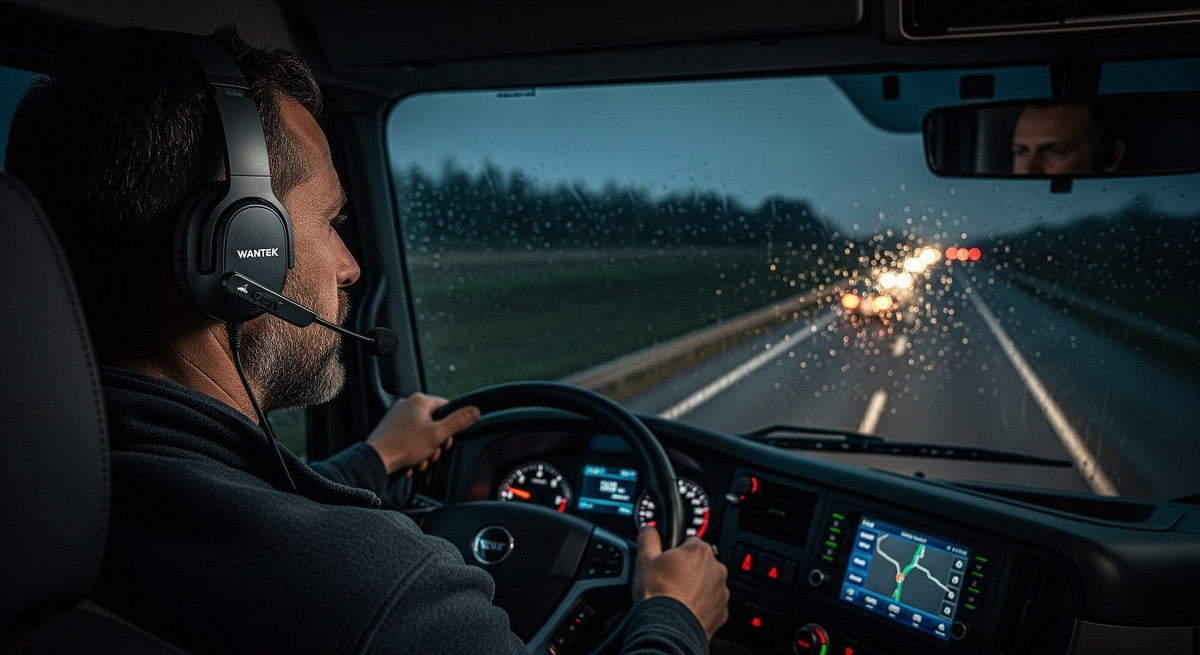
Choose a trucker Bluetooth headset by how well the caller can understand you, how the controls work with your phone, and whether the fit remains comfortable. Listener-side ANC and microphone noise reduction solve different problems. Neither feature makes a headset legally approved for driving.
Start with the call you need to make
Write down your phone model, calling app, expected call time, and charging opportunities. If dispatch uses a separate radio, record its exact model too. Bluetooth multipoint does not establish CB-radio compatibility, and a headset paired with two devices does not necessarily mix both audio streams.
Check the FMCSA mobile-phone restrictions that apply to your operation. Its guidance addresses holding, dialing, and reaching for a phone. State headphone rules are a separate check; our headphones-while-driving guide explains why single-ear use is not a nationwide exemption.
| Priority | Test while parked | Do not infer |
|---|---|---|
| Outgoing voice | Ask a caller to compare speech with normal cab noise | ANC means a noise-free microphone |
| Controls | Answer, end, mute, and unmute with your phone | Every button works in every app |
| Fit | Wear your usual glasses and headwear | Low weight guarantees comfort |
| Battery | Compare rated talk time and your charging routine | Standby time equals call time |
| Two devices | Receive a call while the second device is connected | Multipoint means simultaneous mixing |

A documented model to compare
The BlueParrott B550-XT is a purpose-built mono headset with voice-control features. Use the current manufacturer's documentation to check the exact controls and battery conditions. Treat its noise-reduction claims as manufacturer claims, not a guarantee that the person you call will hear no background sound.
It is a candidate for drivers who want an over-the-head mono design. A smaller ear-hook model may be preferable if headband pressure is the main problem, but compare its talk time and stability rather than assuming smaller means better. An open-ear design also requires its own fit and legal checks.

Separate microphone performance from listening comfort
A boom brings the microphone near your mouth, but positioning still matters. Follow the manufacturer's orientation instructions and keep the microphone out of direct airflow. Test normal speech, not only a loud voice in a silent room.
Ask the person at the other end whether words remain clear when background noise changes. A short recording is useful, but the final check should use your actual phone and calling service. Aggressive processing can change the sound of your voice as well as reduce noise.
Before ordering for a fleet
Trial one unit in the intended phone and dispatch workflow. Record pairing, reconnect behavior, controls, fit feedback, charging, and available replacement cushions. Confirm the full package contents and warranty from the seller rather than assuming a charging case or spare battery is included.
Frequently asked questions
Will a Bluetooth headset connect to my CB radio?
Only if the radio or a compatible interface supports that exact setup. Phone Bluetooth support and multipoint do not establish radio audio or push-to-talk compatibility.
Is a mono headset automatically legal while driving?
No. Check the rules for your route, vehicle category, phone operation, and employer. A product's “trucker” label does not establish legal permission.

