
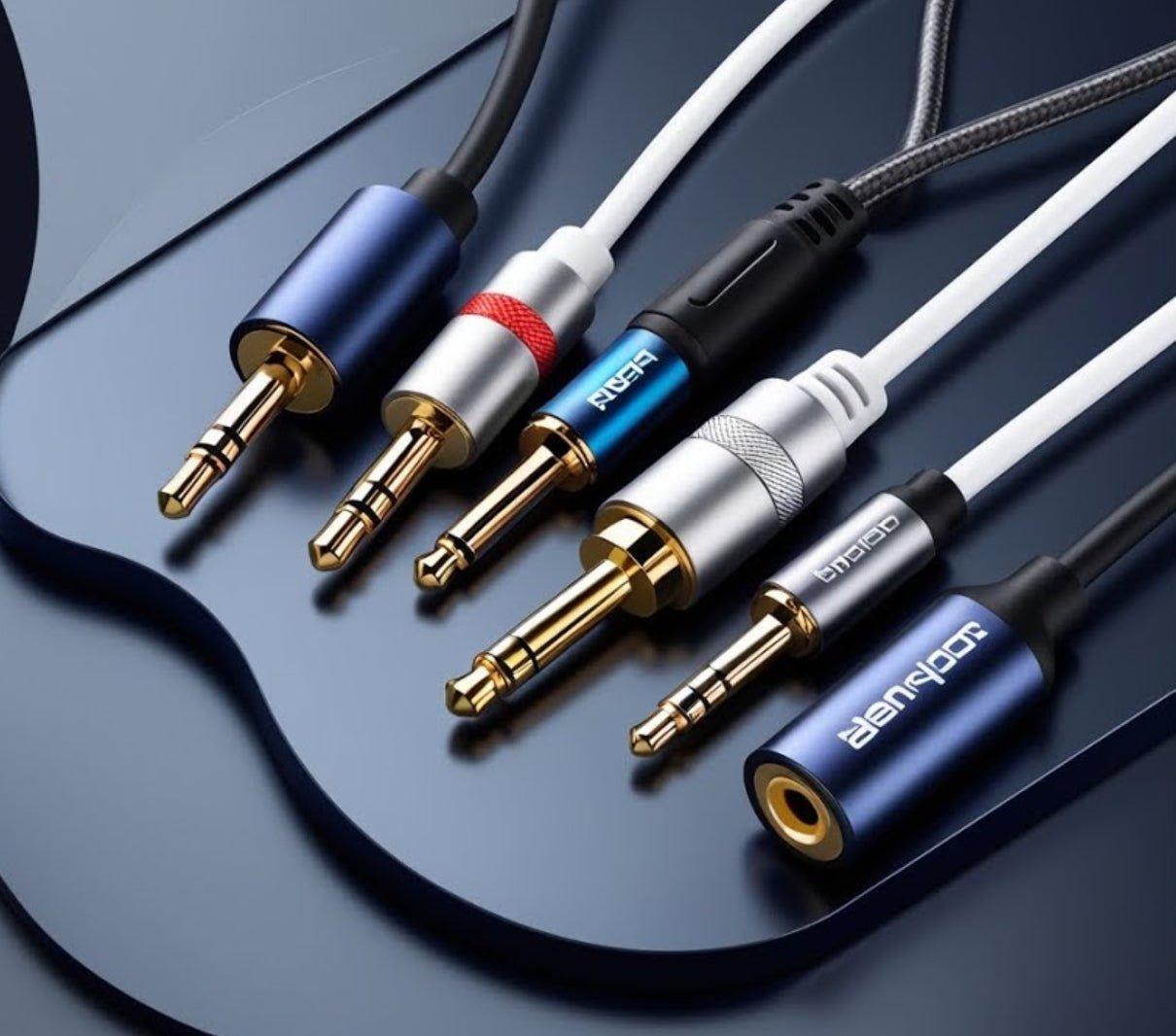
A 3.5 mm plug can fit a socket and still be the wrong cable for the job. Before comparing materials or price, identify the signal you need to carry: stereo audio, headset audio plus microphone, mono audio, or an extension of an existing connection.
Quick answer: use TRS for a typical stereo aux connection, TRRS when a compatible headset connection needs stereo audio plus a microphone, and a male-to-female extension only when the existing plug and socket wiring already match.


TRS vs TRRS: Count the Conductive Sections
| Connector | Typical use | What to verify |
|---|---|---|
| TS | Mono or specialist signal paths | Equipment-specific wiring and signal level |
| TRS | Stereo headphones or stereo aux interconnect | Whether the port is stereo, balanced mono, input, or output |
| TRRS | Stereo headset audio plus microphone | Pinout, microphone support, inline controls, and device jack behavior |
TRS and TRRS describe the contact structure, not a universal signal guarantee. A TRS connector can carry stereo unbalanced audio in consumer equipment or a balanced mono signal in some professional equipment. For a connector-focused explanation, see Wantek's TRS vs TRRS guide.
Headset Microphone Compatibility Depends on Pinout
For Android-compatible 4-conductor 3.5 mm headset accessories, the Android Open Source Project specifies stereo audio output, microphone input, ground, and a CTIA LRGM pinout as the required baseline, with OMTP support optional in most regions.
That is why two TRRS products can look identical but behave differently on older or specialized hardware. If audio works but the microphone does not, check the device's headset-jack wiring and whether it supports a combined headset input.
Reference: Android 3.5 mm headset accessory specification.
Male-to-Male Cables Are for Compatible Outputs and Inputs
A standard stereo male-to-male aux cable normally uses TRS plugs at both ends. Typical examples include a laptop headphone output feeding powered speakers, a portable player feeding a car AUX input, or another analog stereo source feeding a compatible line input.
Do not use plug diameter as the only compatibility test. A headphone output, microphone input, line input, and speaker-level output perform different electrical jobs.
Extensions Preserve the Existing Connection
A 3.5 mm male-to-female extension is useful when a headphone or headset cable simply does not reach. It should preserve the contacts required by the original connection. A three-conductor stereo extension cannot add microphone support to a four-conductor headset path.
Choose only as much length as needed. Every added connector creates another physical contact point, and very long unbalanced analog runs are more exposed to resistance, capacitance, and environmental interference.
Right-Angle, Coiled, and Braided Cables Solve Mechanical Problems
- Right-angle plugs can reduce protrusion beside a phone case, controller, or tight desk layout.
- Coiled cables can keep unused length off a desk or floor when variable reach is useful.
- Braided jackets may improve abrasion resistance, but can also transmit more rubbing noise in some portable headphone uses.
- Strain relief matters because repeated bending at the connector is a common mechanical failure point.
Gold Plating and Premium Materials Do Not Fix a Wrong Cable
Gold plating is useful primarily for corrosion resistance and stable contact surfaces. Conductor material, shielding, resistance, and capacitance are real electrical properties, but none can compensate for the wrong pinout, wrong signal direction, or incompatible source and input.
For most short consumer interconnects, start with correct wiring, secure connectors, sensible cable length, adequate shielding for the environment, and durable strain relief.
USB-C to 3.5 mm Is a Different Problem
USB-C is a digital interface and does not automatically expose analog audio. Many USB-C-to-3.5 mm adapters contain their own DAC, and microphone or inline-control support can vary. Verify the host device and adapter rather than treating USB-C as a passive shape converter.
Frequently Asked Questions
Does TRRS always mean microphone support?
TRRS provides four contacts, but actual microphone support still depends on the wiring, device jack, pinout, and software behavior. Physical fit alone is not enough.
Can I use a TRRS headset in a TRS headphone jack?
You may get headphone audio in some combinations, but the microphone will not work through a headphone-only TRS connection. Compatibility varies by jack design.
Does a more expensive 3.5 mm cable improve sound?
Not automatically. Correct wiring, reliable contacts, reasonable resistance, shielding where needed, and mechanical durability matter more than price or decorative materials alone.
Should I buy the longest cable available?
No. Choose the shortest length that reaches comfortably without tension. Extra length adds resistance, capacitance, clutter, and more exposure to interference.

