
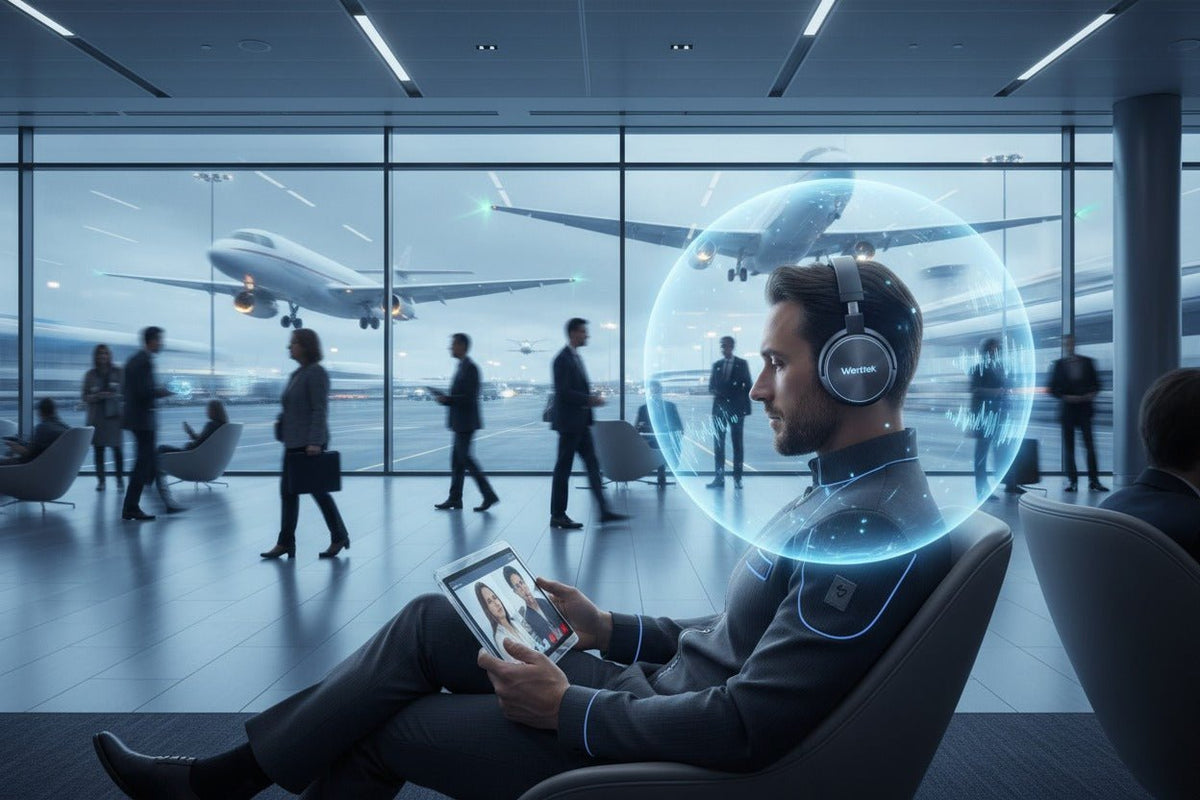
The best noise-cancelling headphones for business calls are not defined by ANC alone. For work calls, you need to separate two jobs: listener-side noise cancellation, which reduces what you hear, and microphone noise reduction, which affects what the other person hears. Business controls, platform certification, connection method, and comfort can matter just as much.
Quick answer: Start with the Jabra Evolve3 85, HP Poly Voyager Surround 80 UC, or Logitech Zone Wireless 2 ES if business-call controls and deployment features lead the decision. Consider the Sony WH-1000XM6, Apple AirPods Max 2, or Bose QuietComfort Ultra Headphones (2nd Gen) when premium ANC and general listening are equally important. This guide compares documented specifications and use cases; it is not a head-to-head lab test.

What matters most for business calls?
Start with the call path, not the marketing label. A headset can have excellent ANC for the wearer and still transmit keyboard noise or nearby voices through its microphone. Conversely, a call-focused headset can reduce outgoing background noise without providing strong active cancellation at the ears.
If you are still defining the difference between ANC, passive isolation, microphone noise reduction, and business-platform features, Wantek's office headset and noise-control guide explains those layers in more detail.
1. Listener-side ANC
ANC uses microphones and signal processing to reduce selected environmental sounds before they reach the listener. It is especially useful for persistent noise such as HVAC systems, engines, and low-frequency office rumble. Speech and rapidly changing sounds are harder to remove completely, so earcup seal and passive isolation still matter.
2. Outgoing microphone clarity
For calls, microphone placement, array design, voice-detection algorithms, and the acoustic environment matter more than microphone count by itself. Boom microphones can gain an advantage by placing the pickup element closer to the mouth, while boomless designs rely more heavily on beamforming and processing.
3. Platform and device fit
Business-oriented models may offer certified variants, USB receivers, hardware mute controls, status lights, and remote device-management support. Consumer ANC headphones can still work well for meetings, but their feature set is usually designed around listening first. Certification and supported controls can also vary by exact SKU, so check the version being purchased rather than assuming every model variant behaves identically.
Six current 2026 options to compare
The table below uses current manufacturer documentation to match each model to a business-call workflow. The order is not a performance ranking.
| Model | Documented strengths | Best starting use |
|---|---|---|
| Jabra Evolve3 85 | Adaptive Advanced ANC, six digital MEMS microphones, ClearVoice call-noise reduction, multipoint, business-platform certifications on applicable variants, and up to 25 hours of talk time with ANC and busylight off. | Call-heavy enterprise and hybrid work where UC controls, a USB adapter, and deployment features matter. |
| HP Poly Voyager Surround 80 UC | Hybrid ANC, boomless 10-microphone system, Microsoft Teams Open Office certification, multipoint, and up to 21 hours of talk time. | Managed Teams environments that want a boomless over-ear business headset. |
| Logitech Zone Wireless 2 ES | Adaptive hybrid ANC, two noise-cancelling microphones with AI-based processing, hardware call controls, and Teams or UC variants with different certification coverage. | Business deployment where management, platform certification, and a lighter on-ear format are priorities. |
| Sony WH-1000XM6 | Adaptive noise cancellation, a 12-microphone system used across noise control and call processing, multipoint, and up to 24 hours of continuous communication with noise cancellation on. | Hybrid workers who want premium ANC and music listening alongside regular calls. |
| Apple AirPods Max 2 | Active Noise Cancellation, Voice Isolation, nine microphones total with three used for voice pickup, Bluetooth 5.3, USB-C audio, and up to 20 hours of listening with ANC enabled. | Apple-device users who value ecosystem switching and integrated call features more than enterprise headset management. |
| Bose QuietComfort Ultra Headphones (2nd Gen) | Adjustable ANC, four front microphones documented for phone calls, Bluetooth 5.4, USB-C audio, and up to 30 hours of battery life. | General-purpose ANC listening with phone and meeting use, without a business-first UC feature set. |

Business-first choices
Jabra Evolve3 85: for call-heavy UC work
The Evolve3 85 is designed as a business headset rather than a consumer headphone adapted for meetings. Jabra lists Adaptive Advanced ANC, six digital MEMS microphones, ClearVoice deep-learning voice isolation, a 360-degree busylight, Bluetooth multipoint, and Microsoft Teams certification on applicable variants. The current package uses the Jabra Link 390 adapter rather than the older Link 380 referenced in some early summaries.
Battery figures also depend on mode. Jabra lists up to 25 hours of talk time with ANC and the busylight off, or up to 21 hours with them on. See the Jabra Evolve3 85 product specifications for the current configuration and certification details.
Consider it when: business-call workflow, platform controls, device management, and a supplied PC adapter matter more than having a traditional boom microphone.
HP Poly Voyager Surround 80 UC: boomless business deployment
The Voyager Surround 80 UC takes another boomless approach but keeps a business-first feature set. HP lists hybrid ANC, transparency mode, a 10-microphone design, Bluetooth 5.3, two paired devices, and up to 21 hours of talk time. The Teams version is documented as meeting Microsoft Teams Open Office certification requirements.
HP's current specifications are available on the Voyager Surround 80 support page. Microsoft also lists the Voyager Surround 80 UC/85 UC in its current certified-device catalog.
Consider it when: you want over-ear ANC and a boomless design but still need enterprise-oriented controls and Teams deployment support.
Logitech Zone Wireless 2 ES: platform-certified on-ear option
Logitech's Zone Wireless 2 ES uses adaptive hybrid ANC and documents two noise-cancelling microphones with AI-based algorithms. Certification depends on the version: Logitech lists a Teams variant with Microsoft Teams certification and a UC variant certified for Zoom, Google Meet, and Google Voice.
The exact differences are documented in Logitech's Zone Wireless 2 ES specifications. This is the model to compare when platform support, device management, and an on-ear form factor are more important than maximum passive isolation.
Consumer ANC headphones that also handle work calls
Sony WH-1000XM6: focus-first hybrid work
Sony's WH-1000XM6 is a consumer ANC headphone with documented call features rather than a UC headset. Sony lists Adaptive NC Optimizer, multipoint, Bluetooth 5.3, and a 12-microphone system that its QN3 processor uses for noise cancellation, sound quality, and call clarity. Sony's technical specifications list up to 24 hours of continuous communication with noise cancellation on.
Review the current Sony WH-1000XM6 specifications before buying, especially if laptop/phone multipoint and battery behavior matter to your workflow.
Consider it when: strong listener-side ANC and general audio quality lead the decision, while meetings are important but enterprise certification is not required.
Apple AirPods Max 2: Apple ecosystem workflow
AirPods Max 2 is now a shipping product, not a hypothetical future model. Apple lists Active Noise Cancellation, Voice Isolation, an H2 chip in each earcup, nine microphones total, and three microphones used for voice pickup. The headphones also support USB-C audio and Bluetooth 5.3, with up to 20 hours of listening time with ANC enabled.
Apple's AirPods Max 2 technical specifications provide the current details. They are a logical comparison for Mac/iPhone users who value automatic switching and Apple-native call controls, but they are not positioned as a managed enterprise UC headset.
Bose QuietComfort Ultra Headphones (2nd Gen): general-purpose ANC with calls
Bose's current QuietComfort Ultra Headphones are the second-generation model introduced in 2025. Bose documents adjustable active noise cancellation, Bluetooth 5.4, USB-C audio, up to 30 hours of battery life, and four front microphones used for phone calls.
See the Bose QuietComfort Ultra Headphones (2nd Gen) user guide for the call-microphone layout and the Bose product specifications for current connectivity and battery details. This model fits buyers who want one premium ANC headphone for listening, travel, and calls rather than a headset built around UC certification.

How to choose for your actual workday
Decide which noise problem is more important.
If your priority is concentration, compare listener-side ANC and passive isolation. If other people complain about your background noise, focus on microphone design and outgoing voice processing.
Map the headset to the calling device.
Confirm whether calls happen mainly on a managed Windows PC, Mac, smartphone, or multiple devices. A dedicated USB receiver and certified controls may be valuable in enterprise setups; they may matter less for individual mobile use.
Check the exact SKU and certification.
Teams, UC, USB-A, USB-C, adapter, and bundle variants can differ. Do not assume a certification or accessory listed for one SKU applies to every version with the same family name.
Treat battery numbers as mode-specific.
Talk time and music playback are different measurements. ANC, status lights, codec choice, volume, and connection method can also change runtime, so compare the operating mode you actually expect to use.
For fixed desks: ANC is not always the first requirement. If a stable wired connection, physical mute controls, and no battery management matter more, compare a wired office headset instead of forcing a wireless ANC model into the workflow.
Where Wantek fits
Wantek's current wireless range separates listener-side ANC from call-focused headset design. The T3 is the ANC model, with Bluetooth 5.3, transparency mode, an inline microphone, and up to 60 hours of listed battery life. WK881BT and WK882BT are work-call headsets with boom microphones and passive noise control rather than an ANC claim.
That makes the trade-off straightforward: choose the T3 when listener-side ANC is the requirement, or start with the boom-mic work models when the calling workflow matters more. The Wantek wireless headset collection shows the current distinction between those categories.
Compare Wantek wireless work headsets
Review current ANC and call-focused wireless models, then match the microphone style, connection, and noise-control approach to your work setup.
FAQ
Does ANC improve what the other person hears on a call?
Not necessarily. ANC mainly reduces environmental sound for the wearer. Outgoing call clarity depends on the microphone system, voice processing, placement, room acoustics, and the software or device carrying the call.
Are business headsets always better than consumer ANC headphones for meetings?
No. Business headsets add features such as certified variants, USB receivers, call controls, and device management. Consumer models may offer stronger listening-focused features, but the better fit depends on your actual workflow.
Do I need a Microsoft Teams-certified headset?
Certification is most useful in managed Teams environments where supported call controls and deployment behavior matter. Individual users can still use non-certified Bluetooth or USB headphones, but features may differ.
Is a boom microphone required for clear business calls?
No. Boomless arrays can produce clear speech, but a boom places the microphone closer to the mouth and can improve the voice-to-background ratio in difficult environments.
Should I compare talk time or music battery life?
Use talk time when calls dominate your day. Music playback figures are measured under different operating conditions and should not be treated as a substitute for call-runtime specifications.

