
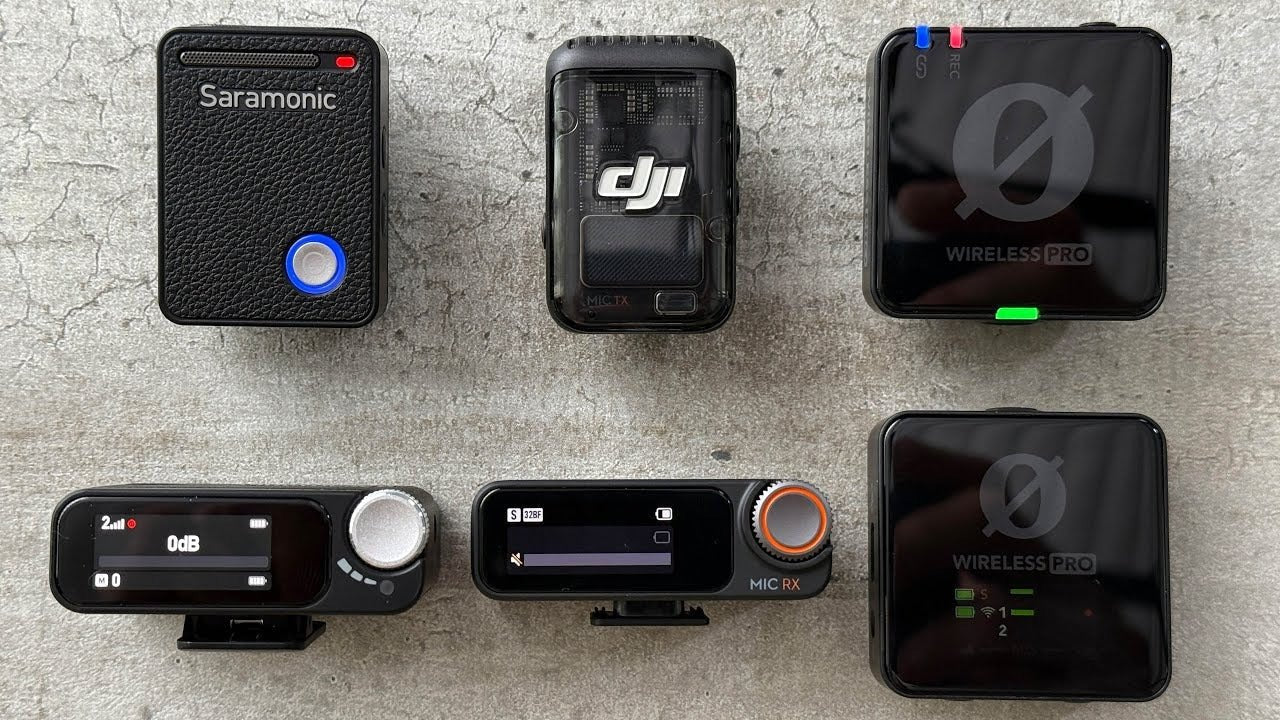
A Bluetooth microphone is not one standardized product category. Some current wireless microphones can connect directly to a phone over Bluetooth, while many creator systems use a dedicated 2.4 GHz or proprietary wireless link to a receiver that plugs into USB-C, Lightning, a camera, or a mixer.
Choose the signal path first. For iPhone or Android recording, a dedicated receiver usually gives the app a predictable external-microphone input. Direct Bluetooth can be convenient when the exact phone and app support it. For speakers or PA systems, Bluetooth often handles music playback—not microphone input—so use a real mic input or the speaker's matched wireless microphone system.

Wireless Microphone Paths to Compare in 2026
| Use case | Current option | Connection to verify |
|---|---|---|
| Phone recording with direct Bluetooth option | DJI Mic 3 | DJI supports direct transmitter-to-phone Bluetooth on compatible devices/apps, plus receiver-based wireless operation; app compatibility still matters. |
| Simple smartphone creator kit | RØDE Wireless Micro | Dedicated receiver plugs directly into USB-C or Lightning; this is a wireless microphone system but not generic Bluetooth-audio input. |
| Portable PA with conventional mic | Bose S1 Pro+ + Wireless Mic/Line Transmitter | Bose uses a matched 2.4 GHz XLR transmitter to the PA's built-in receiver; Bluetooth is separately used for audio streaming. |
| Portable PA with wired microphones | JBL EON ONE Compact | Bluetooth is for audio streaming; microphones connect through its mic/line inputs rather than pairing as a generic Bluetooth mic. |
Why “Bluetooth Microphone” Causes So Much Confusion
Bluetooth can carry several kinds of audio, but a phone, recording app, speaker and microphone all need compatible profiles and routing. A product advertising Bluetooth 5.x does not prove that a recording app will accept it as an external microphone.
Creator wireless systems often avoid that uncertainty by sending audio over their own radio link to a small receiver connected directly to the phone's USB-C or Lightning port.
DJI Mic 3: Direct Bluetooth Exists, but App Compatibility Still Matters
DJI Mic 3 currently supports direct Bluetooth connection from a transmitter to a smartphone. DJI's own FAQ warns that livestreaming/recording support depends on the phone operating system and the app; it recommends verifying compatibility in actual use.
The system can also use its dedicated receiver and provides internal recording, including 32-bit float modes. That gives a creator a fallback when direct Bluetooth routing is not the best path.
RØDE Wireless Micro: Wireless Does Not Mean Bluetooth
RØDE Wireless Micro uses compact transmitters that pair automatically with a dedicated receiver. RØDE sells USB-C and Lightning receiver versions and documents support for modern Android/iPhone devices according to connector type.
This is often the easier concept for phone video: the microphone is wireless on the person, but the phone receives the audio through a physical digital receiver.
iPhone: Match USB-C vs. Lightning
Current USB-C iPhones can use USB-C receiver systems directly when supported. Older Lightning iPhones need a Lightning receiver or an explicitly supported adapter path. Check the phone case too: thick cases can prevent small plug-in receivers from seating fully.
Also verify the recording app. A microphone that works in one camera or voice app may not be available in every livestreaming or social app.
Android Compatibility Is More Than “Has USB-C”
USB-C is only the connector shape. The Android device and app still need to accept the external USB audio input. Wireless-microphone manufacturers publish compatibility lists because behavior differs among phones and software.
Test the exact Android model, OS version, camera/livestream app, stereo/mono mode and monitoring path before relying on the setup for paid work.
Bluetooth Speakers Usually Use Bluetooth for Playback
A portable speaker advertising Bluetooth commonly accepts music or backing-track audio from a phone. That does not mean it accepts a Bluetooth microphone as an input.
The JBL EON ONE Compact, for example, documents Bluetooth audio streaming separately from its physical mic/line inputs. Bose S1 Pro+ similarly supports Bluetooth streaming, while wireless microphones use Bose's dedicated 2.4 GHz Mic/Line transmitter into its built-in receiver.
Speaker rule: if you need live amplified speech, look for a speaker with a real microphone input or a documented matched wireless-mic accessory. Do not assume two Bluetooth logos mean the devices can pair in the required direction.
Latency: Bluetooth Version Alone Is Not the Answer
A newer Bluetooth version does not automatically mean low recording latency. The codec, audio profile, phone OS, app buffer, processing and monitoring path all contribute.
For video, record a clap or spoken consonant and check lip sync in the final file. For live monitoring or PA use, test the complete chain because even small delays can be distracting.
How to Choose a Wireless Phone Microphone
- Choose the host device: iPhone, Android, camera, computer or PA.
- Choose the receiver path: USB-C, Lightning, 3.5 mm, XLR, or verified direct Bluetooth.
- Check whether you need one or two transmitters.
- Verify the exact recording or livestreaming app.
- Check onboard recording if losing the wireless link would be costly.
- Test range in your real environment rather than relying only on open-field specifications.
- Check battery runtime with the features you will actually enable.
Frequently Asked Questions
Can I connect a Bluetooth microphone directly to an iPhone?
Some systems support direct Bluetooth, including DJI Mic 3 on compatible phones and apps. Support is not universal, so verify the exact app or use a dedicated receiver.
Is RØDE Wireless Micro a Bluetooth microphone?
It is a wireless smartphone microphone system, but its normal connection uses a dedicated USB-C or Lightning receiver. “Wireless” and “Bluetooth” are not interchangeable terms.
Can a Bluetooth speaker receive a Bluetooth microphone?
Usually not by default. Many speakers use Bluetooth for playback from a phone. Live microphones normally use a physical mic input or a manufacturer-supported wireless receiver/transmitter system.
Does Bluetooth 5.4 guarantee low microphone latency?
No. End-to-end delay depends on the profile, codec, OS, app, processing and monitoring path. Test the complete recording or PA chain.

