
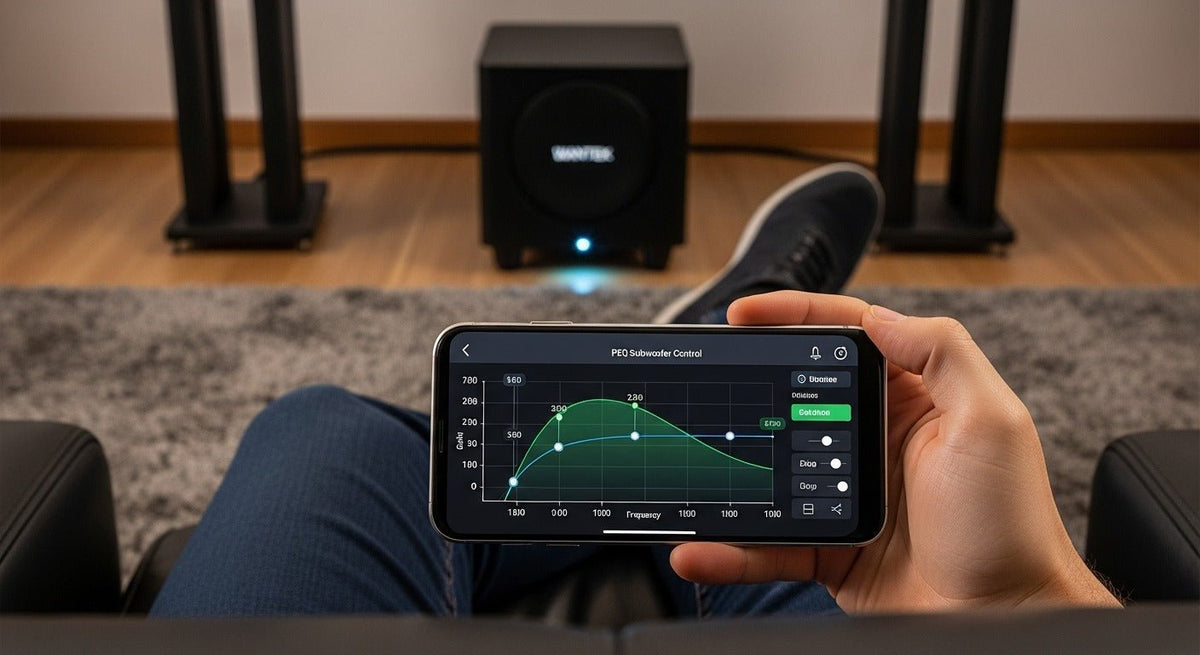
A good audiophile subwoofer should extend your system's low-frequency range without calling attention to itself. The harder part is not buying the model with the largest driver or amplifier number; it is matching output, controls, connections, placement, and crossover behavior to your room and main speakers.
Quick answer: five current models worth comparing are the SVS SB-1000 Pro, REL T/9x, KEF KC62, Bowers & Wilkins DB4S, and RSL Speedwoofer 10S MKII. They represent different approaches to hi-fi bass: app-based DSP, high-level stereo integration, ultra-compact force-cancelling design, premium closed-box control, and high-value ported output.
This is a use-case shortlist, not a claim that one model is universally “best.” Manufacturer frequency-response figures also use different test conditions, so they should not be treated as a single apples-to-apples ranking.
What Matters Most in an Audiophile Subwoofer?
For a two-channel hi-fi system, the goal is usually smooth extension below the main speakers rather than maximum bass quantity. A subwoofer that is well placed and correctly integrated can add low-frequency fundamentals while keeping vocals and instruments anchored to the stereo image.

Room behavior matters more than a single specification
Low frequencies interact strongly with room boundaries. Peaks and nulls can change dramatically with subwoofer and listening-position placement. Genelec's placement guidance notes that changing subwoofer location changes how room modes are excited, and that phase should be aligned around the crossover region. That is why placement and calibration often matter as much as the cabinet itself. See Genelec's room-placement guidance.
Do not choose by enclosure type alone
Sealed and ported designs can both work well for music. Sealed cabinets are compact and often provide a gradual low-frequency roll-off, while ported or passive-radiator systems can gain output around their tuning region. Driver design, amplifier behavior, DSP, placement, and crossover integration are at least as important as the enclosure label.

Check the connection path before buying
Some stereo amplifiers provide a dedicated subwoofer or preamp output; others do not. High-level speaker connections can be useful in traditional two-channel systems, while RCA or XLR line-level inputs suit systems with preamp outputs, AV processors, or bass-management hardware. App control and parametric EQ can make integration easier, but they do not replace sensible placement.
5 Current Subwoofers to Compare for Hi-Fi Systems
The models below were selected because they illustrate clearly different design and integration priorities. Specifications are taken from current manufacturer pages. Frequency-extension numbers are shown with each maker's stated tolerance because the figures are not directly comparable when one brand reports ±3 dB and another reports -6 dB.
| Model | Verified core specification | Best reason to shortlist it |
|---|---|---|
| SVS SB-1000 Pro | Sealed 12 in driver; 325 W RMS; 20-270 Hz ±3 dB | App-based DSP and parametric EQ in a relatively compact sealed cabinet |
| REL T/9x | 10 in active driver plus 10 in passive radiator; 300 W Class A/B; -6 dB at 27 Hz | High-level, low-level, and LFE inputs for flexible stereo integration |
| KEF KC62 | Dual 6.5 in force-cancelling drivers; 1,000 W RMS; 11-200 Hz ±3 dB | Very small cabinet with speaker-level input and placement EQ presets |
| Bowers & Wilkins DB4S | Closed-box 10 in Aerofoil cone; 1,000 W Class D; 10-350 Hz -3 dB | Premium closed-box design with XLR/RCA inputs, Dynamic EQ, and app setup |
| RSL Speedwoofer 10S MKII | 10 in rear-vented design; 400 W RMS; 22-200 Hz ±3 dB in LFE mode, anechoic | Strong output-per-dollar with selectable DSP modes and built-in wireless receiver |

SVS SB-1000 Pro: useful when you want DSP without a large cabinet
The SB-1000 Pro combines a sealed 12-inch driver with a 325-watt RMS amplifier. SVS specifies a 20-270 Hz ±3 dB response and provides smartphone control for volume, crossover, phase, room-gain compensation, presets, and a three-band parametric EQ. That makes it especially practical when you expect to tune the system from the listening position.
Consider it when: you want compact dimensions, app-based adjustment, and speaker-level as well as line-level connectivity. Its published response and amplifier rating are useful specifications, but they do not by themselves predict how evenly bass will measure in your room.
REL T/9x: designed around traditional stereo integration
The T/9x uses a front-firing 10-inch active driver, a down-firing 10-inch passive radiator, and a 300-watt RMS Class A/B amplifier. REL specifies -6 dB at 27 Hz and provides High Level Neutrik Speakon, low-level RCA, and LFE RCA inputs. The supplied high-level cable makes it particularly relevant to stereo amplifiers that do not offer conventional bass management.
Consider it when: high-level connection is central to your setup or you want one subwoofer that can accept both stereo-oriented and LFE connection paths. High-level input is an option, not a mandatory connection method.
KEF KC62: the space-saving engineering option
KEF's KC62 uses two opposing 6.5-inch Uni-Core drivers in a force-cancelling arrangement with 1,000 watts RMS of Class D amplification. KEF specifies 11-200 Hz ±3 dB and 105 dB maximum SPL at 1 meter. It also includes RCA and speaker-level inputs plus five placement-EQ presets.
Consider it when: cabinet size is a hard constraint. Its compact enclosure is the distinguishing feature; the 11 Hz figure should still be read within KEF's stated measurement conditions rather than as a guarantee of equal output at every frequency and listening level.
Bowers & Wilkins DB4S: premium closed-box control and balanced inputs
The current DB4S replaces the older ASW610XP in this updated shortlist. Bowers & Wilkins specifies a 10-inch Aerofoil driver, 1,000-watt Class D amplification, a 10-350 Hz -3 dB frequency response, Dynamic EQ, app-based setup, and both RCA and XLR inputs.
Consider it when: you want a premium closed-box subwoofer with balanced analog connectivity and app-assisted setup. This update removes the previous article's incorrect claim that the ASW610XP used a Continuum cone; Bowers & Wilkins specifies a paper/Aramid-fiber cone for that older model.
RSL Speedwoofer 10S MKII: current value-focused ported option
RSL's current 10S MKII uses a rear-vented Compression Guide design and an XDR DSP amplifier rated at 400 watts RMS and 1,020 watts peak. RSL specifies 22-200 Hz ±3 dB anechoic in LFE mode and provides a separate Music mode, plus a built-in wireless receiver.
Consider it when: you want a lower-cost route to meaningful output and flexible DSP modes. The previous article's 350-watt specification and front-ported description are no longer accurate for the current 10S MKII.
How to Match a Subwoofer to Your Hi-Fi System
1. Start with your main speakers, not the subwoofer
Find the useful low-frequency range of your main speakers and the controls available in your amplifier or processor. A subwoofer should overlap enough with the mains to create a smooth crossover, but not so high that low bass becomes easy to localize.
2. Choose the connection method your system actually supports
If your preamp or integrated amplifier has variable line outputs, RCA or XLR may be simplest. If it lacks a subwoofer output, a model with speaker-level input can be easier to integrate. Home-theater processors typically use an LFE path with bass management handled upstream.
3. Treat placement as part of the purchase
Moving a subwoofer can change bass response significantly because the room's standing waves are spatial. Start with practical positions near the front wall, measure or listen from the main seat, and adjust placement before relying on EQ to solve everything.
4. Use crossover, level, and phase together
A crossover setting is only a starting point. Level and phase affect how the subwoofer and main speakers sum through the crossover region. Genelec recommends choosing a crossover where both systems can contribute and aligning phase at that crossover to avoid cancellation.
When Two Subwoofers Make Sense
Two subwoofers are not automatically about “more bass.” Their more useful advantage can be smoother response across a wider seating area. Research from Harman and placement guidance from Genelec both show that multiple subwoofers, when positioned and calibrated appropriately, can reduce seat-to-seat variation caused by room modes. Read Harman's multiple-subwoofer research.

For a single listening seat, one well-positioned subwoofer may be sufficient. For a sofa or multiple seats, two subs can be more useful if the goal is consistent bass rather than simply higher maximum output.
Frequently Asked Questions
Do floor-standing speakers still benefit from a subwoofer?
They can. The benefit depends on the speakers' real low-frequency extension, playback level, room, and crossover setup. A subwoofer is most useful when it extends response or improves bass placement and integration.
Is a sealed subwoofer always better for music?
No. Enclosure type alone does not determine musical accuracy. A well-designed sealed, ported, or passive-radiator subwoofer can work well when output, placement, crossover, phase, and room behavior are properly matched.
What crossover frequency should I use?
Use the overlap between your main speakers and subwoofer as the starting point, then adjust by measurement or careful listening. There is no single crossover frequency that is correct for every speaker and room.
Does a higher amplifier wattage mean a better subwoofer?
No. Amplifier power is only one part of the system. Driver efficiency, excursion, enclosure design, DSP limiting, frequency range, distortion, and room placement all affect usable low-frequency performance.
Are manufacturer frequency-response numbers directly comparable?
Not always. Brands may use different tolerances, environments, and output conditions. Compare the stated measurement window—such as ±3 dB versus -6 dB—before treating two extension numbers as equivalent.
Bottom Line
The most useful shortlist depends on what your system lacks. Choose the SVS SB-1000 Pro when app-based DSP is a priority, REL T/9x when high-level stereo integration matters, KEF KC62 when cabinet size is the main constraint, Bowers & Wilkins DB4S when you want a premium closed-box design with balanced inputs, and RSL Speedwoofer 10S MKII when value and output are central.
None of those labels replaces room matching. The better buying decision is the model that fits your connection path, available space, output needs, and calibration workflow—not the one with the most dramatic single specification.

