
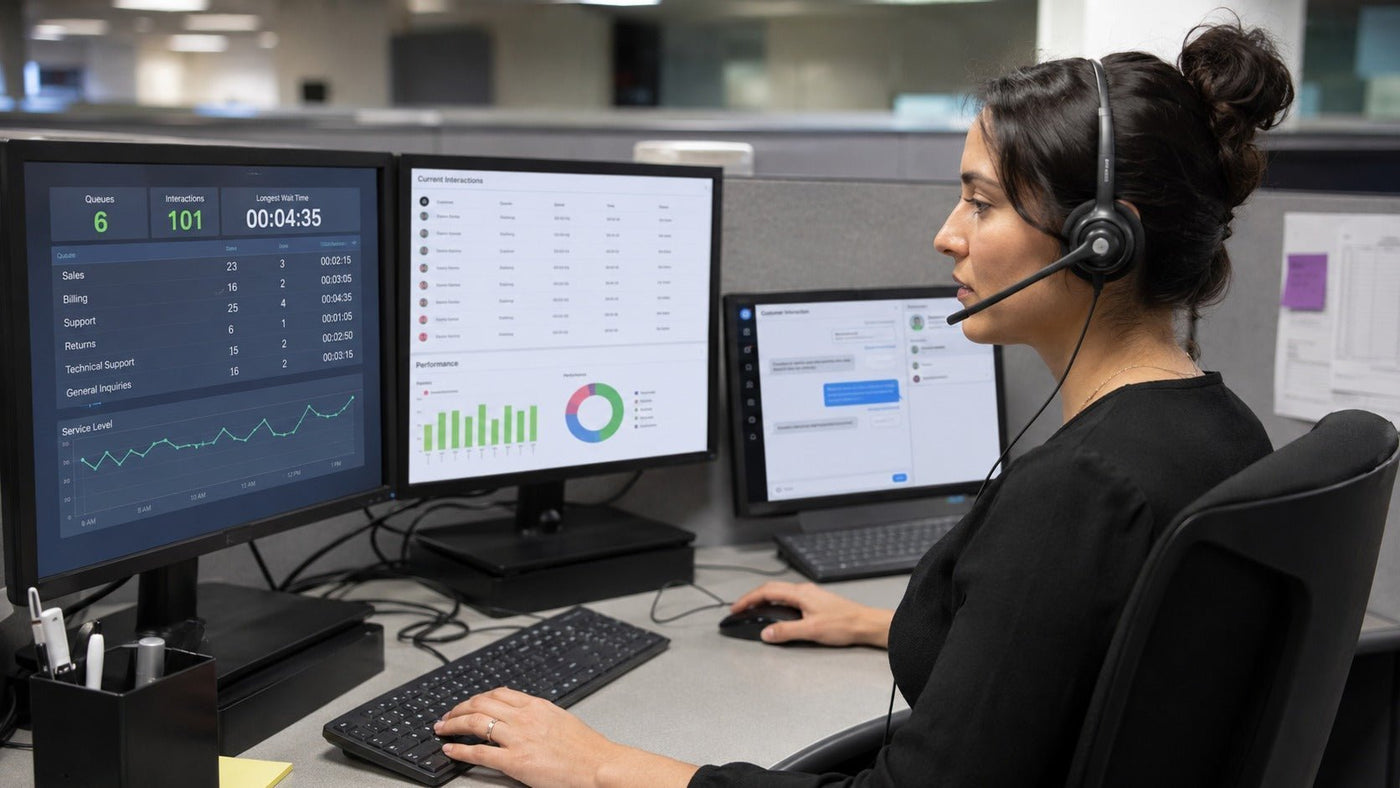
Inbound and outbound call centers use many of the same people, phone, CRM, recording, and reporting systems, but the work starts differently. Inbound interactions begin with the customer; outbound interactions begin with the organization. That difference changes staffing, routing, metrics, scripts, consent, and compliance.
Inbound: design for unpredictable demand, access, resolution, and service quality. Outbound: design for list quality, dialing method, contact strategy, conversion or task completion, and applicable telemarketing rules. Many modern contact centers operate both.

Inbound vs. Outbound Call Centers
| Dimension | Inbound | Outbound |
|---|---|---|
| Who initiates? | Customer or prospect contacts the organization | Organization contacts the customer, lead, debtor, survey participant, or other recipient |
| Typical work | Support, service, orders, billing, technical help, retention, inbound sales | Sales, lead follow-up, appointment setting, collections, surveys, notifications, retention outreach |
| Workload pattern | Demand arrives in queues and can spike unexpectedly | Campaign volume can be scheduled and controlled, subject to rules and list availability |
| Core systems | ACD, IVR, CRM, knowledge, ticketing, recording, QA, WFM | CRM, dialer, campaign/list management, consent/DNC controls, recording, QA, analytics |
| Common measures | Service level, response time, abandonment, resolution, quality, customer feedback | Contact rate, right-party contact, conversion/task completion, quality, compliance, outcomes |
How an Inbound Call Center Works
Inbound operations receive calls or other customer contacts and place them into queues. Routing rules use factors such as language, skill, customer status, priority, or reason for contact to select the next agent or self-service path.
Common inbound work includes technical support, billing, order status, account changes, product questions, complaints, returns, retention, and inbound sales. The operational challenge is matching variable demand with enough trained capacity while keeping resolution quality stable.
Inbound Technology: ACD, IVR, CRM, Knowledge and WFM
An automatic call distributor (ACD) organizes and routes incoming calls. Interactive voice response (IVR) can collect information, complete some self-service tasks, or route the customer before an agent joins. CRM and ticketing systems provide customer and case context, while knowledge systems help agents find approved answers.
Workforce management forecasts demand and schedules staff. Recording, quality management, analytics, and coaching close the loop by showing whether the operation is actually resolving customer needs.
Inbound Metrics Need to Be Read Together
- Service level / response time: how quickly customers reach service.
- Abandonment: how often contacts leave before service.
- Average handle time: how much capacity each interaction consumes.
- First-contact resolution: whether the issue appears resolved without another contact.
- Quality: whether sampled interactions meet defined accuracy, process, and communication criteria.
- Customer feedback: how responding customers describe the experience.
Shorter handle time is not automatically better if it increases repeat contacts or lowers accuracy. For a broader operating framework, see the Call Center Management in 2026 guide.
How an Outbound Call Center Works
Outbound operations start from a campaign, list, trigger, or workflow. Agents may call leads, customers, survey participants, patients, debtors, or other recipients depending on the organization and legal basis for the contact.
Common outbound tasks include lead follow-up, appointment setting, sales, customer-success outreach, collections, research, renewal reminders, and service notifications. The dialing method should match the task and the applicable regulatory requirements.
Preview, Progressive and Predictive Dialing
Preview dialing
The agent sees the record before initiating the call. This is useful when context matters more than maximizing dial volume.
Progressive dialing
The system places a call when an agent is available, reducing the chance that a live answer waits for an agent.
Predictive dialing
The system forecasts agent availability and can dial ahead to increase agent talk time. That efficiency also creates regulatory risk if live recipients encounter abandoned calls or dead air.
For U.S. telemarketing, the FTC Telemarketing Sales Rule defines an abandoned outbound call in part by whether a live answer is connected to a sales representative within two seconds after the completed greeting. Its safe harbor sets conditions including a maximum abandonment rate, ring-time requirements, a recorded identification message when no representative is available, and records supporting compliance. See the FTC Telemarketing Sales Rule compliance guide.
Outbound Compliance Is Part of System Design
Outbound calling rules depend on the call purpose, recipient, jurisdiction, technology, consent, and organization. In the U.S., the FTC TSR includes Do Not Call restrictions, calling-hour limits, Caller ID requirements, restrictions around prerecorded telemarketing messages, and abandoned-call rules. FCC requirements, state laws, industry rules, and other laws can also apply.
That means compliance cannot be reduced to a checkbox that says “DNC filter.” Organizations need current written procedures, list suppression, consent records where required, agent training, campaign controls, calling-time logic, caller-ID configuration, and auditable records.
Do not copy one outbound campaign’s settings into another without review. A customer-service callback, debt collection call, political call, healthcare reminder, B2B outreach, and consumer telemarketing campaign can have different rules.
Inbound and Outbound Teams Need Different Operating Emphasis
Inbound agents typically need strong diagnosis, listening, navigation, product knowledge, and de-escalation because the reason for the contact can vary widely. Outbound agents need those skills too, but also need campaign context, concise openings, objection handling, list discipline, and clear dispositioning.
Both teams benefit from realistic coaching, usable knowledge, reliable systems, and enough recovery time to sustain quality. The management problem is not to create stereotypes such as “inbound helpers” versus “outbound hunters,” but to train for the actual tasks and risks.
When a Blended Contact Center Makes Sense
A blended operation lets the same platform or workforce handle inbound and outbound work. This can improve utilization when outbound activity is paused during inbound peaks, but it adds scheduling and skill complexity.
Before blending, define queue priority, campaign interruption rules, agent skills, compliance boundaries, reporting, and how the desktop changes between inbound and outbound contexts.
Headset Requirements Are Similar—but the Workflow Matters
Both inbound and outbound agents need a stable microphone, comfortable fit, and controls that match the workstation. Mono headsets can keep one ear open to the room; dual-ear headsets can increase listening focus. USB-A, USB-C, 3.5 mm, and Bluetooth solve different endpoint requirements.
Do not choose a call-center headset from the inbound/outbound label alone. Start with the phone or computer, calling platform, shift length, noise environment, mute/volume requirements, mobility, and deployment quantity.
Compare Headsets for Call Center Deployment
Match the headset to the endpoint, connection, microphone, wearing style, controls, and scale of the deployment.
Frequently Asked Questions
What is the main difference between inbound and outbound call centers?
Inbound contacts are initiated by customers or prospects; outbound contacts are initiated by the organization. That changes workload patterns, routing, metrics, campaign management, and compliance requirements.
Can one call center handle both inbound and outbound calls?
Yes. Blended contact centers can use shared agents or systems, but queue priority, skills, campaign interruption, reporting, and regulatory controls need to be designed explicitly.
Are predictive dialers legal?
They can be used in lawful workflows, but applicable rules restrict abandoned calls, calling practices, prerecorded messages, consent, and Do Not Call behavior. Configure campaigns against current federal, state, and industry requirements.
Which metrics should inbound and outbound teams share?
Both should monitor quality, task outcomes, repeat work, agent performance, and customer impact. Inbound adds queue-access measures; outbound adds contact, campaign, conversion or completion, and compliance measures.

