
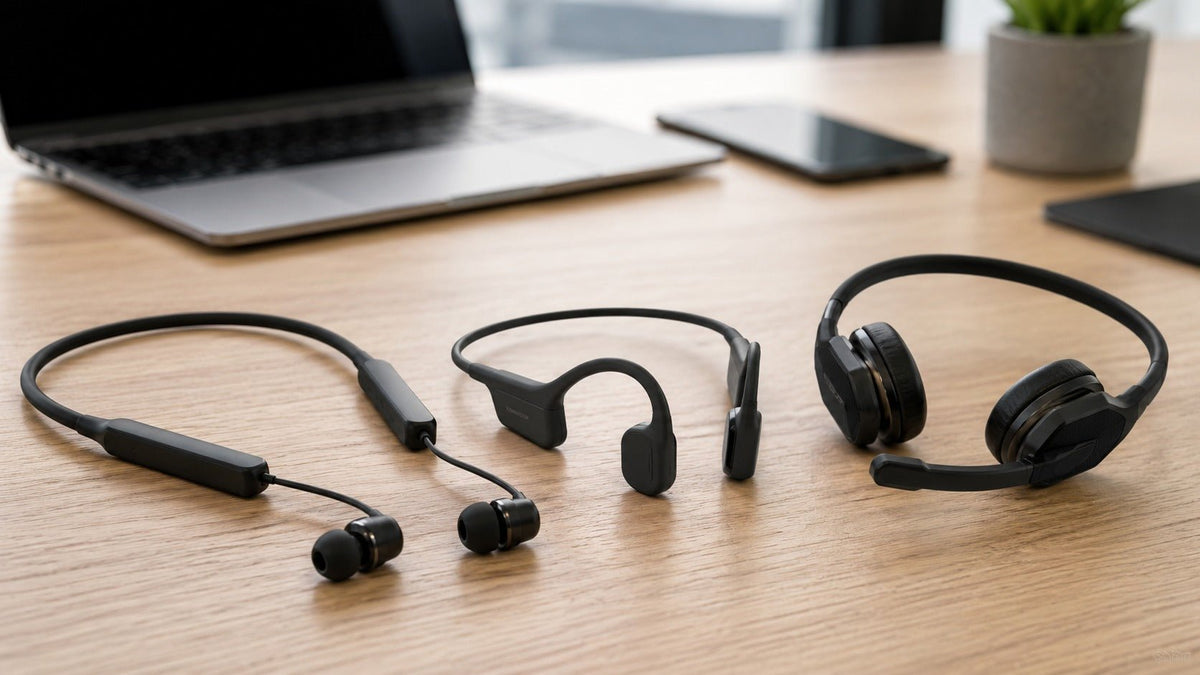
Un casque tour de nuque utilise un arceau ou un cadre qui passe derrière la tête plutôt que sur le sommet du crâne. Cela semble simple, mais les pages de vente mélangent souvent les véritables casques de communication tour de nuque, les écouteurs à oreille libre (open-ear), les modèles à conduction osseuse et les écouteurs avec tour de cou dans une seule catégorie. Faire le bon choix commence par identifier le style de port réel, puis par adapter le microphone, la connexion, le maintien et les exigences de protection à vos activités.
Réponse rapide : choisissez un modèle à oreille libre ou à conduction osseuse pour la course à pied et pour garder conscience de votre environnement ; privilégiez un modèle de communication avec micro sur perche si la clarté des appels est essentielle ; optez pour un casque radio tour de nuque spécifiquement conçu si vous avez besoin de compatibilité avec un casque, d'une fonction push-to-talk ou d'une protection auditive. Ne présumez pas qu'un casque de gaming ou de bureau classique est un modèle « tour de nuque » simplement parce que son arceau est discret.

Qu'est-ce qui définit un casque tour de nuque ?
L'expression est utilisée de manière vague ; la conception physique compte donc plus que l'appellation commerciale. Une façon utile de différencier cette catégorie est de considérer l'emplacement de l'arceau et la manière dont les écouteurs entrent en contact avec l'oreille.
| Style de port | Maintien et usage typiques | À vérifier |
|---|---|---|
| Véritable casque de communication tour de nuque | Arceau arrière avec un ou deux écouteurs ; courant pour les talkies-walkies et les communications industrielles. | Connecteur, PTT, micro sur perche, compatibilité avec casque de protection, protection auditive requise |
| Casque tour de nuque à oreille libre / conduction osseuse | Cadre arrière avec transducteurs autour ou devant les oreilles ; courant pour la course et les appels mobiles. | Technologie audio, micro, maintien, batterie, protection contre la sueur/l'eau attestée |
| Écouteurs avec tour de cou | Le bandeau repose plus bas sur le cou ou le col et se connecte à des oreillettes intra-auriculaires. | Adaptation des embouts, batterie, ANC si nécessaire, microphone, emplacement des modules |
| Casque classique avec arceau supérieur | L'arceau passe sur le sommet du crâne ; courant pour le gaming, les appels de bureau et la musique. | Pression, confort des coussinets, microphone, compatibilité de la plateforme |
Si vous comparez spécifiquement des modèles à conduction osseuse avec cadre arrière, le guide des casques à conduction osseuse de Wantek explique comment fonctionnent les transducteurs, où cette conception est avantageuse et quels compromis attendre.
Choisir le style de port selon l'usage
Pour les appels professionnels : donnez la priorité au microphone et à la connexion
Une conception avec arceau arrière peut être utile lorsque vous souhaitez garder le sommet de votre tête dégagé, mais le format seul ne suffit pas à rendre un casque performant pour les appels. Vérifiez s'il dispose d'un microphone sur perche dédié, comment il se connecte à votre ordinateur ou téléphone, et si le modèle exact prend en charge la plateforme d'appel ou l'adaptateur que vous utilisez.
Par exemple, le modèle actuel OpenComm2 2025 Upgrade de Shokz est un casque de communication à oreille libre avec un microphone antibruit DSP et une autonomie annoncée de 16 heures en conversation. Shokz propose séparément sa variante UC pour les communications informatiques de bureau, ce qui rappelle l'importance de vérifier la version exacte plutôt que d'acheter uniquement selon la silhouette.
Si un maintien par l'arrière n'est pas une exigence stricte, comparez-le avec les options mono, stéréo, filaires, Bluetooth et DECT classiques dans le guide d'achat des casques de centre d'appels de Wantek. La compatibilité de l'appareil et du connecteur doit primer sur l'apparence.
Pour la course à pied et l'exercice en extérieur : maintien et vigilance sont primordiaux
Les casques à oreille libre avec cadre arrière sont courants pour la course à pied car ils permettent de laisser le conduit auditif ouvert tout en aidant à stabiliser le casque. Cela ne garantit pas un maintien parfait pour toutes les morphologies, et l'écoute à oreille libre ne dispense pas de maintenir un volume sonore suffisamment bas pour percevoir votre environnement.
Shokz répertorie l' OpenRun Pro 2 comme un modèle de sport à oreille libre avec une résistance à l'eau IP55 et jusqu'à 12 heures d'autonomie. Ces spécifications sont pertinentes pour l'entraînement sur terre, mais IP55 ne signifie pas qu'il est adapté à la natation. Pour un cadre de référence axé sur le maintien, consultez le guide des écouteurs de running de Wantek.
Pour les casques de sécurité, les talkies-walkies et le travail en milieu bruyant : utilisez du matériel spécialisé
Les casques industriels tour de nuque appartiennent à une catégorie différente des casques grand public à oreille libre. Le casque PMLN6852 de Motorola, par exemple, est conçu pour passer sous la plupart des casques de chantier, se connecte directement aux radios compatibles, inclut une commande push-to-talk et affiche un indice de réduction du bruit (NRR) de 24 dB.
Ne considérez pas le terme « oreille libre » comme une protection auditive. Les directives de l'OSHA sur les casques antibruit et la protection auditive distinguent les produits d'écoute grand public des protecteurs auditifs et exigent une atténuation adéquate lorsque les règles sur le bruit professionnel s'appliquent. Utilisez l'équipement de protection auditive requis par votre employeur et vérifiez son indice de protection plutôt que de supposer qu'un casque grand public convient.
Pour la natation : les conseils sur l'eau et la lecture locale importent plus que la version Bluetooth
Un cadre arrière peut être efficace à la piscine, mais seulement si le fabricant certifie le produit pour cet usage aquatique. Les signaux Bluetooth ne restent pas fiables dans l'eau lors d'une utilisation classique téléphone-casque ; c'est pourquoi les modèles dédiés à la natation s'appuient souvent sur un stockage interne.
Le Wantek BC3 Pro est un modèle à conduction osseuse tour de nuque avec une protection IP68, 32 Go de stockage MP3 interne, le Bluetooth 5.3 pour une utilisation sur terre et jusqu'à six heures d'autonomie annoncée. Les conseils actuels de Wantek orientent les nageurs vers la lecture MP3 locale plutôt que vers le streaming sous-marin depuis un téléphone.
Besoin d'un casque tour de nuque prêt pour la natation ?
Vérifiez les spécifications, le stockage interne, les commandes et les conseils d'utilisation aquatique du BC3 Pro avant de décider s'il convient à votre routine de natation.
Casques tour de nuque et lunettes
Supprimer l'arceau au-dessus de la tête peut aider les utilisateurs qui n'aiment pas la pression sur le sommet du crâne, mais la compatibilité avec les lunettes reste propre à chacun. Le cadre arrière, le module haut-parleur ou le transducteur peuvent entrer en conflit avec les branches des lunettes derrière l'oreille. Les montures épaisses, les lunettes de sport, la forme de la tête et la taille du casque peuvent influencer le résultat.

Le test utile est simple : mettez les lunettes que vous utilisez réellement, positionnez le casque normalement et vérifiez la pression au niveau des tempes, derrière les oreilles et là où l'arceau arrière touche la tête. Une conception peut éviter la pression sur le sommet de la tête sans pour autant être universellement plus confortable.
Spécifications à vérifier avant d'acheter
- Style de port réel : confirmez s'il s'agit d'un casque à arceau arrière, d'un modèle à oreille libre, d'écouteurs avec tour de cou ou d'un casque classique avec arceau supérieur.
- Conception du microphone : pour des appels fréquents, un micro sur perche bien positionné est généralement plus simple à évaluer qu'une vague promesse de « micro intégré ». Consultez la documentation du fabricant pour les fonctionnalités de réduction du bruit et les modes d'appel pris en charge.
- Connexion et compatibilité : le Bluetooth, les adaptateurs USB, les connecteurs radio, les protocoles de console et les interfaces de téléphone de bureau ne sont pas interchangeables. Vérifiez le chemin de connexion exact dont vous avez besoin.
- Protection auditive : une conception à oreille libre aide à garder le conduit auditif physiquement ouvert, mais ne remplace pas une protection auditive certifiée en cas de bruit dangereux.
- Protection contre les intrusions (IP) : les codes IP classent la protection contre les intrusions selon des conditions de test définies. La norme IEC 60529 est la norme de base. Associez toujours le code aux instructions du fabricant concernant la profondeur, la durée, la sueur, la pluie ou la natation.
- Batterie et mode de lecture : comparez l'autonomie en fonction du mode que vous utiliserez réellement. Une valeur pour la musique en Bluetooth peut ne pas correspondre au temps de conversation ou à la lecture via stockage local.
- Commandes : les boutons physiques peuvent être importants lorsque vous portez des gants, courez, nagez ou utilisez une radio. Vérifiez si les commandes de sourdine, de volume, de lecture et de push-to-talk sont accessibles dans votre configuration réelle.
Matrice de décision rapide
| Usage principal | Style de départ utile | Priorités / points de vigilance |
|---|---|---|
| Appels mobiles ou de bureau | Communication à oreille libre ou casque de bureau classique | Priorisez le micro sur perche et la connexion ; ne choisissez pas par la forme seule. |
| Course / fitness en extérieur | Tour de nuque à oreille libre ou conception sportive sécurisée | Priorisez le maintien et la protection certifiée ; ne confondez pas oreille libre et sécurité automatique. |
| Natation | Modèle de natation spécialisé avec stockage interne | Priorisez les conseils sur l'eau et la lecture locale ; ne comptez pas sur un streaming Bluetooth classique. |
| Industrie / radio | Véritable casque radio tour de nuque | Priorisez le connecteur, le PTT, le port avec casque de sécurité et la protection auditive requise. |
| Gaming | Généralement un casque gaming classique avec arceau supérieur | Priorisez la plateforme, la latence, le micro et le confort ; ne forcez pas une position d'arceau inadaptée. |
Ce qu'il ne faut pas déduire du nom du produit
- Tour de nuque ne signifie pas automatiquement conduction osseuse. Certains casques à arceau arrière utilisent des haut-parleurs ou des coussinets classiques.
- Oreille libre ne signifie pas automatiquement tour de nuque. Des designs à clip ou à crochet d'oreille peuvent également laisser le conduit libre sans arceau arrière.
- Un indice IP ne signifie pas automatiquement « prêt pour la natation ». Lisez les instructions spécifiques au modèle.
- Une version Bluetooth plus récente ne prouve pas une meilleure qualité d'appel, de son ou une latence plus faible. Ces éléments dépendent de l'implémentation globale et du chemin de connexion.
- L'absence d'arceau supérieur ne garantit pas le confort avec des lunettes. Le cadre peut toujours chevaucher les branches des lunettes autour des oreilles.
Foire aux questions
Les casques tour de nuque sont-ils adaptés aux porteurs de lunettes ?
Ils peuvent réduire la pression sur le sommet du crâne, mais le cadre arrière ou les transducteurs peuvent toujours chevaucher les branches des lunettes. Le maintien dépend de l'épaisseur de la monture, de la taille du casque et de la forme de la tête.
Les casques tour de nuque sont-ils les mêmes que les casques à conduction osseuse ?
Non. La conduction osseuse est une méthode de transmission audio, tandis que « tour de nuque » décrit un style de port. Certains modèles à conduction osseuse utilisent un arceau arrière, mais beaucoup de casques tour de nuque utilisent des haut-parleurs conventionnels.
Un casque tour de nuque peut-il être utilisé pour des appels professionnels ?
Oui, si le modèle exact possède un microphone approprié et prend en charge votre ordinateur, téléphone, adaptateur ou plateforme d'appel. Vérifiez la compatibilité au lieu de supposer que tous les casques tour de nuque sont prêts pour le bureau.
Les casques tour de nuque sont-ils bons pour le gaming ?
Il existe des modèles spécialisés, mais la plupart des casques gaming actuels utilisent un arceau supérieur. Pour le gaming, privilégiez la compatibilité, la latence, la qualité du micro et le confort plutôt que de chercher absolument une position d'arceau spécifique.
Puis-je porter un casque tour de nuque sous un casque de chantier ?
Certains modèles industriels sont spécifiquement conçus pour cela, mais les casques de sport grand public ne sont pas équivalents. Consultez la documentation du casque, la compatibilité radio, les règles de votre lieu de travail et la protection auditive requise.
Un casque Bluetooth tour de nuque peut-il être utilisé pour nager ?
Seulement si le fabricant certifie le modèle pour la natation. Pour l'audio sous-marin, recherchez un modèle avec stockage interne ou une autre méthode de lecture prise en charge plutôt que de compter sur un streaming Bluetooth classique dans l'eau.

