
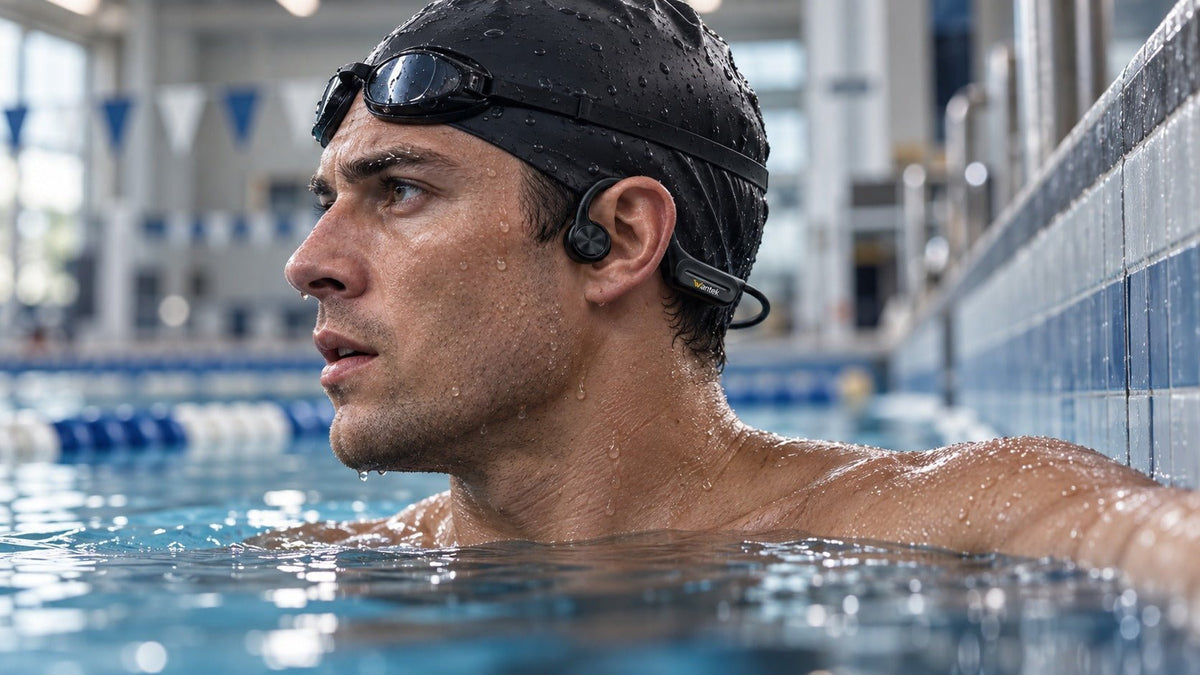
Les meilleurs écouteurs sous-marins pour la natation ne sont pas simplement ceux affichant l'indice d'étanchéité le plus élevé. Commencez par vérifier si le modèle exact est approuvé pour votre type de nage, comment l'audio est diffusé une fois la tête immergée, si la tenue est compatible avec vos lunettes et votre bonnet, et si vous pouvez utiliser les commandes avec des mains mouillées.
Réponse rapide : pour la plupart des nageurs, la lecture locale (MP3 ou autre) est plus importante que la version Bluetooth. La connexion Bluetooth standard entre un téléphone et des écouteurs n'est pas fiable sous l'eau ; c'est pourquoi les modèles conçus pour la natation reposent généralement sur un stockage interne.
Commencez par ces cinq vérifications avant l'achat
| Point à vérifier | Ce qu'il faut contrôler | Pourquoi c'est important |
|---|---|---|
| Usage aquatique | Activité approuvée, profondeur, durée, type d'eau et instructions d'entretien | Un indice IP ne remplace pas les limites d'utilisation spécifiques du modèle. |
| Méthode de lecture | MP3 intégré, autre mode local documenté ou système spécialisé | Le Bluetooth classique d'un téléphone n'est pas fiable sous l'eau. |
| Tenue | Compatibilité avec vos lunettes, bonnet, forme de tête et virages | Une tenue parfaite hors de l'eau peut bouger lors des longueurs répétées. |
| Commandes | Lecture, pause, volume, changement de piste et changement de mode | Des commandes petites ou mal placées sont difficiles à utiliser mouillées. |
| Batterie et entretien | Autonomie en mode natation, méthode de charge, séchage et maintenance | Les chiffres théoriques d'autonomie varient selon le mode et le modèle. |
1. Vérifiez les instructions d'usage aquatique, pas seulement l'indice IP

Les indices IP sont utiles, mais le chiffre seul ne constitue pas une spécification de natation complète. Le code IP de la norme IEC 60529 classe la protection des boîtiers, tandis que le fabricant définit les conditions applicables au produit fini.
Pour un achat destiné à la natation, consultez la documentation du modèle exact pour savoir si la nage est une utilisation approuvée, ainsi que les limites de profondeur, les environnements aquatiques supportés, les accessoires requis et l'entretien après usage. Ne supposez pas qu'un casque de sport résistant à la sueur convient à la natation, et ne considérez pas IPX8 ou IP68 comme une autorisation de profondeur ou de durée illimitée.
Les instructions spécifiques au produit sont souvent bien plus utiles que l'indice seul. Par exemple, Shokz documente le OpenSwim Pro comme étant IP68, limite l'usage sous-marin au mode MP3 et publie une limite spécifique d'immersion en eau douce. C'est le type de conseil au niveau du modèle qu'il convient de rechercher avant d'acheter.
2. Décidez comment votre audio sera diffusé sous l'eau
Lecture MP3 ou stockage interne
Pour la natation classique, le stockage interne est souvent la solution la plus simple. Vous transférez les fichiers compatibles avant d'entrer dans l'eau, passez en mode de lecture locale et contrôlez l'audio directement depuis le casque.
Cela élimine la dépendance à une connexion téléphonique en direct. Cela signifie également que vous devez vérifier les formats audio pris en charge, la méthode de transfert, le comportement des dossiers ou listes de lecture, et si le câble de charge fourni permet aussi le transfert de données.
Bluetooth depuis un téléphone
Le Bluetooth est utile sur terre, mais une version Bluetooth plus récente ne rend pas le streaming téléphone-écouteurs fiable sous l'eau. Les modèles hybrides orientés natation séparent donc généralement l'écoute Bluetooth sur terre de la lecture locale dans la piscine.
Si un casque annonce à la fois le Bluetooth et une utilisation pour la natation, vérifiez quel mode le fabricant vous demande réellement d'utiliser sous la surface. Ne présumez pas que « sans fil » signifie streaming en direct depuis un téléphone situé au bord du bassin.
Pour une explication approfondie sur la raison pour laquelle le Bluetooth classique se comporte différemment sous l'eau et sur la manière dont les modèles spécialisés contournent cette limitation, consultez notre article sur les écouteurs à conduction osseuse sous l'eau et le Bluetooth.
Systèmes dédiés ou spécialisés
Certains produits audio sous-marins utilisent un lecteur séparé, un émetteur ou une source portable plutôt que de dépendre d'une liaison Bluetooth téléphone-casque. Ces systèmes peuvent répondre à des besoins spécifiques, mais ils imposent leurs propres exigences en matière de compatibilité, de charge, de placement et d'accessoires. Considérez-les comme une architecture distincte et suivez les instructions de configuration du fabricant plutôt que de généraliser à partir d'écouteurs Bluetooth classiques.
3. Choisissez un style de port compatible avec votre équipement de natation
Conduction osseuse
Les écouteurs à conduction osseuse reposent à l'extérieur du conduit auditif et transmettent les vibrations par contact près des pommettes. Pour la natation, cela peut se marier naturellement avec une conception tour de cou et une lecture interne tout en laissant le conduit auditif ouvert.
La conception « open-ear » ne garantit pas la conscience de l'environnement ni une tenue parfaite. Le bruit de l'eau, le volume de lecture, les sangles des lunettes, le bonnet, les cheveux, la forme de la tête et le placement des transducteurs peuvent tous affecter ce que vous entendez et la stabilité du casque. Si vous souhaitez comparer les modèles, consultez le guide des écouteurs à conduction osseuse pour la natation de Wantek.
Conception intra-auriculaire étanche et montage sur lunettes
Les écouteurs de natation intra-auriculaires utilisent des embouts ou d'autres joints pour maintenir l'interface stable dans l'eau. Ils peuvent sembler plus familiers aux utilisateurs préférant un ajustement intra-auriculaire, mais l'étanchéité, le passage des câbles et les instructions d'utilisation doivent correspondre à votre nage et à votre équipement.
Les lecteurs montés sur lunettes adoptent une autre approche. La fiche technique du FINIS Duo, par exemple, documente un lecteur à conduction osseuse qui se fixe aux sangles des lunettes et stocke l'audio localement. L'essentiel n'est pas qu'un style soit universellement meilleur, mais que l'appareil s'intègre à l'équipement que vous portez déjà.
4. Traitez la capacité de stockage et la prise en charge des fichiers comme des questions distinctes
La taille de stockage est facile à comparer car elle produit un chiffre unique. En pratique, les formats pris en charge et le mode de transfert peuvent être tout aussi importants.
- Vérifiez quels types de fichiers audio le modèle accepte.
- Confirmez si un ordinateur reconnaît le casque comme un périphérique de stockage transférable ou s'il nécessite une application, un câble ou une station d'accueil spécifique.
- Ne supposez pas qu'un téléchargement hors ligne depuis une application de streaming puisse être copié sur un lecteur de musique séparé.
- Vérifiez si l'ordre de lecture, les dossiers, les listes de lecture, la lecture aléatoire ou la reprise de lecture sont importants pour vos entraînements.
- Vérifiez que le câble inclus prend en charge le flux de travail de transfert que vous prévoyez d'utiliser.
Si vous écoutez principalement des podcasts ou des livres audio, la navigation et la fonction de reprise peuvent être plus importantes que le nombre de gigaoctets. Si vous possédez une vaste bibliothèque musicale locale, la capacité devient prioritaire.
5. Testez la tenue et les commandes avec vos vraies lunettes et votre bonnet
Un casque de natation fait partie d'un système : écouteurs, lunettes, bonnet, cheveux et mouvements de tête répétés interagissent. Mettez les lunettes et le bonnet que vous utilisez habituellement avant de juger la tenue.
Vérifiez si une sangle déplace le transducteur ou l'embout, si la bande crée un point de pression et si les commandes restent accessibles. Ensuite, simulez les actions nécessaires dans l'eau : lecture ou pause, changement de piste, réglage du volume et changement de mode de lecture.
Pour la natation, la stabilité lors des poussées et des virages est plus importante que la sensation du casque lorsque vous êtes immobile au bord de la piscine.
6. Comparez l'autonomie de la batterie dans le mode que vous utiliserez réellement
Les chiffres d'autonomie ne sont pas automatiquement comparables. Un fabricant peut publier des durées séparées pour le Bluetooth et le MP3, tandis qu'un autre peut ne lister qu'un chiffre maximal. Utilisez le chiffre correspondant à votre mode de lecture prévu si le fabricant fournit des données spécifiques au mode.
Vérifiez également le temps de charge et les instructions du modèle concernant les contacts humides, les stations d'accueil ou les ports. Les conseils d'entretien varient : certains produits nécessitent un rinçage ou un trempage à l'eau douce après usage, tandis que d'autres fournissent des instructions de séchage ou de stockage différentes. Suivez le manuel exact plutôt que d'appliquer la même routine d'entretien à chaque casque « étanche ».

Où se situe le Wantek BC3 Pro
La page actuelle du casque de natation BC3 Pro de Wantek mentionne une protection IP68, 32 Go de stockage MP3 interne, le Bluetooth 5.3, un microphone intégré, jusqu'à six heures d'autonomie et un temps de charge de 1,5 heure. La page oriente les nageurs vers la lecture MP3 locale car l'eau perturbe les signaux Bluetooth.
La page actuelle ne publie pas de profondeur ou de durée spécifique pour la natation. Cette limite ne doit pas être inventée à partir du label IP68. Le BC3 Pro est particulièrement pertinent pour un nageur qui souhaite une conception à conduction osseuse open-ear avec un stockage local conséquent et le Bluetooth disponible pour un usage supporté hors de la piscine.

