
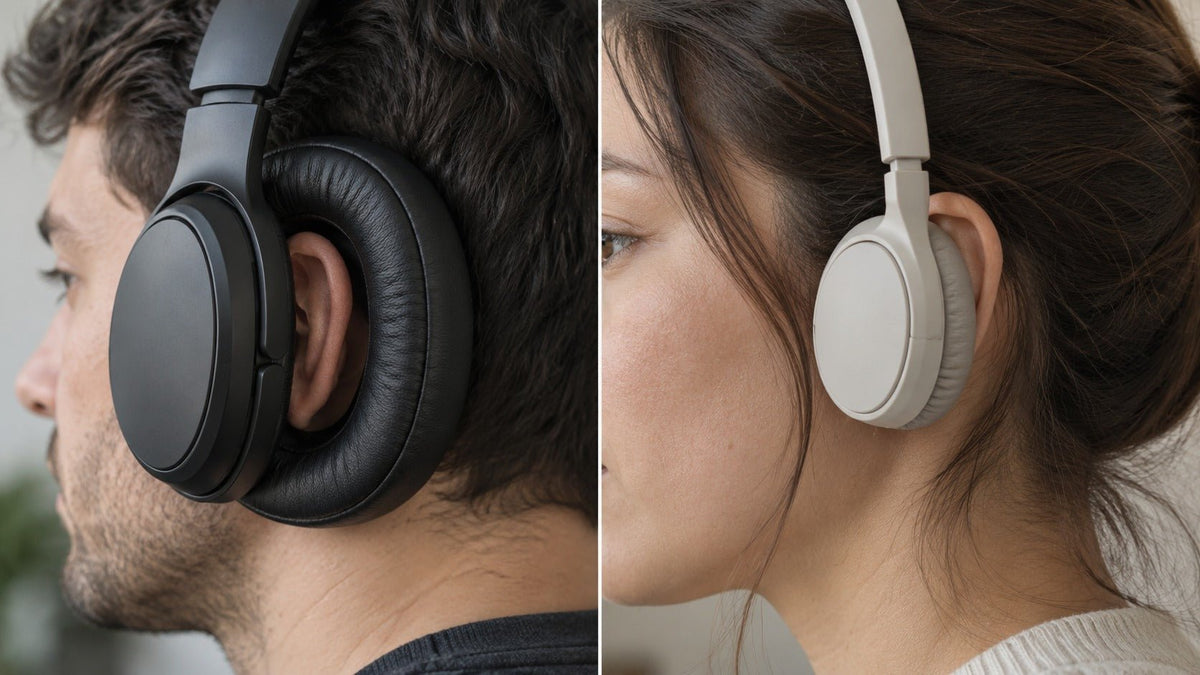
Around-ear headphones are the same basic fit category commonly called over-ear or circumaural headphones: the ear cushions are designed to sit around the outer ear rather than directly on it. The useful question is whether a specific pair gives your ears enough room and matches how you listen.
Quick answer: Choose around-ear headphones by usable ear-cup space, clamp, pad material, heat, open- or closed-back design, connection, and microphone needs. The label describes the fit; it does not guarantee comfort, sound quality, isolation, or active noise cancellation.
What Are Around-Ear Headphones?
Around-ear, over-ear, and circumaural are commonly used for headphones with earcups intended to surround the pinna, or outer ear. This is different from on-ear headphones, whose pads rest directly on the outer ear. RTINGS uses the same over-ear/circumaural distinction when describing these two headband styles.
The name does not tell you whether your ears will actually fit inside the cushions. Pad opening, cup depth, headband adjustment, clamp, glasses, hair, and head shape can all change the real fit. A model marketed as over-ear can still touch the ear or feel tight for a particular listener.
If your main decision is between the two headband formats, Wantek's over-ear vs. on-ear headphones guide goes deeper into pad position, portability, pressure, and isolation trade-offs.

Around-Ear Headphones at a Glance
| Factor | Why it matters | What to check |
|---|---|---|
| Ear clearance | Contact with the pad edge or driver cover can create pressure during longer sessions. | Usable pad opening and cup depth, not only outside earcup dimensions. |
| Clamp and headband fit | Too much pressure can be tiring; too little can make the headphones unstable. | Headband range, cup angle, weight distribution, and fit with your usual glasses. |
| Heat | Large cushions can trap warmth around the ears. | Pad material, room temperature, session length, and how often you take breaks. |
| Noise control | Physical coverage can help with isolation, but results vary by seal and construction. | Open- vs. closed-back design and whether the exact model includes ANC. |
| Connection | The fit does not determine whether the headphones work with your source device. | 3.5 mm, USB, Bluetooth, wireless receiver, codec support, and platform compatibility as applicable. |
| Microphone | Music listening and regular work calls can require different microphone designs and controls. | Integrated or boom mic, mute access, call controls, and device support. |
Fit Comes Before Feature Count
The most important check is simple: your ears should sit naturally inside the cushion opening if the model is intended to fit around them. If the ear touches the driver cover, pad seam, or inner wall, that contact can become more noticeable over time.
Clamp matters too. Some pressure is needed to keep a headband headphone stable, but the right amount varies with head shape and cushion compliance. Glasses can add another pressure point where the temple passes under the pad. A short try-on may feel fine even when heat or pressure becomes distracting later.
For more detail on long-session fit, see Wantek's over-ear headphone comfort guide.
Closed-Back and Open-Back Are Separate Choices
Around-ear describes where the pads sit. Open-back and closed-back describe the earcup construction. An around-ear headphone can use either design.
- Closed-back: usually keeps more sound inside the cup and provides more physical separation from the room, making it a practical starting point for commuting, shared spaces, recording, or office use.
- Open-back: intentionally allows more acoustic interaction with the room and usually leaks more sound, so it is better suited to quiet, private listening when isolation is not required.
Neither construction automatically sounds better. Tuning, distortion, fit, driver implementation, and the rest of the acoustic design still matter.
Passive Isolation and ANC Are Not the Same Thing
The ear cushions can reduce some outside sound simply by creating a physical barrier. That is passive isolation. Active noise cancellation, or ANC, is a separate electronic system that uses microphones and signal processing to reduce selected external noise.
An around-ear shape does not prove that ANC is present, and ANC performance cannot be inferred from cup size alone. Check the exact model if noise reduction is important to you.
Wired, Wireless, and Microphone Needs
Around-ear headphones can be wired or wireless. Wired models may use analog 3.5 mm connections, USB, or other device-specific paths. Wireless models add battery, pairing, codec, latency, and device-switching considerations. The physical fit does not determine any of those features.
If you mainly listen to music, an integrated microphone may be enough for occasional calls. If you spend hours in meetings, customer support, gaming chat, or other voice-heavy work, microphone position, mute controls, monitoring, and device compatibility deserve separate attention. A boom microphone can offer more consistent placement near the mouth, but the exact implementation still matters.
Common Around-Ear Fit Problems
- Ears touch the inside of the cup: look for a larger usable opening or deeper cushion.
- Jaw or temple pressure: compare clamp, cup angle, cushion softness, and glasses interaction.
- Headband bottoms out: the minimum headband size may be too large for your head.
- Hot ears: large pads, dense materials, room temperature, and long sessions can increase heat buildup.
- Unstable fit: check headband adjustment and clamp rather than assuming a larger earcup will stay in place better.
Who Should Consider Around-Ear Headphones?
They are a sensible format to try if you dislike pressure directly on your outer ears, want a full-size headband design, or need enough earcup space for longer desk, gaming, travel, studio, or home-listening sessions. They are less attractive when compact packing, low weight, or maximum airflow matters more than ear coverage.
For a broader view of how around-ear models fit among other designs, Wantek's headphone types guide separates fit, enclosure, connection, and noise control so those categories are not confused.
Around-Ear Headphones FAQ
Are around-ear and over-ear headphones the same?
Usually, yes. Both terms commonly describe circumaural headphones whose cushions are intended to surround the outer ear rather than rest directly on it.
Are around-ear headphones always more comfortable?
No. They avoid direct on-ear pad placement, but comfort still depends on ear clearance, clamp, weight distribution, cushion material, heat, glasses, and head shape.
Do around-ear headphones block outside noise?
They can provide passive isolation when the pads form an effective seal, but the amount varies. ANC is a separate feature that must be checked on the exact model.
Are around-ear headphones good for work calls?
They can be, but the wearing style alone does not determine call quality. Check the microphone, mute controls, connection, device compatibility, and long-session comfort.
Compare Headsets and Headphones for PC Use
If you need a microphone for work or gaming, compare current PC models by connection, wearing style, and call controls.

